Empower
Educators
Search

Key Stage 3 and GCSE · History

Key Stage 3 and GCSE History, sequenced

Year 7 · Year 8 · Year 9 · Year 10 · Year 11 · 32 units in all

Six half-termly units an academic year (eight in Year 11, where the last of them is the revision cycle), set out as one sequence table instead of a page per lesson. Each year is written backwards from what the next one states it assumes on entry, so Year 7 ends where Year 8 needs it to start and nothing is taught twice by accident. Every unit maps to the statutory content. The GCSE books run to 51 to 60 pages each against 56 to 59 pages at Key Stage 3. Most departments just call it a SOW.

Written for AQA 8145. The GCSE History schemes follow that specification lesson by lesson instead of the subject content alone. Key Stage 3 has no awarding body, and those years map to the national curriculum.

Also need exam support? GCSE assessment objectives

Practising exam technique? History questions and answers

Want the whole department covered, not just the year groups? The Historian’s Craft, Confident Schools

Writing one from scratch? How to write a KS3 scheme of work

Alongside the scheme: KS3 History knowledge organisers · GCSE History knowledge organisers

3 years, together or one at a time

Key Stage 3 · first 8 pages of each open here

Cover of Year 7 History Scheme of Work

History · Key Stage 3 £4.99

Year 7 History Scheme of Work

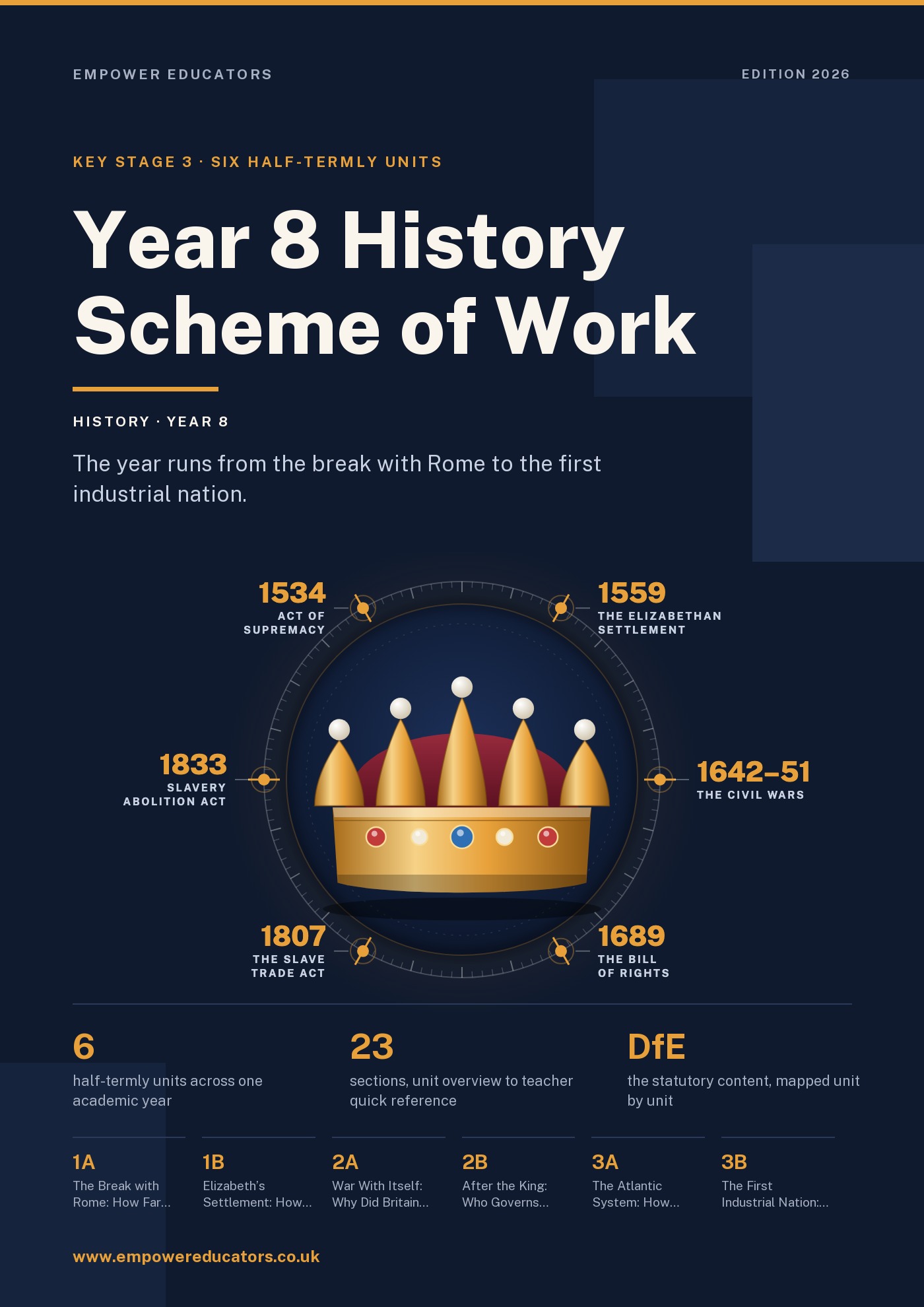
Six half-termly units across one academic year, in chronological order. The year opens before 1066 because that is where evidence is easiest to teach. The record is thin enough that a class has to reason from it. It closes on the world beyond Christendom, so that England is not the only place history happens.

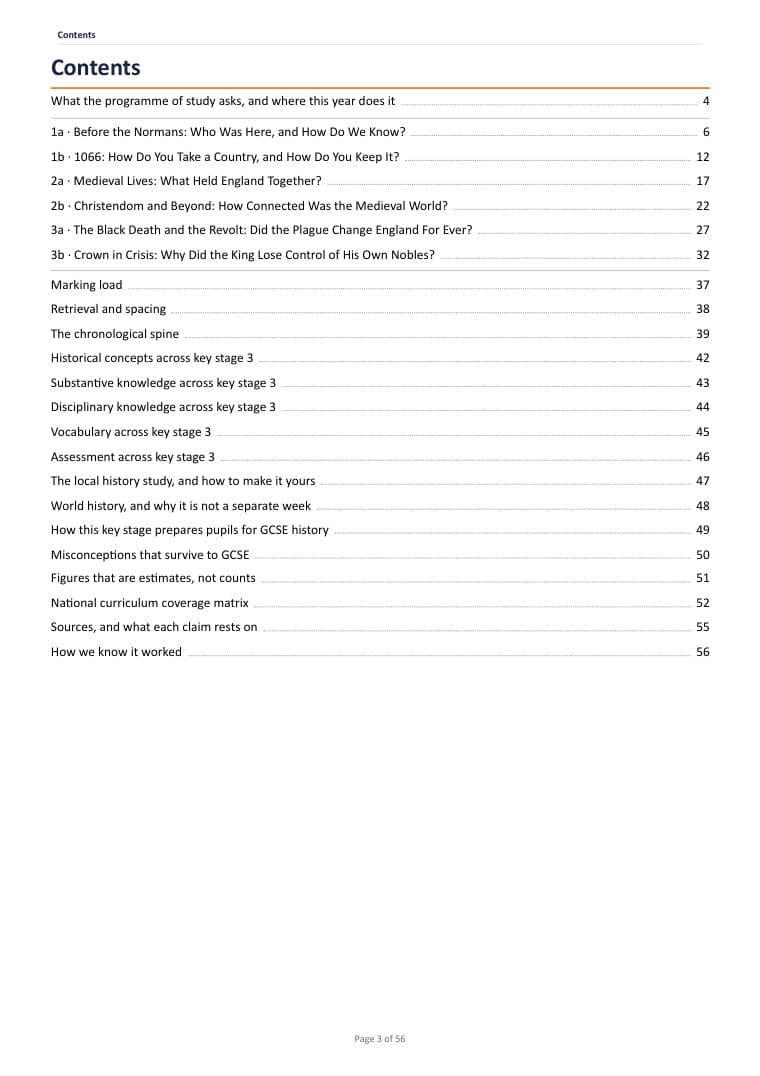
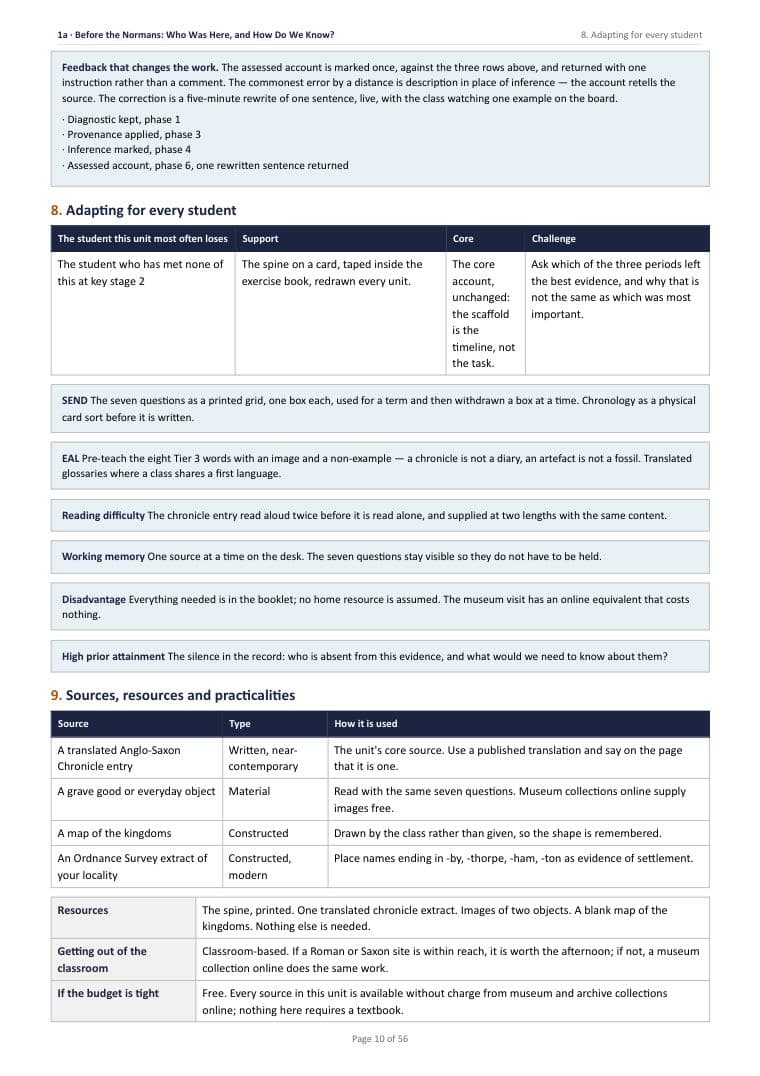
  1. 1a Before the Normans: Who Was Here, and How Do We Know?
  2. 1b 1066: How Do You Take a Country, and How Do You Keep It?
  3. 2a Medieval Lives: What Held England Together?
  4. 2b Christendom and Beyond: How Connected Was the Medieval World?
  5. 3a The Black Death and the Revolt: Did the Plague Change England For Ever?
  6. 3b Crown in Crisis: Why Did the King Lose Control of His Own Nobles?

The statutory programme of study for key stage 3 history (DfE, 2013) · 56 pages, 23 sections ·For heads of history, subject leaders and every teacher who has to deliver it
Preview · first 8 pages

🔒 48 more pages unlock on purchase

One purchase covers the school that buys it · PDF straight after payment · Refunds

Cover of Year 8 History Scheme of Work

History · Key Stage 3 £4.99

Year 8 History Scheme of Work

Six half-termly units across one academic year. The year turns on two questions a class will meet again in every unit of Year 9: who holds power, and who pays for prosperity. It runs from the break with Rome to the first industrial nation, and it carries the local history study.

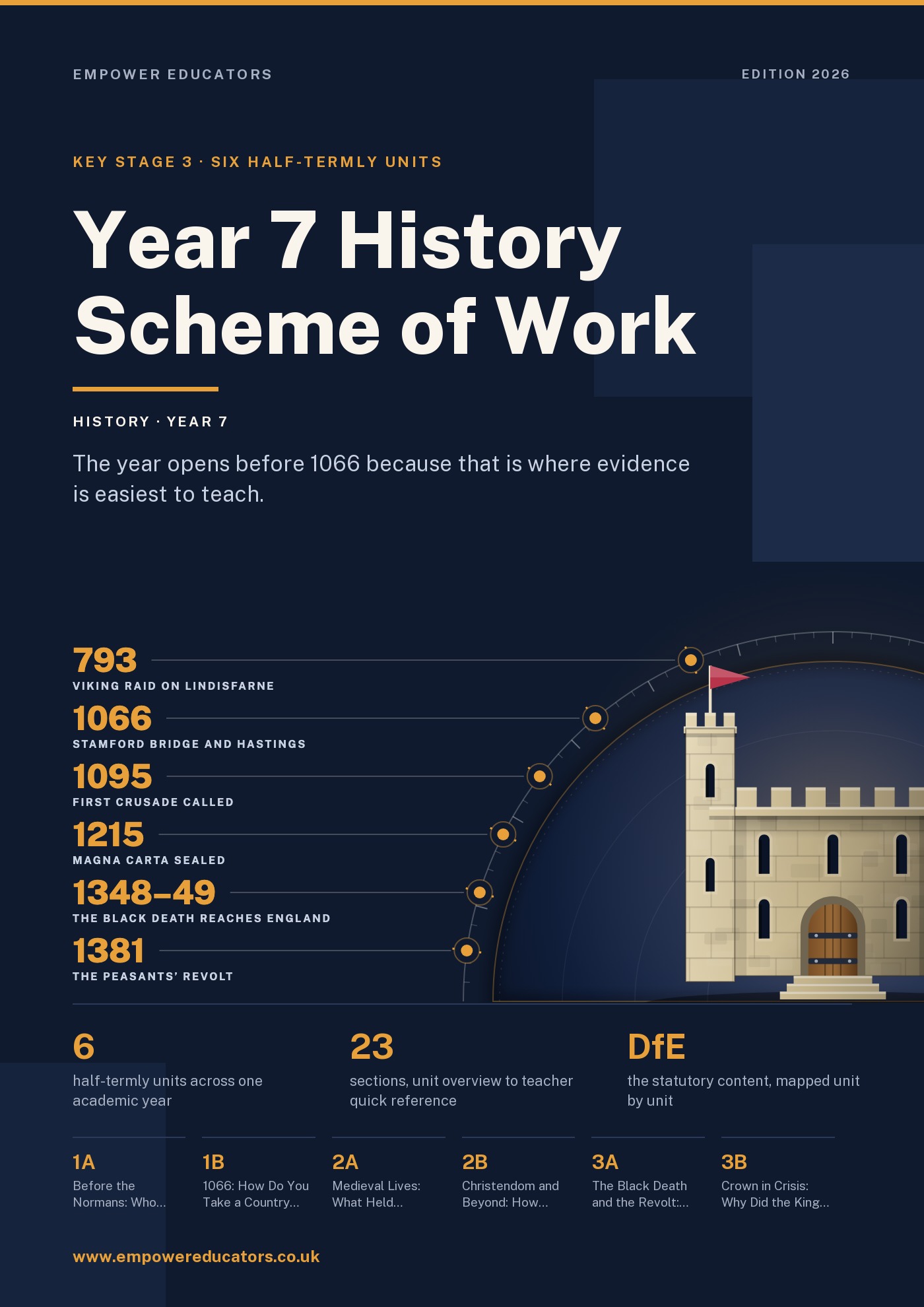
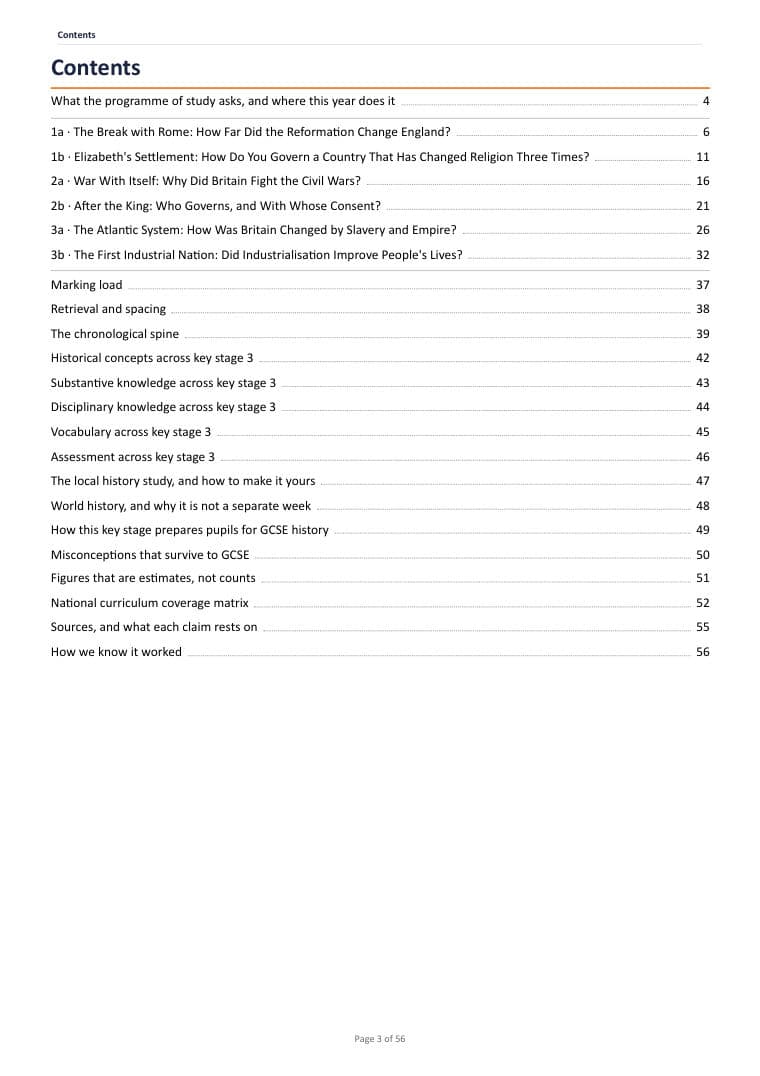
  1. 1a The Break with Rome: How Far Did the Reformation Change England?
  2. 1b Elizabeth’s Settlement: How Do You Govern a Country That Has Changed Religion Three Times?
  3. 2a War With Itself: Why Did Britain Fight the Civil Wars?
  4. 2b After the King: Who Governs, and With Whose Consent?
  5. 3a The Atlantic System: How Was Britain Changed by Slavery and Empire?
  6. 3b The First Industrial Nation: Did Industrialisation Improve People’s Lives?

The statutory programme of study for key stage 3 history (DfE, 2013) · 56 pages, 23 sections ·For heads of history, subject leaders and every teacher who has to deliver it

Preview · first 8 pages

🔒 48 more pages unlock on purchase

One purchase covers the school that buys it · PDF straight after payment · Refunds

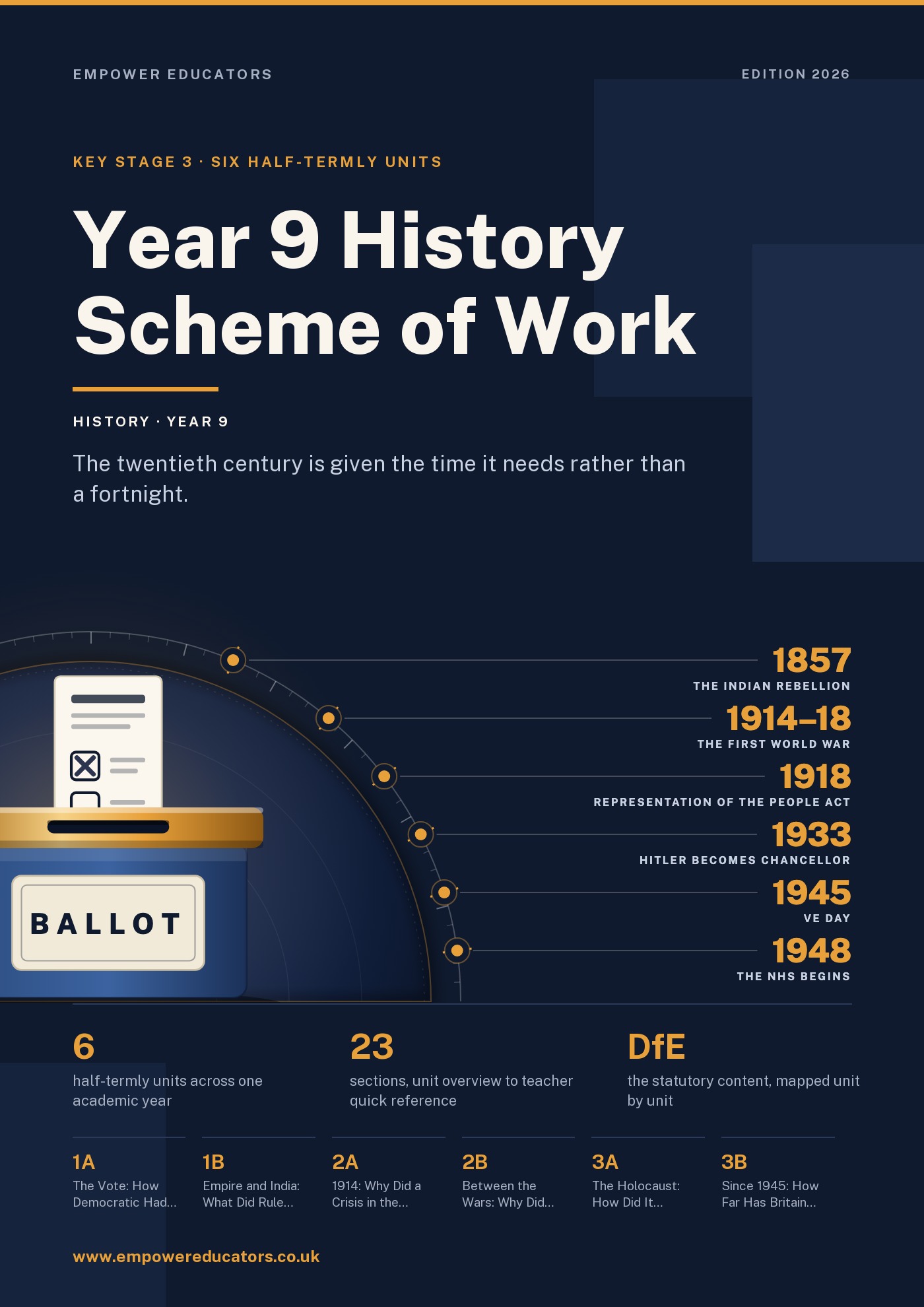
Cover of Year 9 History Scheme of Work

History · Key Stage 3 £4.99

Year 9 History Scheme of Work

Six half-termly units across one academic year. The twentieth century is given the time it needs rather than a fortnight, and the key stage closes with an enquiry the student frames, plans and answers for themselves.

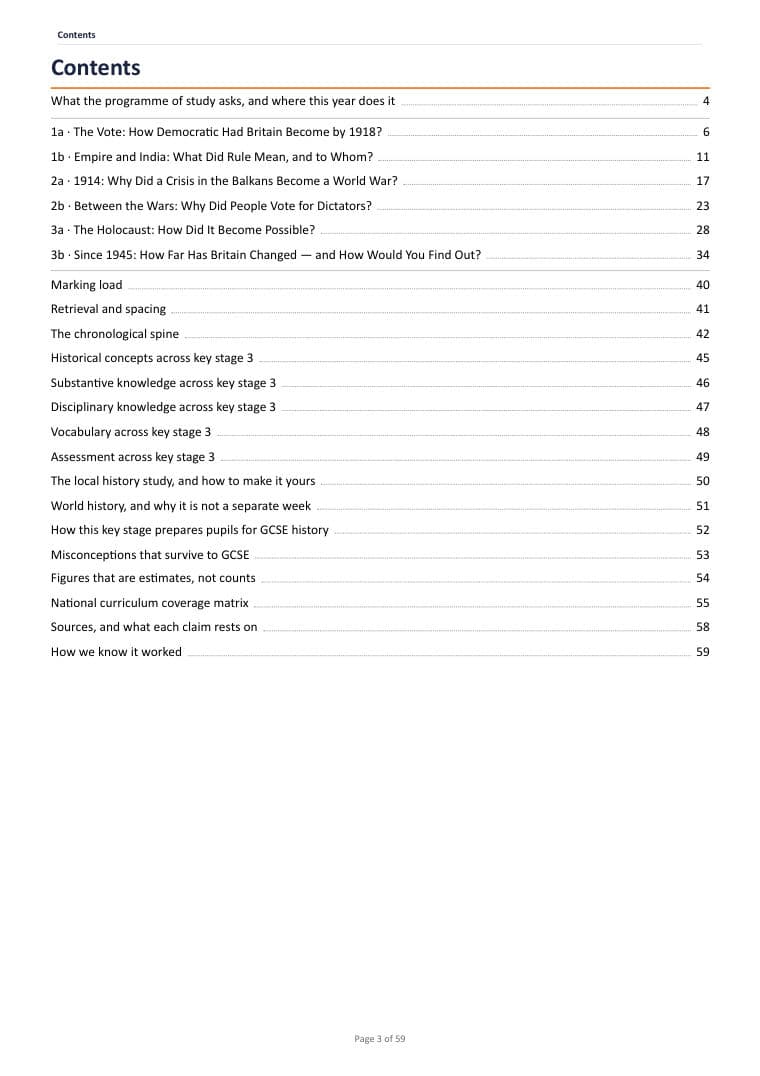
  1. 1a The Vote: How Democratic Had Britain Become by 1918?
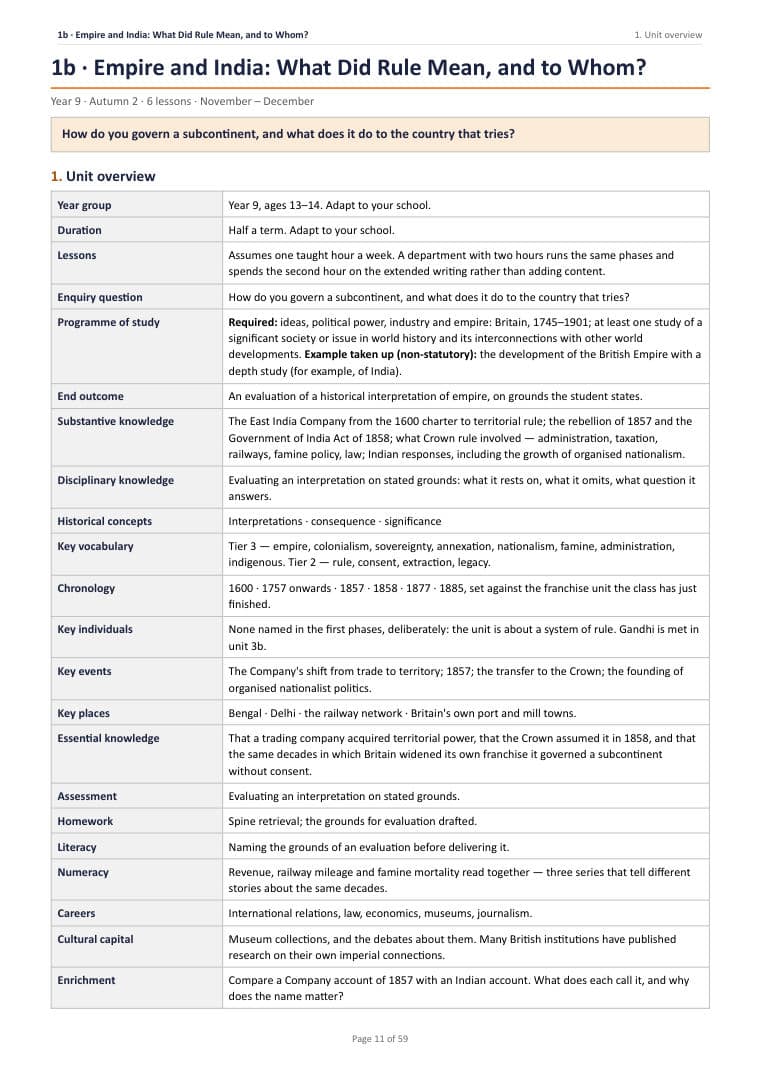
  2. 1b Empire and India: What Did Rule Mean, and to Whom?
  3. 2a 1914: Why Did a Crisis in the Balkans Become a World War?
  4. 2b Between the Wars: Why Did People Vote for Dictators?
  5. 3a The Holocaust: How Did It Become Possible?
  6. 3b Since 1945: How Far Has Britain Changed — and How Would You Find Out?

The statutory programme of study for key stage 3 history (DfE, 2013) · 59 pages, 23 sections ·For heads of history, subject leaders and every teacher who has to deliver it
Preview · first 8 pages

🔒 51 more pages unlock on purchase

One purchase covers the school that buys it · PDF straight after payment · Refunds

Save £2.98

KS3 History set

Year 7, Year 8, Year 9 — the whole key stage, sequenced as one curriculum rather than three separate years.

£11.99 £14.97 bought separately

GCSE, Year 10 and Year 11

51 to 60 pages each · both tiers where the subject is tiered · first 8 pages open here · all GCSE schemes of work

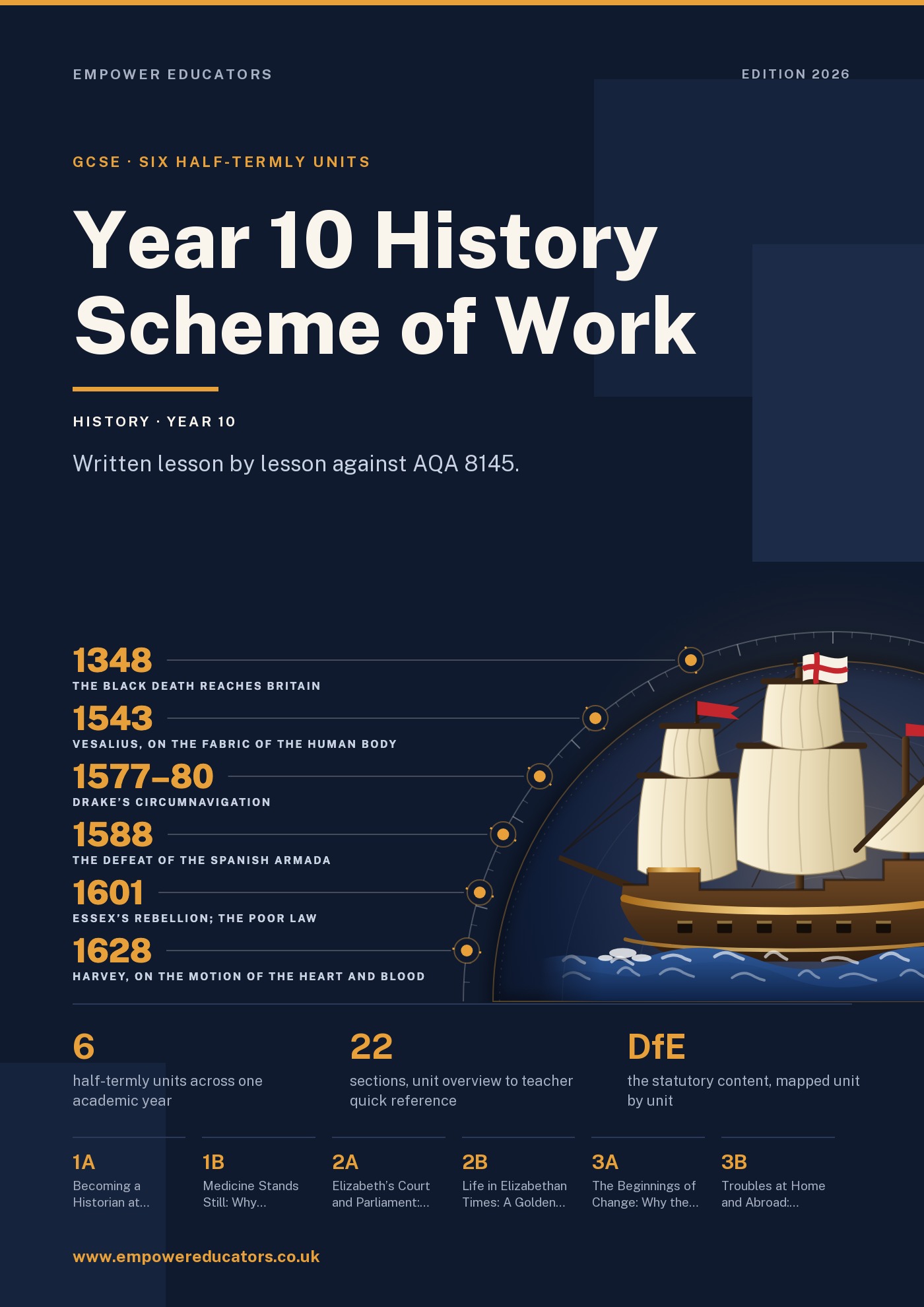
Cover of Year 10 History Scheme of Work

History · GCSE (Key Stage 4) £5.99

Year 10 History Scheme of Work

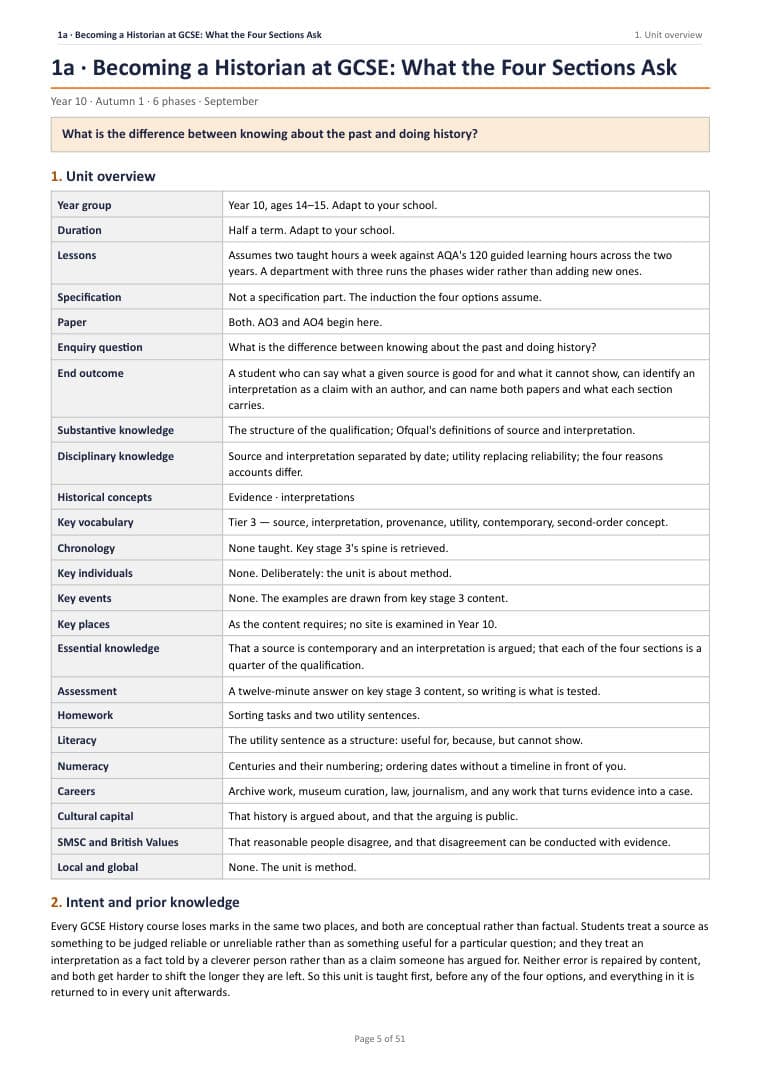
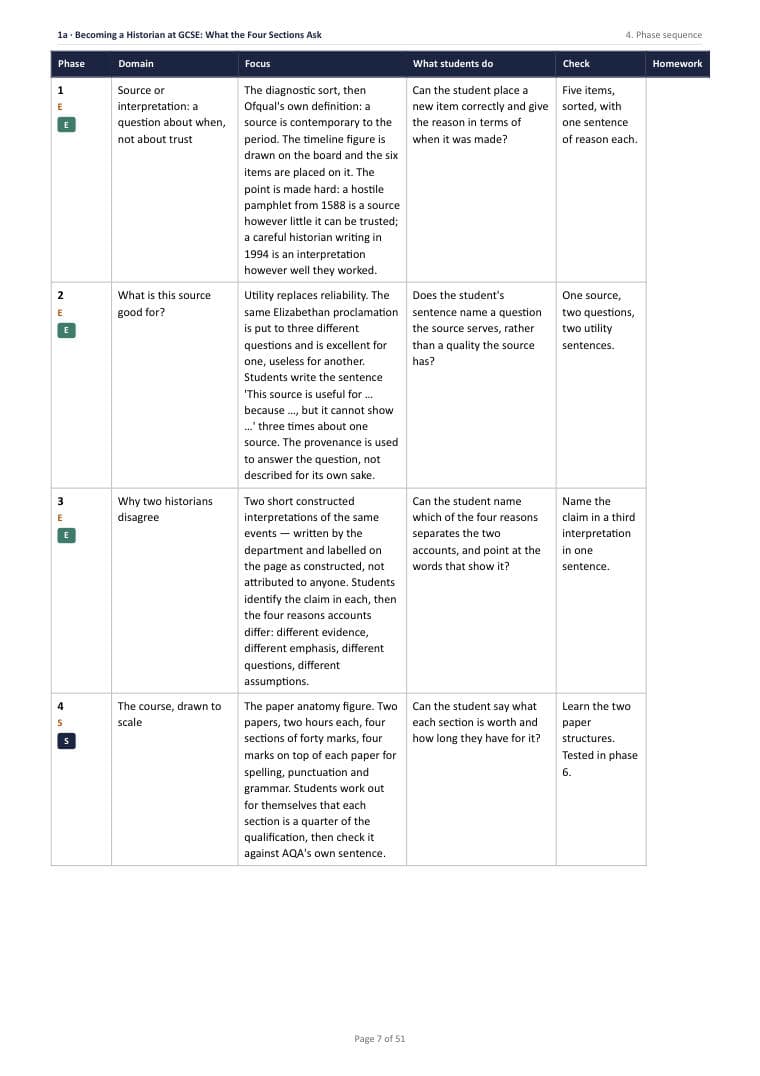
Fifty-one pages, written lesson by lesson against AQA 8145. Six units, thirty-six phases, eight purpose-drawn figures. Five specifications set GCSE History and they set different papers, so no single sequence can be accurate for all of them. The back matter maps the architecture onto Edexcel, both OCR routes and Eduqas, from each board’s own document. Every quotation resolves against its source on every build, and no year reaches a page unless it is on a checked chronology.

  1. 1a Becoming a Historian at GCSE: What the Four Sections Ask
  2. 1b Medicine Stands Still: Why Nothing Changed for Five Centuries
  3. 2a Elizabeth’s Court and Parliament: Authority Without an Army
  4. 2b Life in Elizabethan Times: A Golden Age for Whom?
  5. 3a The Beginnings of Change: Why the Renaissance Changed Medicine Slowly
  6. 3b Troubles at Home and Abroad: Religion, Mary and the Armada

GCSE subject content: history (DfE, DFE-00346-2014), Ofqual’s assessment objectives, and AQA 8145 version 1.3 · 51 pages, 22 sections ·For heads of history, subject leaders and every teacher who has to deliver it
Preview · first 8 pages

🔒 43 more pages unlock on purchase

One purchase covers the school that buys it · PDF straight after payment · Refunds

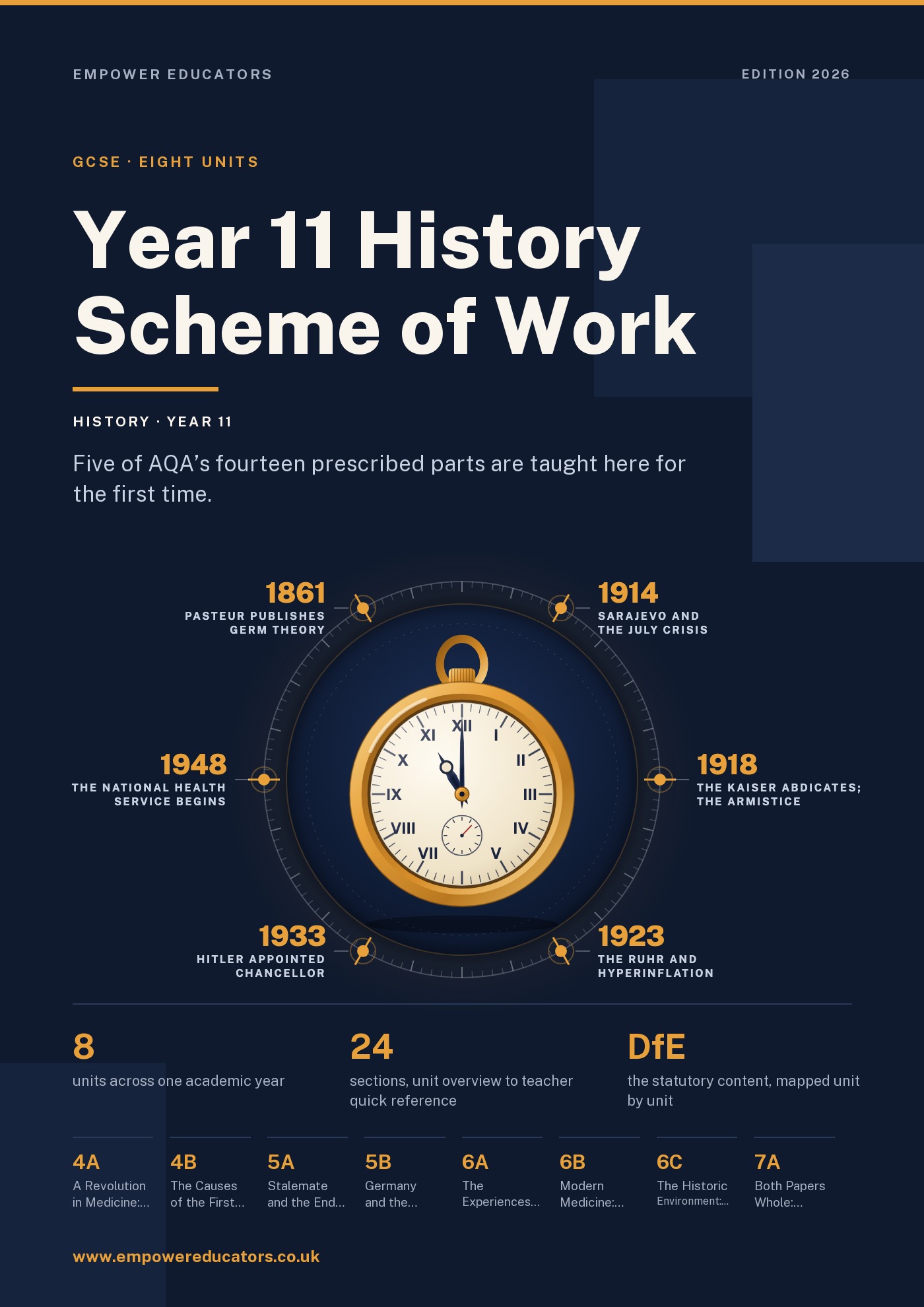
Cover of Year 11 History Scheme of Work

History · GCSE (Key Stage 4) £5.99

Year 11 History Scheme of Work

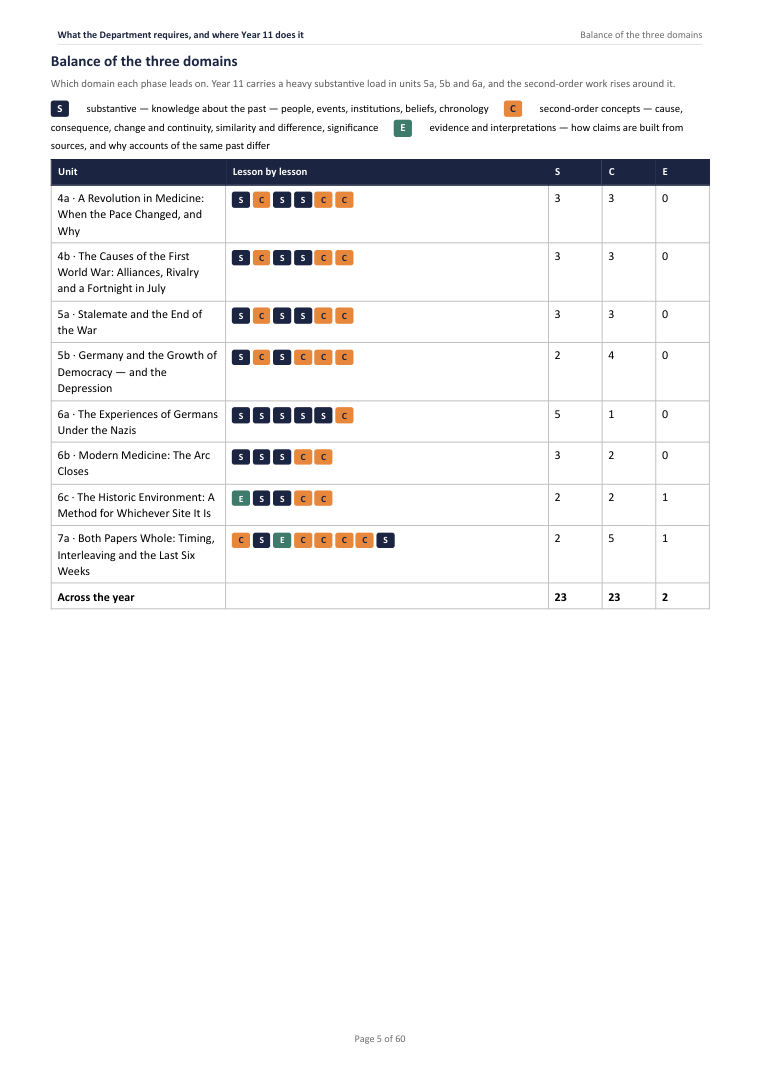
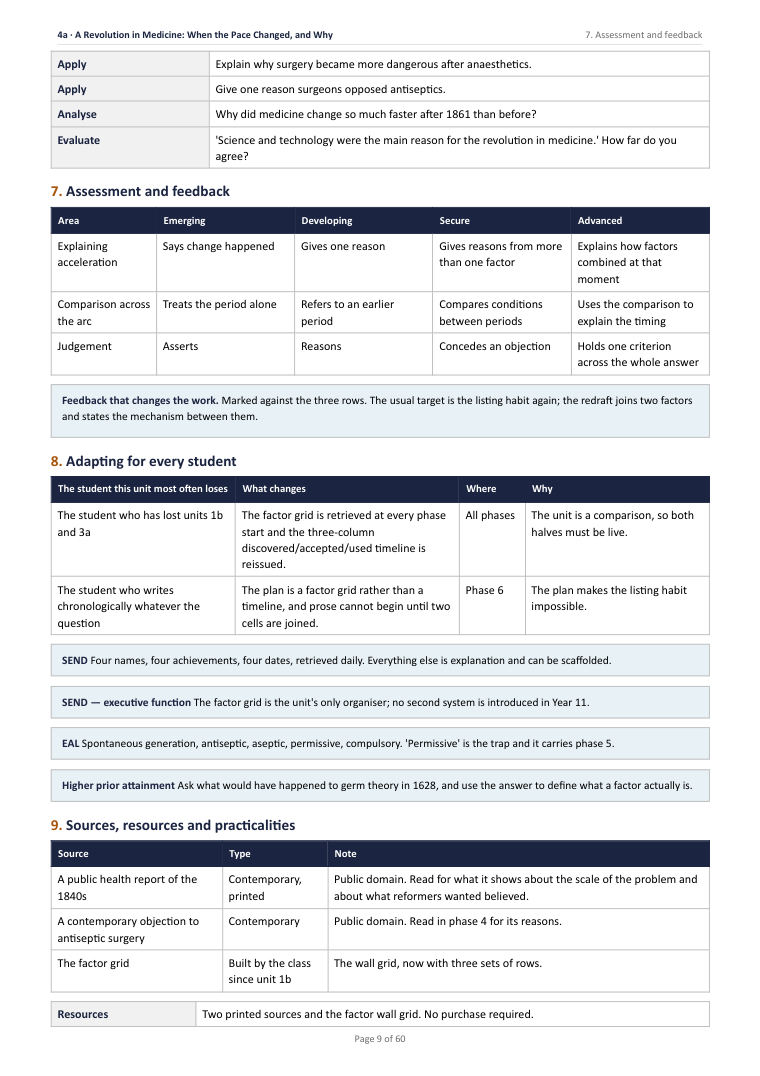
Sixty pages completing the course. Eight units, forty-eight phases. Five of AQA’s fourteen prescribed parts are taught here for the first time, so this is a teaching year with a revision unit at the end rather than a revision year. Revision is six diagnostic cycles, each of which finds something and treats it. The historic environment is taught as a transferable method, because AQA changes the specified site every year.

  1. 4a A Revolution in Medicine: When the Pace Changed, and Why
  2. 4b The Causes of the First World War: Alliances, Rivalry and a Fortnight in July
  3. 5a Stalemate and the End of the War
  4. 5b Germany and the Growth of Democracy — and the Depression
  5. 6a The Experiences of Germans Under the Nazis
  6. 6b Modern Medicine: The Arc Closes
  7. 6c The Historic Environment: A Method for Whichever Site It Is
  8. 7a Both Papers Whole: Timing, Interleaving and the Last Six Weeks

GCSE subject content: history (DfE, DFE-00346-2014), Ofqual’s assessment objectives, and AQA 8145 version 1.3 · 60 pages, 24 sections ·For heads of history, subject leaders and every teacher who has to deliver it
Preview · first 8 pages

🔒 52 more pages unlock on purchase

One purchase covers the school that buys it · PDF straight after payment · Refunds

Save £1.99

GCSE History set

Year 10, Year 11 — the whole key stage, sequenced as one curriculum rather than two separate years.

£9.99 £11.98 bought separately

Your basket

Nothing in it yet.

Total £0.00

Checkout

Your download is ready straight after payment. Downloading it ends the 14-day right to cancel; a file that is faulty or not as described is always refunded. Refunds