History · Key Stage 3 · £4.99
Year 7 History
Scheme of Work
Six half-termly units across one academic year, in chronological order. The year opens before 1066 because that is where evidence is easiest to teach. The record is thin enough that a class has to reason from it. It closes on the world beyond Christendom, so that England is not the only place history happens.
£4.99The Year 7 scheme: 6 half-termly units, 56 pages
- A4 PDF
- first 8 pages free to read
- instant download
Teaching all of Key Stage 3? Year 7, Year 8 and Year 9 as one set: £11.99, saving £2.98.
One purchase covers the school that buys it. Print it, copy it, hand it round your department. Not for passing to other schools or uploading anywhere.
PDF download, ready straight after payment. Downloading it ends the 14-day right to cancel; a file that is faulty or not as described is always refunded. Refunds
Read before publication by serving senior leaders, in school.
5.0 from 24+ reviews on Google
Schools that have bought from Empower Educators include Nottingham High School, Northampton High School GDST and Sutton Valence School.
Complete your History
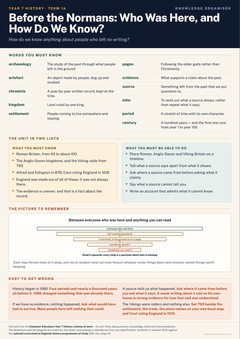
The whole key stage: KS3 History scheme of work
Everything else this site has for History: History teaching resources
- 1aBefore the Normans: Who Was Here, and How Do We Know?
- 1b1066: How Do You Take a Country, and How Do You Keep It?
- 2aMedieval Lives: What Held England Together?
- 2bChristendom and Beyond: How Connected Was the Medieval World?
- 3aThe Black Death and the Revolt: Did the Plague Change England For Ever?
- 3bCrown in Crisis: Why Did the King Lose Control of His Own Nobles?
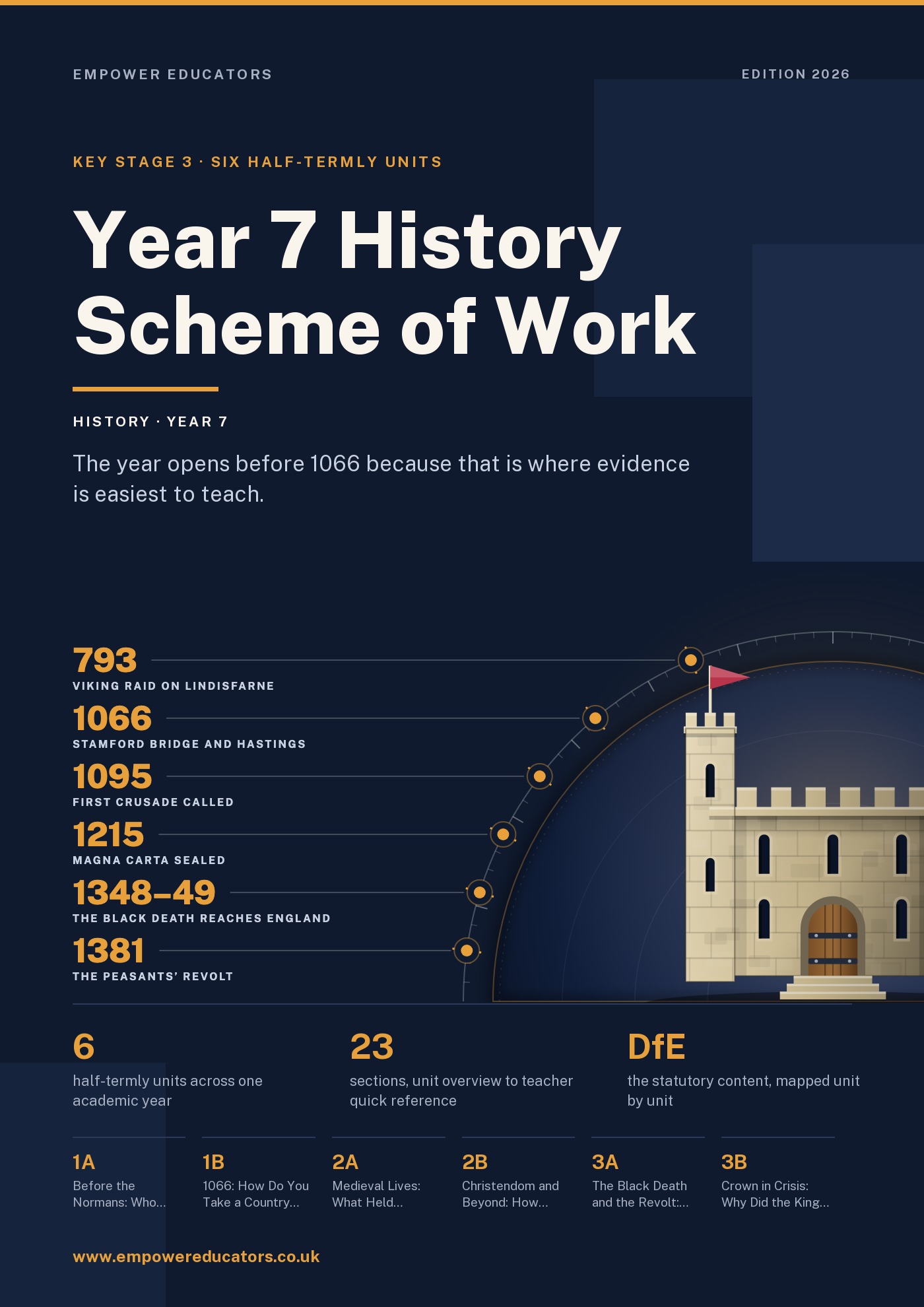
Ten sections per unit, in the same order every time. One row per phase rather than per lesson, because a history unit is a sequence of enquiries and not a sequence of forty-five separate objectives. Six units: one on how we know, four on medieval England, and one on the world beyond it.
Substantive and disciplinary knowledge are separated and both are planned. Every unit carries a diagnostic, six hinge questions with the wrong answers named, a question bank graded from recall to argument, a four-band rubric and the misconceptions that actually appear. One chronological spine runs through all three years and is drawn in the first lesson of every unit.
Every date, person and event in the book is checked against a verified chronology at build time, and every figure that is an estimate is printed as one. The coverage matrix at the back sets out every line of the programme of study and says plainly which lines the document requires and which it offers as an example, including the examples this scheme does not take up.
- Written to
- The statutory programme of study for key stage 3 history (DfE, 2013)
- Intended for
- heads of history, subject leaders and every teacher who has to deliver it
- Extent
- 56 pages · 23 sections
The sequence
What this scheme of work covers, unit by unit
The 6 units of the Year 7 History Scheme of Work, in teaching order, with the term each one runs in and the question it is built to answer.
1a
Before the Normans: Who Was Here, and How Do We Know?
Year 7 · Autumn 1 · 6 lessons · September – October
How do we know anything about people who left no writing?
1b
1066: How Do You Take a Country, and How Do You Keep It?
Year 7 · Autumn 2 · 6 lessons · November – December
Was the Conquest a victory, or an occupation that lasted twenty years?
2a
Medieval Lives: What Held England Together?
Year 7 · Spring 1 · 6 lessons · January – February
If there was no police force and no standing army, why did most people obey?
2b
Christendom and Beyond: How Connected Was the Medieval World?
Year 7 · Spring 2 · 6 lessons · February – March
Was medieval Europe the centre of the world, or the edge of someone else's?
3a
The Black Death and the Revolt: Did the Plague Change England For Ever?
Year 7 · Summer 1 · 6 lessons · April – May
Did the Black Death change England, or did it only speed up what was already happening?
3b
Crown in Crisis: Why Did the King Lose Control of His Own Nobles?
Year 7 · Summer 2 · 6 lessons · June – July
How does a crown that had conquered a country end up unable to govern it?
Look inside
Real pages, straight from the PDF
Click any page to see it full size.
Contents
All 23 sections
Taken from the book’s own contents page, so the page numbers are the real ones.