History · GCSE · £6.99
GCSE History
Questions
& Answers
History is the one subject where the boards do not share a syllabus: AQA sets Germany and Elizabethan England, Edexcel sets Medicine and Weimar, OCR differs again. So this book is built on what every specification does share: the four assessment objectives, the question types they force, and the enquiries those questions are. Every source and every interpretation in it is genuine, out of copyright, quoted verbatim with its provenance printed, and checked character by character against the original text on every build.
£6.99100 questions, each answered three times (weak, middling, strong), 102 pages
- A4 PDF
- first 14 pages free to read
- instant download
One purchase covers the school that buys it. Print it, copy it, hand it round your department. Not for passing to other schools or uploading anywhere.
PDF download, ready straight after payment. Downloading it ends the 14-day right to cancel; a file that is faulty or not as described is always refunded. Refunds
Read before publication by serving senior leaders, in school.
5.0 from 24+ reviews on Google
Schools that have bought from Empower Educators include Nottingham High School, Northampton High School GDST and Sutton Valence School.
Complete your History


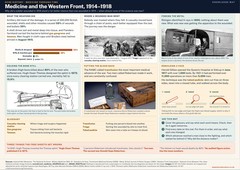
Everything else this site has for History: History teaching resources
Also teaching history lower down the school, or the exam itself? History scheme of work · GCSE History assessment objectives
- 1Reading a source
- 2How useful is this source
- 3Two sources together
- 4What an interpretation says
- 5Why interpretations differ
- 6Judging an interpretation
- 7Cause and consequence
- 8Change, continuity and significance
- 9Narrative and the historic environment
- 10Substantiated judgement
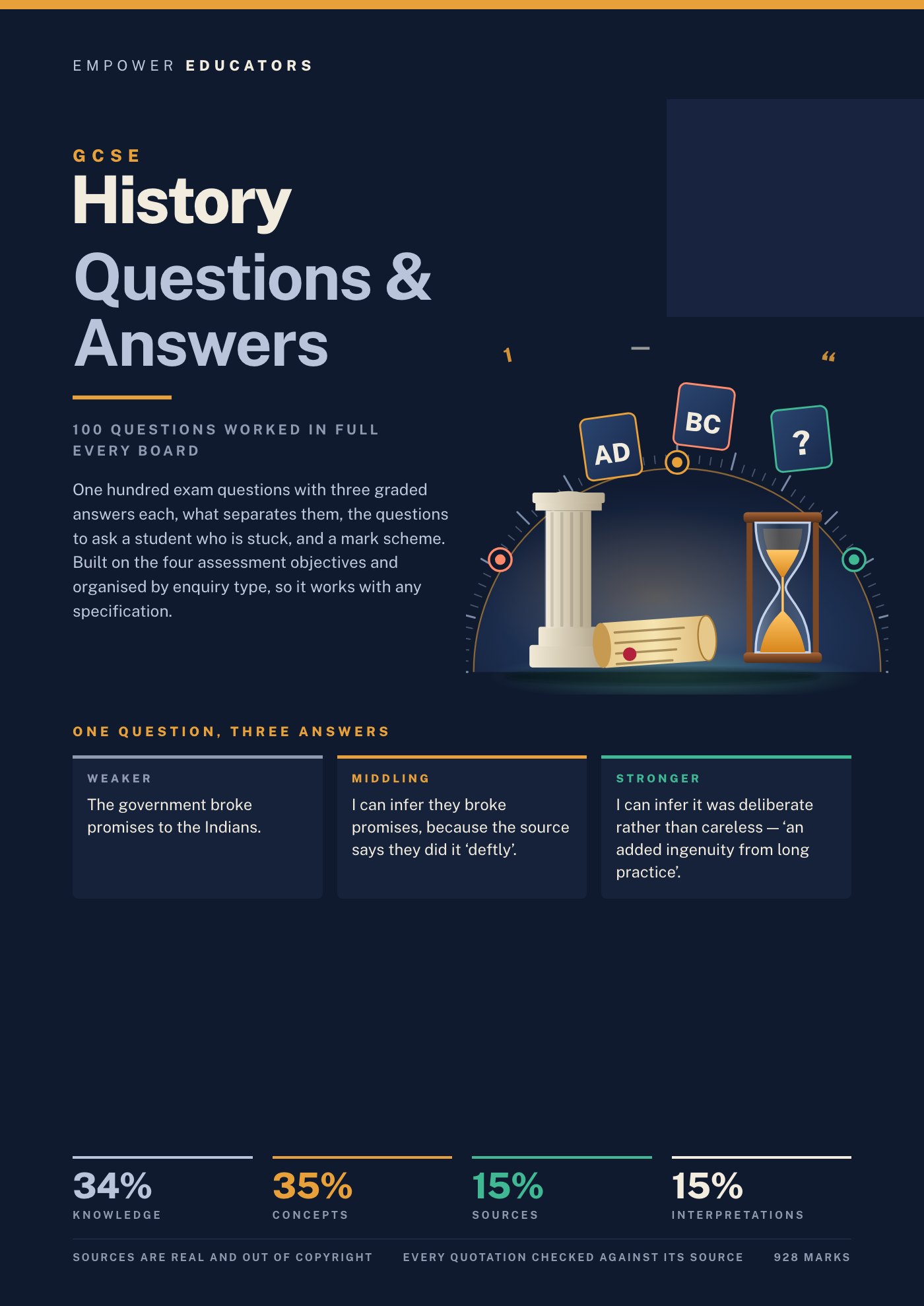
Not a bank of questions with the answers printed underneath. The three banded responses are the starting point, not the output: what follows each one is the discriminator, named out loud, then the questions you actually ask to move a student from the first answer to the last, then the mark scheme that shows what each line was worth.
Every other subject is board-neutral for nothing. History has to be built that way. The Department prescribes the shape of a history GCSE and leaves the topics to the boards, so a book organised around named topics sells to a third of the market and is useless to the rest. This one is organised by enquiry type and time scale, and says so on the page. A department teaching Weimar can use a source-utility page built on a Victorian poverty survey, because what is being taught is what a source-utility answer has to do.
Every source is real, and that is not a small claim. A fabricated source about a real event would teach students to weigh evidence that does not exist, which is the opposite of the subject. So the sources here are genuine, out of copyright, quoted verbatim with the precise provenance printed, and re-checked against the original text every time the book is built. Fifty-six extracts are resolved that way on each build; four further resources are labelled adapted rather than quoted, because that is what they are.
That check earns its place. Three of the source texts turned out to be the wrong book — Macaulay filed as Harrison, Defoe’s account of the great storm filed as Round — and a keyword test passed on both, because the words it looked for appear in any Victorian history. The build now asserts a phrase out of each file’s own header before it will use it.
The signature page puts one source under three different questions. A source is not useful or useless; it is useful for something, and the same 1889 poverty notebook is strong evidence for how poverty was measured and weak evidence for how it felt. A student who has learned "check the provenance" as a ritual cannot tell those apart. Behind it sits the wall students never hold: a source is contemporary with the period and an interpretation is a deliberate construct made after it. They are different objectives, marked differently, and merging them is the commonest way an able answer loses marks.
The regulator does not only weight the objectives, it caps how the marks inside them may be spent, and all of it is computed from the hundred questions on every build: no more than a tenth of the marks for knowledge in isolation, no more than a third of the AO3 marks for analyse-only questions, at least half the AO4 marks on the judgement itself, and British history above the forty per cent floor. The build stops if any of them drift. No board is named anywhere.
- Written to
- The GCSE subject content for history published by the Department for Education and Ofqual’s subject level guidance — the four assessment objectives at 35/35/15/15, the three eras, time scales and geographies, and the caps the regulator sets on how the marks inside each objective may be spent
- Intended for
- history teachers and heads of department. Used with a class, not a student revision guide
- Extent
- 102 pages · 10 sections
Sample questions
Sample GCSE History questions and answers
One question from the book, printed exactly as they appear in it: the question, the answers it works through, and the mark each one scores. All of them are in the free preview.
Question 45·Cause and consequence·4 marks
Describe two features of the Norman system of landholding.
Weaker1 mark
The Normans took the land off the English and gave it to their own people, and they built castles on it.
Middling3 marks
One feature was that the king owned all the land. Another was that barons held land from the king in return for providing knights.
Stronger4 marks
One feature was that all land was held ultimately from the king: nobody owned land outright, and tenants-in-chief held directly from William. A second was subinfeudation — tenants-in-chief granted portions to their own followers in return for service, so a single estate could carry obligations up through several layers to the crown.
What separates them
Two features, two marks each: the feature named, and the feature developed. The first answer gives a consequence of the Conquest rather than a feature of the system, and castles are not landholding. The second names two real features and develops neither — it is a list, and lists take half the marks. The third adds the sentence that turns each name into a description. That is the whole difference on a four-mark ‘describe’ question, and it costs about fifteen words.
The full-mark answer4 marks
One feature was that all land was held from the king rather than owned: tenants-in-chief held directly from William in return for military service. A second was subinfeudation, by which tenants-in-chief granted land on to their own followers in return for service to them, so obligations ran upward through several levels to the crown.
Look inside
Real pages, straight from the PDF
Click any page to see it full size.
Contents
All 10 sections
Taken from the book’s own contents page, so the page numbers are the real ones.