History · GCSE (Key Stage 4) · £5.99
Year 10 History
Scheme of Work
AQA GCSE History Scheme of Work (SOW) — Year 10, 8145 PDF
Fifty-one pages, written lesson by lesson against AQA 8145. Six units, thirty-six phases, eight purpose-drawn figures. Five specifications set GCSE History and they set different papers, so no single sequence can be accurate for all of them. The back matter maps the architecture onto Edexcel, both OCR routes and Eduqas, from each board’s own document. Every quotation resolves against its source on every build, and no year reaches a page unless it is on a checked chronology.
£5.99The Year 10 scheme: 6 units, 51 pages
- A4 PDF
- first 8 pages free to read
- instant download
Teaching all of the GCSE course? Year 10 and Year 11 as one set: £9.99, saving £1.99.
One purchase covers the school that buys it. Print it, copy it, hand it round your department. Not for passing to other schools or uploading anywhere.
PDF download, ready straight after payment. Downloading it ends the 14-day right to cancel; a file that is faulty or not as described is always refunded. Refunds
Read before publication by serving senior leaders, in school.
5.0 from 24+ reviews on Google
Schools that have bought from Empower Educators include Nottingham High School, Northampton High School GDST and Sutton Valence School.
Complete your History


Written for AQA 8145. All GCSE schemes of work
The whole course: GCSE History scheme of work
Everything else this site has for History: History teaching resources
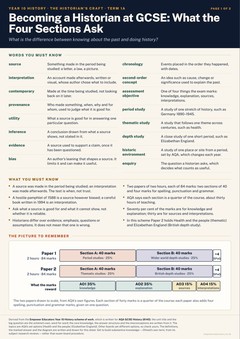
- 1aBecoming a Historian at GCSE: What the Four Sections Ask
- 1bMedicine Stands Still: Why Nothing Changed for Five Centuries
- 2aElizabeth’s Court and Parliament: Authority Without an Army
- 2bLife in Elizabethan Times: A Golden Age for Whom?
- 3aThe Beginnings of Change: Why the Renaissance Changed Medicine Slowly
- 3bTroubles at Home and Abroad: Religion, Mary and the Armada
Ten sections per unit, in the same order every time. Phases rather than single lessons, planned against AQA’s 120 guided learning hours across the two years — the assumption is stated rather than hidden.
The order is argued for rather than chronological. The thematic study is spread across four separated returns instead of blocked into a term, because a c1000-to-present arc is the one element that rewards spacing. Elizabethan England sits between the first two of those returns, so that when students meet Renaissance medicine they already know the period from the inside. And the wider-world work waits for Year 11, so that the First World War’s ending hands straight over to Weimar’s founding rather than being separated by a summer.
Written against AQA because a lesson-by-lesson sequence has to choose: Edexcel sets three papers of unequal weight, Eduqas two components split into four, and OCR pairs particular thematic studies with particular depth studies so that choosing one chooses the other. The architecture — the sequencing, the spiral, the assessment and retrieval plan, the two statutory option-compliance tests — transfers to all of them, and the table showing where each board differs is quoted from each board’s own specification rather than summarised.
- Written to
- GCSE subject content: history (DfE, DFE-00346-2014), Ofqual’s assessment objectives, and AQA 8145 version 1.3
- Intended for
- heads of history, subject leaders and every teacher who has to deliver it
- Extent
- 51 pages · 22 sections
The sequence
What this scheme of work covers, unit by unit
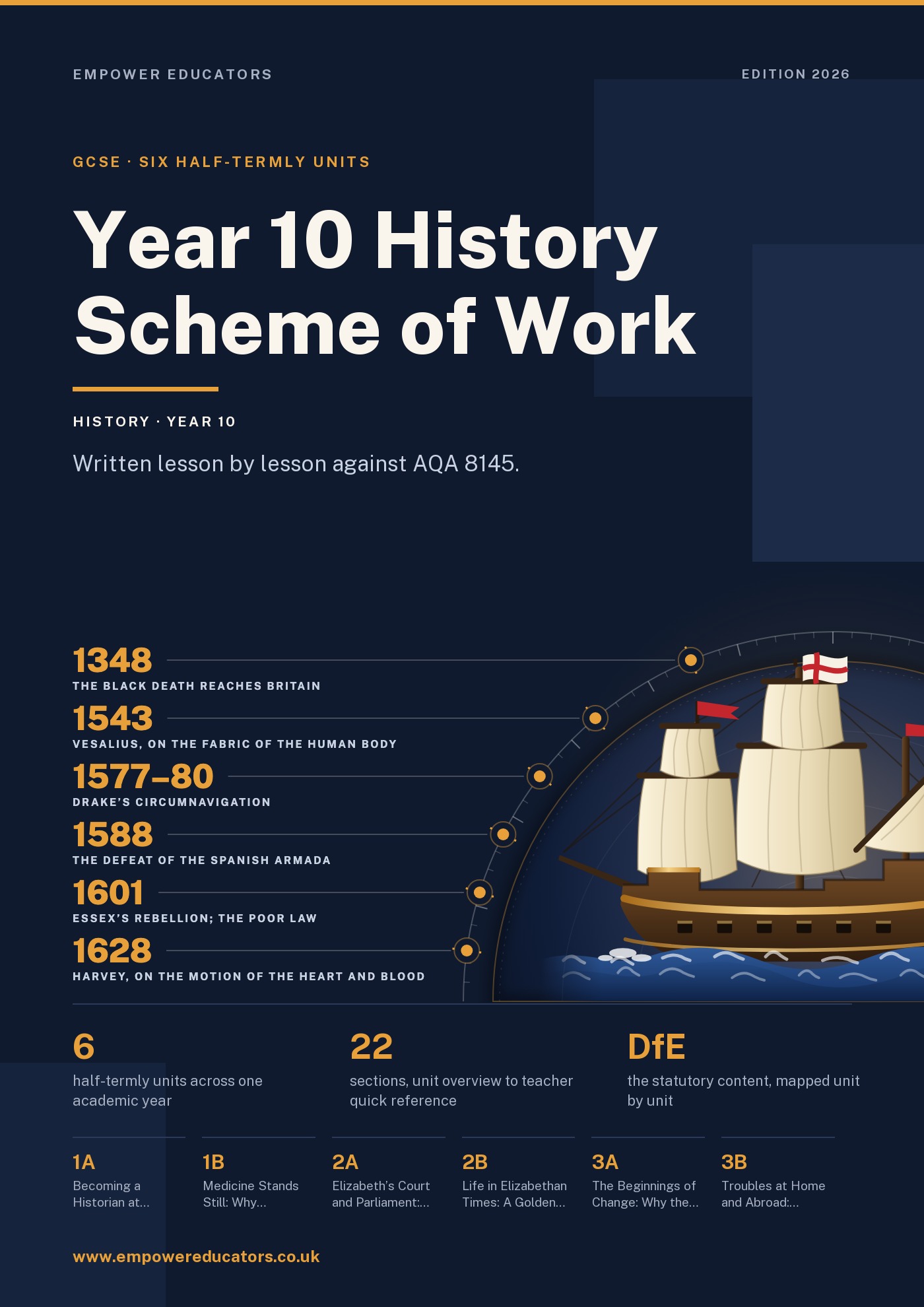
The 6 units of the Year 10 History Scheme of Work, in teaching order, with the term each one runs in and the question it is built to answer.
1a
Becoming a Historian at GCSE: What the Four Sections Ask
Year 10 · Autumn 1 · 6 phases · September
What is the difference between knowing about the past and doing history?
1b
Medicine Stands Still: Why Nothing Changed for Five Centuries
Year 10 · Autumn 1–2 · 6 phases · September – October
Why did medicine change so little between 1000 and 1500?
2a
Elizabeth's Court and Parliament: Authority Without an Army
Year 10 · Autumn 2 – Spring 1 · 6 phases · November – January
How did a queen with no standing army stay in power for forty-five years?
2b
Life in Elizabethan Times: A Golden Age for Whom?
Year 10 · Spring 1–2 · 6 phases · January – March
Who was the Elizabethan Golden Age golden for?
3a
The Beginnings of Change: Why the Renaissance Changed Medicine Slowly
Year 10 · Spring 2 – Summer 1 · 6 phases · March – May
Why did new ideas about the body take so long to change how people were treated?
3b
Troubles at Home and Abroad: Religion, Mary and the Armada
Year 10 · Summer 1–2 · 6 phases · May – July
Why did three serious threats to Elizabeth all fail?
Look inside
Real pages, straight from the PDF
Click any page to see it full size.
Contents
All 22 sections
Taken from the book’s own contents page, so the page numbers are the real ones.