History · Key Stage 3 · £4.99
Year 8 History
Scheme of Work
Six half-termly units across one academic year. The year turns on two questions a class will meet again in every unit of Year 9: who holds power, and who pays for prosperity. It runs from the break with Rome to the first industrial nation, and it carries the local history study.
£4.99The Year 8 scheme: 6 half-termly units, 56 pages
- A4 PDF
- first 8 pages free to read
- instant download
Teaching all of Key Stage 3? Year 7, Year 8 and Year 9 as one set: £11.99, saving £2.98.
One purchase covers the school that buys it. Print it, copy it, hand it round your department. Not for passing to other schools or uploading anywhere.
PDF download, ready straight after payment. Downloading it ends the 14-day right to cancel; a file that is faulty or not as described is always refunded. Refunds
Read before publication by serving senior leaders, in school.
5.0 from 24+ reviews on Google
Schools that have bought from Empower Educators include Nottingham High School, Northampton High School GDST and Sutton Valence School.
Complete your History
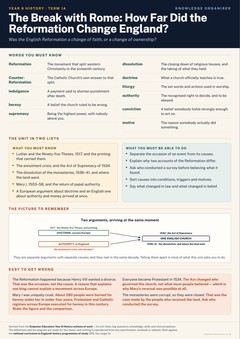
The whole key stage: KS3 History scheme of work
Everything else this site has for History: History teaching resources
- 1aThe Break with Rome: How Far Did the Reformation Change England?
- 1bElizabeth’s Settlement: How Do You Govern a Country That Has Changed Religion Three Times?
- 2aWar With Itself: Why Did Britain Fight the Civil Wars?
- 2bAfter the King: Who Governs, and With Whose Consent?
- 3aThe Atlantic System: How Was Britain Changed by Slavery and Empire?
- 3bThe First Industrial Nation: Did Industrialisation Improve People’s Lives?
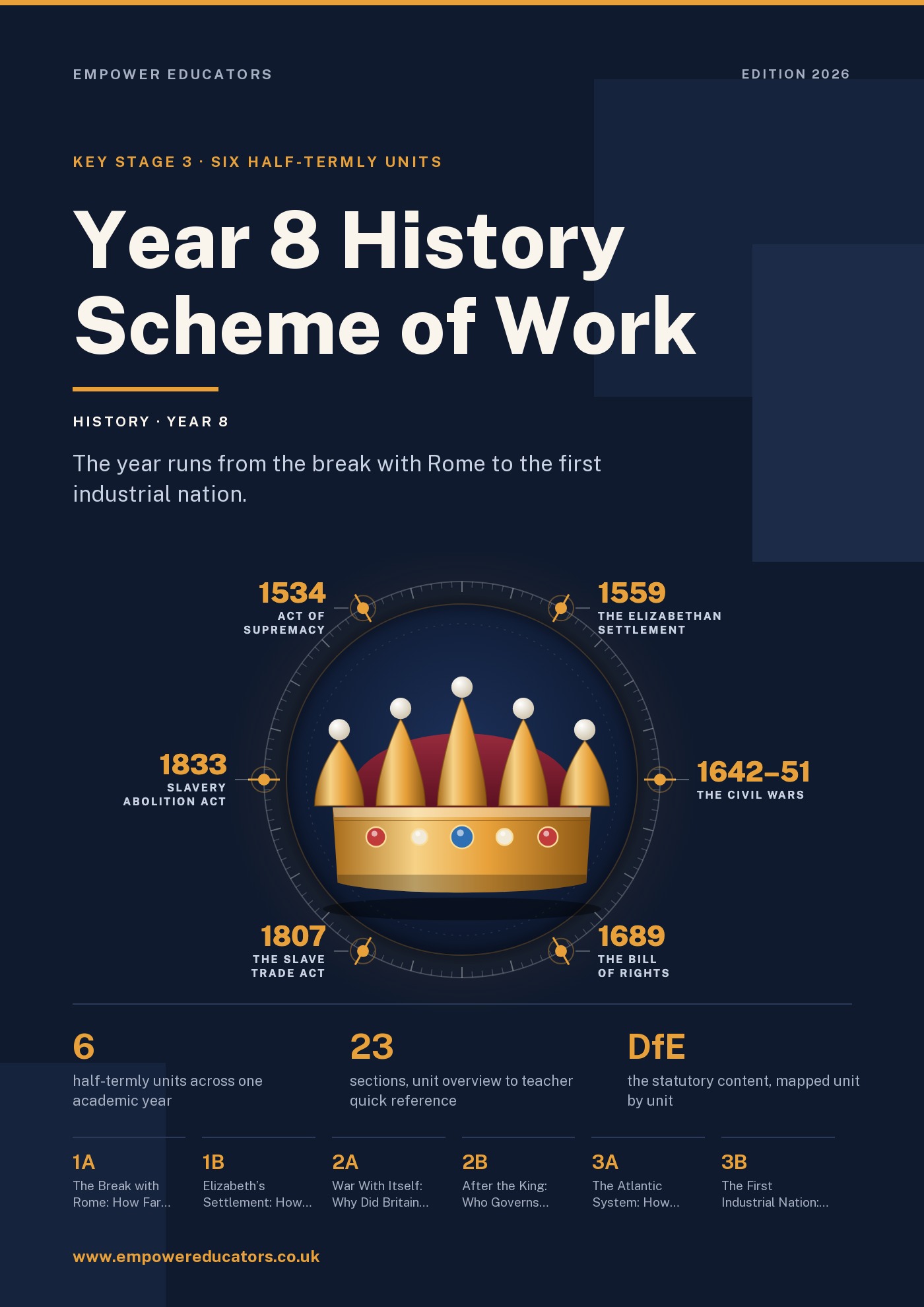
Ten sections per unit, in the same order every time. One row per phase rather than per lesson. Six units: the Reformation as a European movement and an English act of state, the Elizabethan settlement, the civil wars and what followed them, the Atlantic slave trade and abolition, and industrialisation.
The statutory local history study sits in unit 3b, where almost every English locality becomes legible in the record: census returns, trade directories, tithe and enclosure maps, successive Ordnance Survey editions. The scheme cannot write your locality, so it gives the shape, six enquiry questions that work anywhere, and where the evidence is kept.
Substantive and disciplinary knowledge are separated and both are planned. Every date, person and event is checked against a verified chronology at build time, and figures historians argue about are printed as estimates with the reason. The coverage matrix at the back distinguishes what the programme of study requires from what it offers as an example.
- Written to
- The statutory programme of study for key stage 3 history (DfE, 2013)
- Intended for
- heads of history, subject leaders and every teacher who has to deliver it
- Extent
- 56 pages · 23 sections
The sequence
What this scheme of work covers, unit by unit
The 6 units of the Year 8 History Scheme of Work, in teaching order, with the term each one runs in and the question it is built to answer.
1a
The Break with Rome: How Far Did the Reformation Change England?
Year 8 · Autumn 1 · 6 lessons · September – October
Was the English Reformation a change of faith, or a change of ownership?
1b
Elizabeth's Settlement: How Do You Govern a Country That Has Changed Religion Three Times?
Year 8 · Autumn 2 · 6 lessons · November – December
Was the Elizabethan settlement a solution, or a postponement?
2a
War With Itself: Why Did Britain Fight the Civil Wars?
Year 8 · Spring 1 · 6 lessons · January – February
Why did a quarrel about money and religion end with a king on trial?
2b
After the King: Who Governs, and With Whose Consent?
Year 8 · Spring 2 · 6 lessons · February – March
Between 1649 and 1707, who ended up holding power — and how would you know?
3a
The Atlantic System: How Was Britain Changed by Slavery and Empire?
Year 8 · Summer 1 · 6 lessons · April – May
Who built the Atlantic system, who paid for it, and who ended it?
3b
The First Industrial Nation: Did Industrialisation Improve People's Lives?
Year 8 · Summer 2 · 6 lessons · June – July
Whose lives improved, whose did not, and how long did it take to tell?
Look inside
Real pages, straight from the PDF
Click any page to see it full size.
Contents
All 23 sections
Taken from the book’s own contents page, so the page numbers are the real ones.