History · Key Stage 3 · £4.99
Year 9 History
Scheme of Work
Six half-termly units across one academic year. The twentieth century is given the time it needs rather than a fortnight, and the key stage closes with an enquiry the student frames, plans and answers for themselves.
£4.99The Year 9 scheme: 6 half-termly units, 59 pages
- A4 PDF
- first 8 pages free to read
- instant download
Teaching all of Key Stage 3? Year 7, Year 8 and Year 9 as one set: £11.99, saving £2.98.
One purchase covers the school that buys it. Print it, copy it, hand it round your department. Not for passing to other schools or uploading anywhere.
PDF download, ready straight after payment. Downloading it ends the 14-day right to cancel; a file that is faulty or not as described is always refunded. Refunds
Read before publication by serving senior leaders, in school.
5.0 from 24+ reviews on Google
Schools that have bought from Empower Educators include Nottingham High School, Northampton High School GDST and Sutton Valence School.
Complete your History
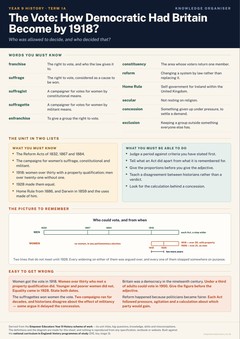
The whole key stage: KS3 History scheme of work
Everything else this site has for History: History teaching resources
- 1aThe Vote: How Democratic Had Britain Become by 1918?
- 1bEmpire and India: What Did Rule Mean, and to Whom?
- 2a1914: Why Did a Crisis in the Balkans Become a World War?
- 2bBetween the Wars: Why Did People Vote for Dictators?
- 3aThe Holocaust: How Did It Become Possible?
- 3bSince 1945: How Far Has Britain Changed — and How Would You Find Out?
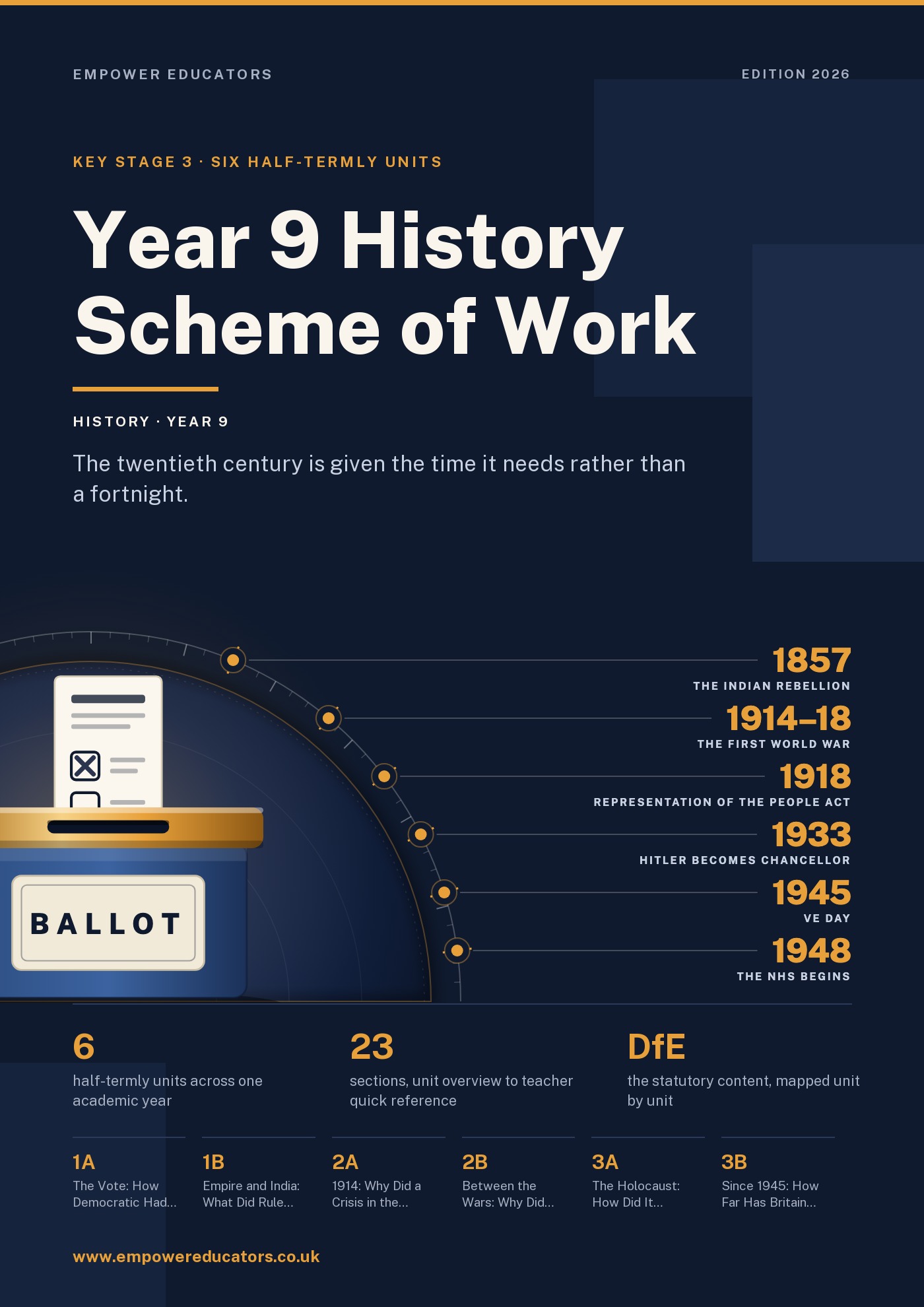
Ten sections per unit, in the same order every time. One row per phase rather than per lesson. Six units: the franchise, empire in India, the origins of the First World War, the inter-war dictatorships, the Holocaust, and Britain since 1945.
The Holocaust is the one thing the programme of study requires by name, and it is taught differently from every other unit here, deliberately. It is built on sequence and assessed on sequence, because the misconception that does real harm is that it happened suddenly. There is no role-play, no simulation and no imaginative writing from any perspective; no images of the dead; and the unit begins with Jewish life in Europe before 1933, so that victims are studied as people with lives. Teachers are pointed at the national memorial and education institutions whose materials exist for this and are free.
Year 9 is not the start of GCSE. No specification content is taught, no board’s wording is used and no essay is written to a mark scheme — what the year does is make the intellectual demands of GCSE ordinary on unfamiliar content. Every date is checked against a verified chronology at build time, estimates are printed as estimates, and the coverage matrix at the back distinguishes what the programme of study requires from what it offers as an example.
- Written to
- The statutory programme of study for key stage 3 history (DfE, 2013)
- Intended for
- heads of history, subject leaders and every teacher who has to deliver it
- Extent
- 59 pages · 23 sections
The sequence
What this scheme of work covers, unit by unit
The 6 units of the Year 9 History Scheme of Work, in teaching order, with the term each one runs in and the question it is built to answer.
1a
The Vote: How Democratic Had Britain Become by 1918?
Year 9 · Autumn 1 · 6 lessons · September – October
Who was allowed to decide, and who decided that?
1b
Empire and India: What Did Rule Mean, and to Whom?
Year 9 · Autumn 2 · 6 lessons · November – December
How do you govern a subcontinent, and what does it do to the country that tries?
2a
1914: Why Did a Crisis in the Balkans Become a World War?
Year 9 · Spring 1 · 6 lessons · January – February
How does a local assassination become a war on four continents in five weeks?
2b
Between the Wars: Why Did People Vote for Dictators?
Year 9 · Spring 2 · 6 lessons · February – March
How does a democracy end — and does it always end the same way?
3a
The Holocaust: How Did It Become Possible?
Year 9 · Summer 1 · 6 lessons · April – May
the work?
3b
Since 1945: How Far Has Britain Changed — and How Would You Find Out?
Year 9 · Summer 2 · 6 lessons · June – July
What kind of country came out of the war, and what kind is it now?
Look inside
Real pages, straight from the PDF
Click any page to see it full size.
Contents
All 23 sections
Taken from the book’s own contents page, so the page numbers are the real ones.