One book for the whole department: the head of English who has to lead it and the teacher who has to teach period four. Built on what AQA, Pearson Edexcel, Cambridge OCR and Eduqas actually require, read from all eighteen current specifications.
1 Curriculum
2 Reading
3 Writing
4 Evidence
5 Standard
All eighteen current AQA, Pearson Edexcel, Cambridge OCR and Eduqas specifications· 74 pages, 71 sections ·For heads of English, subject leaders and every teacher in the department
One book for the whole department: the head of maths who has to build the curriculum and the teacher who has to teach the bottom set on Friday afternoon. Built on what the specifications actually say, read from the current documents.
1 Curriculum
2 Fluency
3 Reasoning
4 Evidence
5 Standard
The current GCSE and A Level mathematics specifications, read in full· 78 pages, 75 sections ·For department CPD, planning and curriculum review
One book for a department that teaches three subjects, runs a laboratory and shares a technician. For the head of science who has to hold it together and the teacher setting up period four with a class already at the door.
1 Curriculum
2 Knowledge
3 Enquiry
4 Practical
5 Standard
The current GCSE and A Level science specifications· 72 pages, 69 sections ·For department CPD, planning and curriculum review
One book for the whole department: the head of art who has to lead it and the teacher who has to teach it on Monday. Built on what AQA, Edexcel, OCR and Eduqas actually require, not on what everyone assumes they require.
1 Curriculum
2 Craft
3 Independence
4 Evidence
5 Standard
AQA, Edexcel, OCR and Eduqas specifications & the Ofsted art and design research review· 93 pages, 88 sections ·For heads of art, subject leaders and every teacher in the department
One book for the whole department: the head of PE who has to defend the curriculum and the teacher who has to run rugby in the rain with two absent staff. Built on what the specifications actually say, read from the current documents.
1 Curriculum
2 Competence
3 Knowledge
4 Participation
5 Standard
The current GCSE and A Level physical education specifications, read in full· 93 pages, 90 sections ·For department CPD, planning and curriculum review
One book for the whole department: the head of geography who has to fund fieldwork and defend the curriculum, and the teacher explaining longshore drift to a wet Year 9. Built on what the specifications actually say, read from the current documents.
1 Curriculum
2 Place
3 Process
4 Enquiry
5 Standard
The current GCSE and A Level geography specifications, read in full· 73 pages, 70 sections ·For department CPD, planning and curriculum review
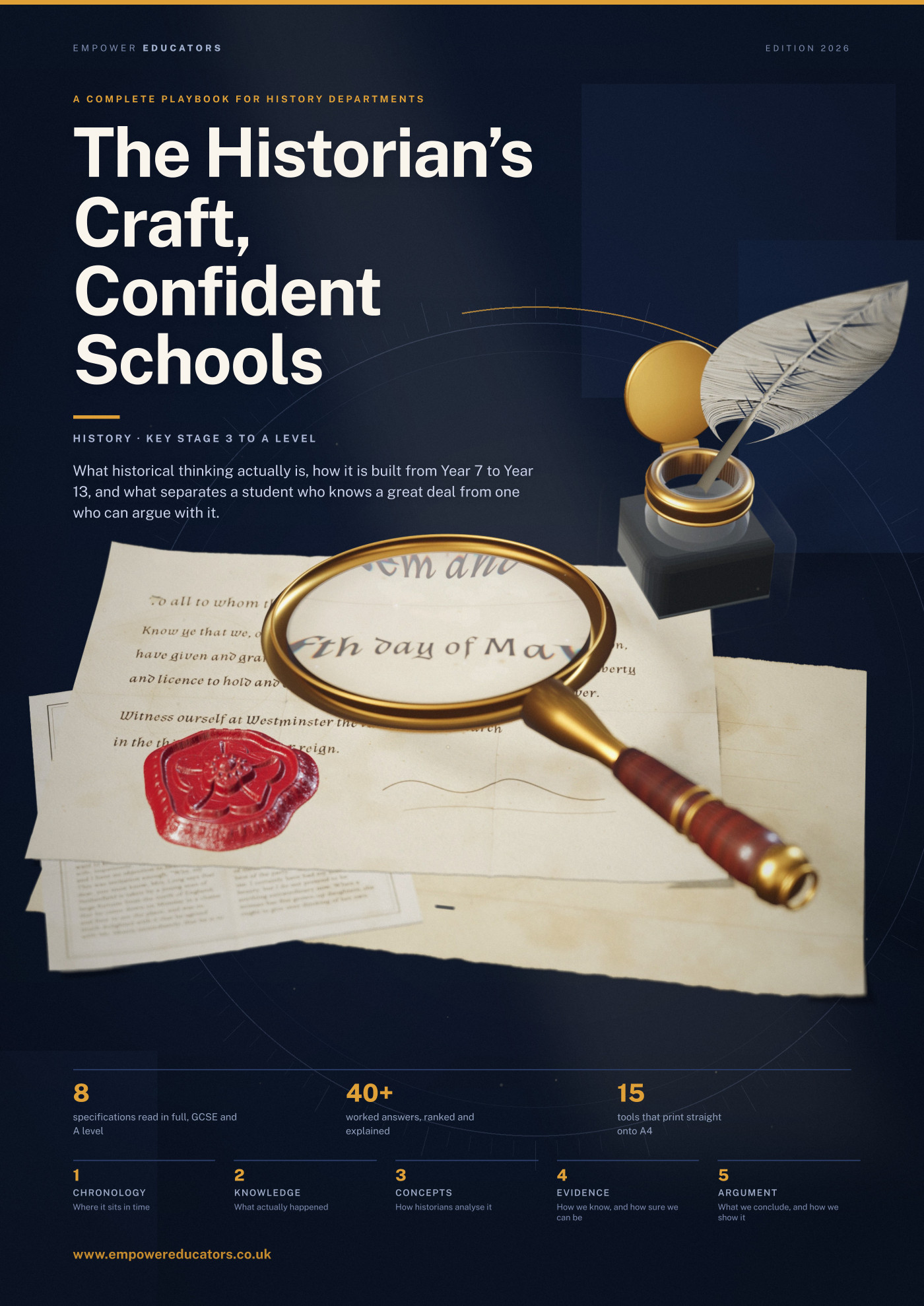
One book for the whole department: the head of history defending curriculum time and the teacher taking a Year 9 class through a source they have never seen. What historical thinking actually is, how it is built from Year 7 to Year 13, and what separates a student who knows a great deal from one who can argue with it.
1 Chronology
2 Knowledge
3 Concepts
4 Evidence
5 Argument
Eight GCSE and A Level history specifications, read in full· 77 pages, 73 sections ·For department CPD, planning and curriculum review
One book for the whole department — the head of business who has to justify a subject nobody took at school, and the teacher covering Year 10 finance on a Friday. Built on what the specifications actually say, read from the current documents.
1 Curriculum
2 Knowledge
3 Application
4 Judgement
5 Standard
The current GCSE and A Level business specifications, read in full· 77 pages, 74 sections ·For department CPD, planning and curriculum review
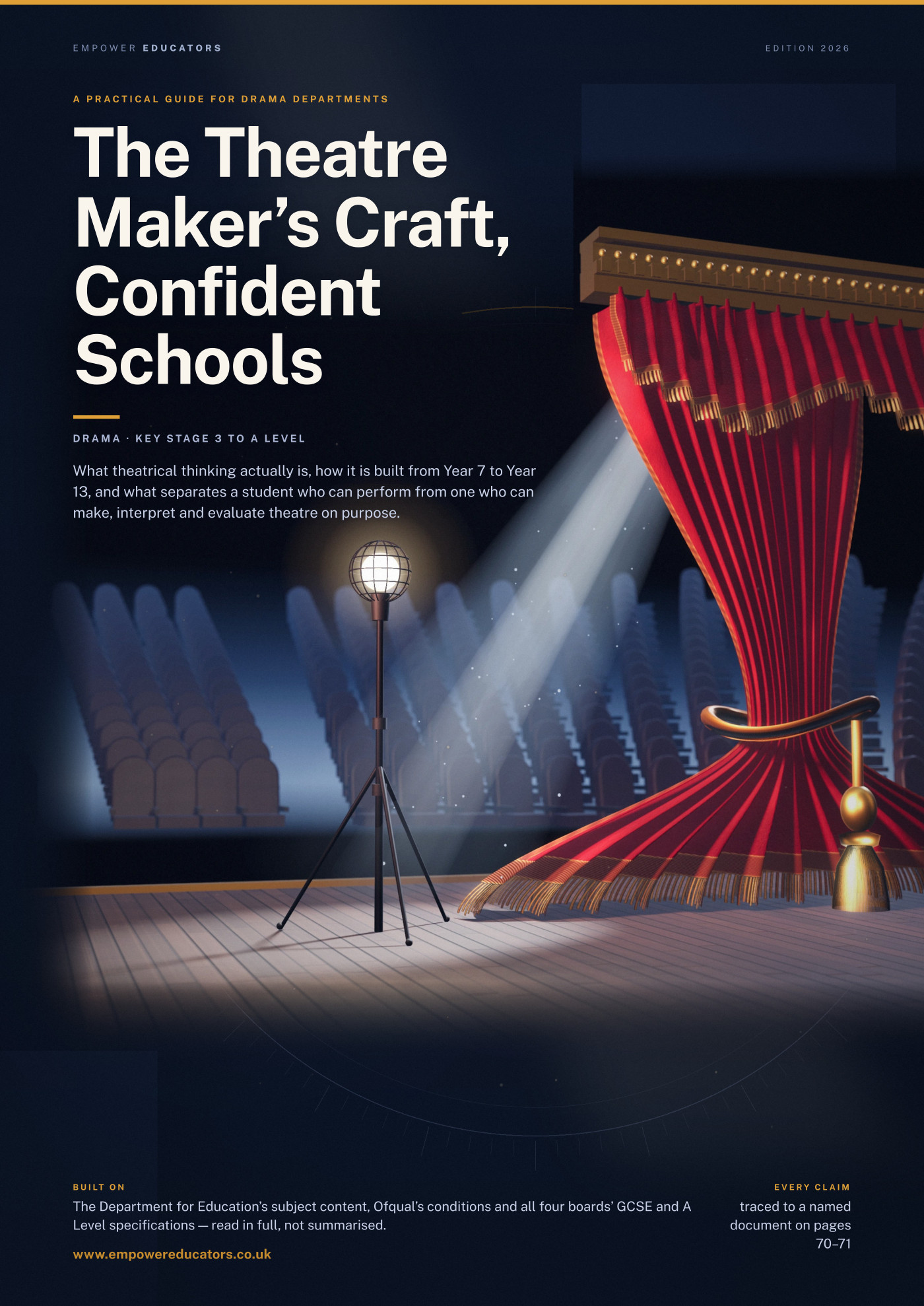
One book for the whole department: the head of drama defending curriculum time and the teacher whose Year 9 group has run the same scene four times and made it no better. What theatrical thinking actually is, how it is built from Year 7 to Year 13, and what separates a student who can perform from one who can make, interpret and evaluate theatre on purpose.
1 Intention
2 Craft
3 Reading
4 Composition
5 Rehearsal
6 Judgement
All four GCSE and all four A Level drama specifications, read in full· 71 pages, 68 sections ·For department CPD, planning and curriculum review
One architecture, used every time — carried on the cover and worked through section
by section. The playbooks are where it is set out in full, and the schemes of work
and examination playbooks are built on the same discipline. Pick a playbook to see
its own.
Articulate Writers, Confident Schools
01CurriculumA reading list is not a curriculum. A spine is a sequence where each year is only possible because of the one before, and you can say what the join is.
02ReadingThe thing most often set and least often taught. Setting a text is giving it out; teaching it is showing students what to do with it.
03WritingThe distance between a grade 4 and a grade 7 is usually visible inside one sentence. That is where the teaching has to happen.
04EvidenceEvery board examines GCSE Literature closed book — a curriculum decision to make in Year 10, not a revision strategy to reach for in April.
05StandardIf two teachers mark the same essay two grades apart, no amount of tracking will help. The standard has to exist somewhere other than in one person’s head.
01CurriculumEvery maths department has a scheme of work. Very few have a sequence — a document recording what must be secure before each unit can be taught, rather than what week it falls in.
02FluencyNot the opposite of understanding, but the condition that makes it affordable: a student computing 7 × 8 has no working memory left to notice the structure of the problem.
03ReasoningTreated in many departments as what the top set does when it has finished. It is the thing the whole subject is for, and it is teachable to every group in the school.
04EvidenceMost assessment tells you what a student scored. Very little tells you which misconception produced the error, which is the only information that changes Monday.
05StandardThe strongest predictor of a department’s results is whether every teacher in it would give the same student the same next step.
01CurriculumScience is three hierarchies running in parallel, and they do not depend on each other evenly. A sequence that ignores the dependencies produces topics that have to be retaught every time they recur.
02KnowledgeExaminations reward application, which has led some departments to conclude recall matters less. It is the reverse: application is impossible while the knowledge is still effortful.
03EnquiryNot a Year 7 topic, and not the same as doing a practical. It is a way of reasoning examined in every paper and taught explicitly in very few schemes of work.
04PracticalExpensive in time, preparation and risk — which is an argument for being clear, every time, about which of three quite different jobs it is doing.
05StandardA science department has more scope for inconsistency than any other, because it teaches three subjects with different conventions, often by teachers who specialise in only one.
01CurriculumMost art curricula are a list of good projects. A spine is different: each year is built from what the last one made possible, and you can say what that was.
02CraftThe part of art teaching that cannot be written down, handed out or covered by a worksheet — and therefore the part that quietly disappears in a term where everybody is busy.
03IndependenceCopying is not the enemy; it is how most artists start. The problem is a portfolio where copying is the last step rather than an early one.
04EvidenceThe sketchbook is the only place three of the four assessment objectives can actually be seen, which makes how students are taught to use it a mark-bearing decision.
05StandardA standard that lives in one person’s head is not a standard. In a subject assessed holistically by the people who taught it, shared judgement is the whole ball game.
01CurriculumA PE curriculum is not a rotation of sports. It is a sequence of movement problems, each depending on the one before — and you should be able to say why netball comes after that unit rather than before it.
02CompetenceThe single largest cause of disengagement is students being asked to play games requiring competences nobody ever taught them. They conclude they are not sporty. They are usually just not taught.
03KnowledgeGCSE PE is a written qualification with a practical component, not the reverse. Departments that accept this early build knowledge into Key Stage 3.
04ParticipationA department is judged by its results and remembered by its non-participants — the students who spend five years finding reasons not to take part.
05StandardIn the non-exam assessment, teacher judgement is the qualification until a moderator says otherwise. Two teachers marking three marks apart are running two different qualifications.
01CurriculumGeography looks like the most modular subject on the timetable. The dependencies are real, and ignoring them means the same concepts get retaught every year.
02PlaceCase studies are the currency of geography examinations and the least deliberately managed part of most curricula. One a student can recite but cannot deploy has cost a term and earns nothing.
03ProcessThe difference between describing and explaining is a single word: because. Physical geography is where explanation can be taught to a genuinely high standard, and where descriptions most often arrive labelled as explanations.
04EnquiryEvery board requires fieldwork and every board examines it in the written papers, on data the student has never seen. Most departments organise the fieldwork excellently and prepare for the examination of it hardly at all.
05StandardMarked in levels, which gives two conscientious teachers room to differ by three marks on a nine-mark answer. A department that has never marked blind together does not know how far apart it is.
01ChronologyAssumed by everyone and taught by almost nobody. Without it students know events but not sequence, topics float free, and nothing taught in September is available in June.
02KnowledgeThere has to be something to think with. Where it is thin, explanation thins into generality and students reach for opinion because they have no material.
03ConceptsCause, change, similarity and significance are the operations a historian performs on knowledge. Answering a concept question with description is the single largest loss of marks in GCSE History.
04EvidenceHow we know, and how sure we can be. Without it history becomes assertion and source work becomes a worksheet exercise detached from what is actually known.
05ArgumentStudents know a great deal and say nothing with it. Essays narrate towards a conclusion they never actually reach.
01CurriculumBusiness content looks modular, which is exactly why so many schemes of work are textbook chapter lists. The dependencies are real, and ignoring them costs the second year.
02KnowledgeA deceptive vocabulary: most of its terms are ordinary English words used in a precise technical sense, so students believe they understand them long before they do.
03ApplicationApplication is not mentioning the business. Writing that something would help a named company increase profit has named it, not applied to it.
04JudgementAnalysis and evaluation carry thirty per cent of the GCSE and more of the top grades, yet are usually addressed as exam technique in the spring of Year 11 — roughly eighteen months too late.
05StandardMarked in levels, not points, which gives two conscientious teachers ample room to award different marks for the same script. A department that has never marked blind together does not know how far apart it is.
01IntentionWhat the audience should experience, decided before anything is made. Without it work is busy and says nothing, and students can describe what they did but never why.
02CraftBody, voice, space and design — the instruments a student can change on demand. Where it is thin, volume, pace and stillness all arrive by accident rather than by choice.
03ReadingWhat a text or stimulus makes possible, rather than what it means. Scripts read as comprehension produce students hunting for meaning instead of for playable action.
04CompositionHow material becomes theatrical form. Devised work without it is a queue of ideas rather than a shape — no contrast, no build, and an ending that arrives because the time ran out.
05RehearsalImproving by diagnosis rather than repetition. A piece run five times and identical five times is the commonest hour in the subject and the most recoverable.
06JudgementWhether the effect matched the intention. AO4 is worth a fifth of the qualification and is the capability most often left to a sheet handed out after a performance.
Questions
Who are the subject playbooks for?
A head of department can read one as a curriculum and quality-assurance document; a teacher can open it at the page they need. One book covers Key Stage 3 to A Level.
What format do I get?
A PDF, typeset for A4 and ready to print. It downloads immediately after payment, and the link stays valid so you can come back to it.
Can I share it with my department?
Yes. Every resource is free to reproduce inside the school that buys it. Print it, copy it, hand it round a department. The licence covers one school.
Can I see it before I buy?
Yes. The opening pages of every paid title are readable in the browser, free and without signing up. The behaviour playbook is free in full for a name and an email.
Is it a subscription?
No. One payment, and the file is yours. There is nothing to cancel.
What if it is not what I expected?
If the file is broken, wrong, or never arrived, you get a refund. Email info@empowereducators.co.uk with the receipt number.
Cookies
This site works the same either way. Measurement — Google Analytics and Microsoft
Clarity — only runs if you say yes, and it is used to see which resources people
actually reach.Measurement only runs if you say yes.What is collected.