Key terms
Key Terms
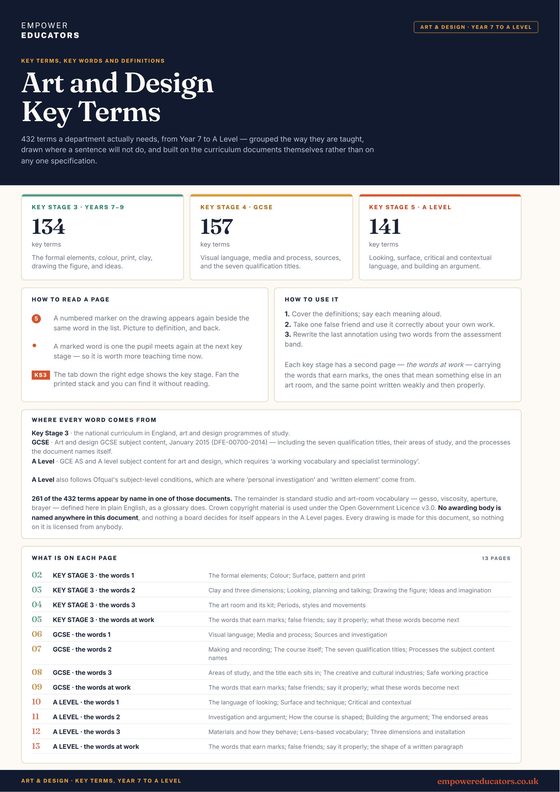
Every word a subject is taught in, Year 7 to A Level, in one book of thirteen pages. The terms sit in the groups they are taught in, each key stage opens on a large labelled drawing, and every key stage ends with a page on using the words rather than only knowing them.
For heads of department, and every teacher in it
A4 books, thirteen pages long, one a subject. Each key stage gets its own pages: the words grouped by the topic they belong to rather than alphabetically, a definition that fits on two lines, and a drawing wherever a sentence will not do. A marked word is one the pupil meets again at the next key stage, so a department can see where its vocabulary carries forward and where it changes name.
The Department for Education’s own documents for each key stage: the national curriculum at Key Stage 3, the GCSE subject content, and the A level subject content with Ofqual’s rules around it. Those are the documents every exam board’s specification has to follow, so one book serves a department whichever board it sits. The cover of each book says where its words come from, and how many of them appear by name in one of those documents.
Numbered markers that tie a word on the drawing to its definition in the list, and back. Then, for each key stage, the words the assessment itself is written in, the false friends that mean something else in this subject, the same point written weakly and then properly, and a table of what each word becomes at the next key stage.
Questions
Which exam board is this for?
All of them. Each key stage is built on the Department for Education document every board has to follow: the national curriculum for Key Stage 3, the GCSE subject content and the A level subject content. No awarding body is named anywhere in the book, so a department teaching any specification can use it as it stands.
How is it different from a glossary?
A glossary is alphabetical, and a pupil never reads one. Here the words sit in the groups they are taught in. Each key stage opens on one large labelled drawing, and the numbers on the drawing appear again beside the same words in the list. Every key stage then has a page on using the words: the ones the assessment is written in, the false friends that mean something else in this subject, and the same point written weakly and then properly.
Is it for pupils or teachers?
Both. It prints one per pupil, and a department uses the same pages to agree the vocabulary it teaches from Year 7 to A Level.
Where do the pictures come from?
Every drawing is made for the book. No artist’s work is reproduced, so there is nothing to clear before printing it for a class.
What format do I get?
A PDF of A4 pages, ready to print one per pupil or one per wall. It downloads immediately after payment, and the link stays valid so you can come back to it.
Can I share it with my department?
Yes. Every resource is free to reproduce inside the school that buys it. Print it, copy it, hand it round a department. The licence covers one school.
Can I see it before I buy?
Yes. The opening pages of every paid title are readable in the browser, free and without signing up. The behaviour playbook is free in full for a name and an email.
Is it a subscription?
No. One payment, and the file is yours. There is nothing to cancel.
What if it is not what I expected?
If the file is broken, wrong, or never arrived, you get a refund. Email info@empowereducators.co.uk with the receipt number.