Empower
Educators
All subject playbooks

10·Biology · Chemistry · Physics · KS3 to A Level

Curious Scientists,
Confident Schools

Secondary science department handbook — KS3 to A Level

One book for a department that teaches three subjects, runs a laboratory and shares a technician — the head of science who has to hold it together and the teacher setting up period four with a class already at the door.

Everything else this site has for Biology: Biology teaching resources

  1. 1Curriculum
  2. 2Knowledge
  3. 3Enquiry
  4. 4Practical
  5. 5Standard
Preview — first 14 pages

72 pages · 69 sections · 🔒 58 more pages unlock on purchase

One purchase covers the school that buys it. Print it, copy it, hand it round your department. Not for passing to other schools or uploading anywhere.
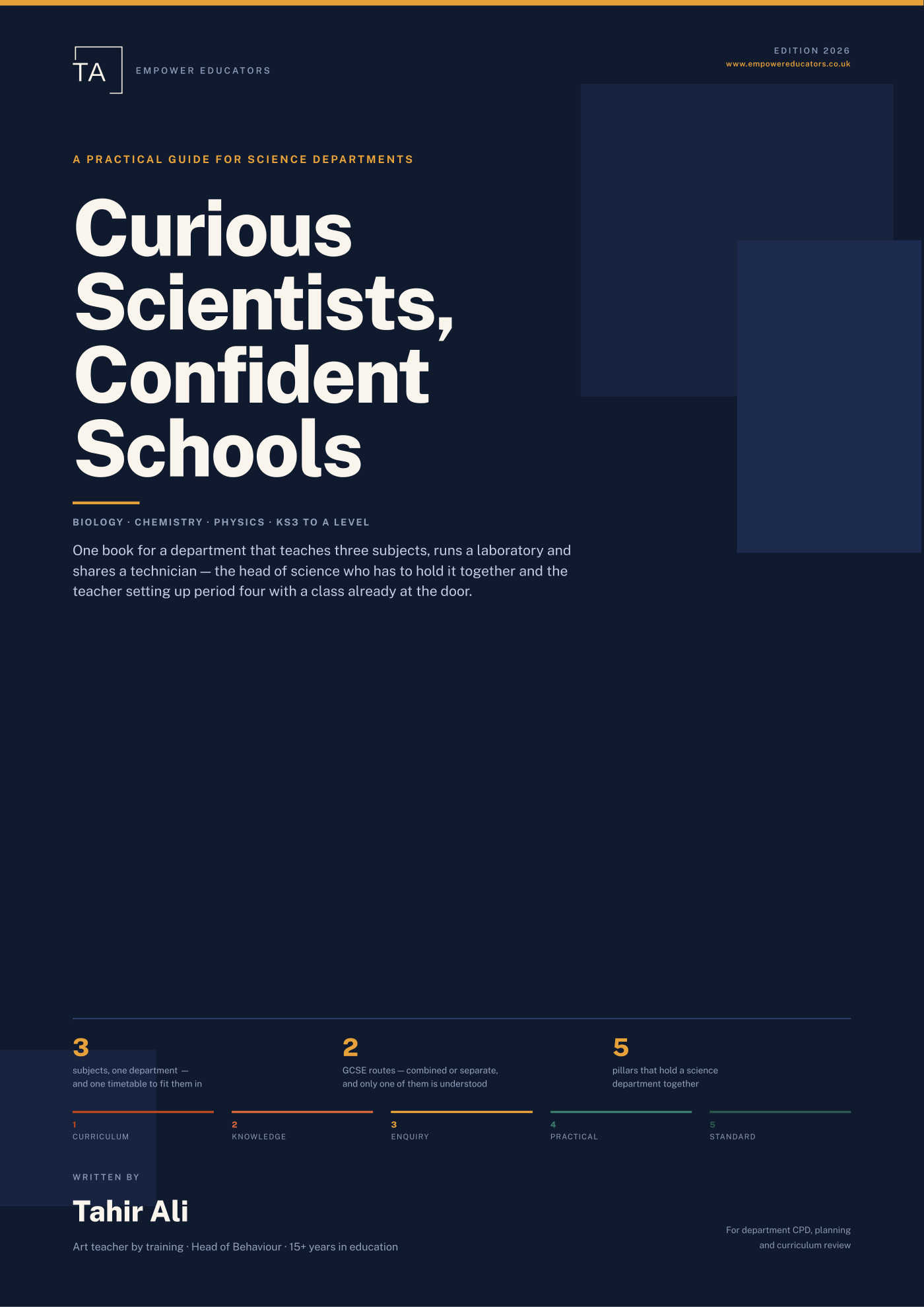
Cover of Curious Scientists, Confident Schools

A science department is three subjects, one laboratory, one technician and one timetable to fit them all into. It has more scope for inconsistency than any other department in the school — units required in physics and tolerated in biology, equations written as symbols in one room and words in the next.

This booklet is written for the whole department at once. A head of science can read it as a curriculum and quality-assurance document; a teacher can open it at the page they need while setting up period four. The two GCSE routes are compared from the specifications themselves, including the one almost nobody outside the department understands.

Written to
The current GCSE and A Level science specifications
Intended for
department CPD, planning and curriculum review
Extent
72 pages · 69 sections

·Look inside

Real pages, straight from the PDF

Click any page to see it full size.

·Contents

All 69 sections

Taken from the booklet’s own contents page, so the page numbers are the real ones.

THE CASE

01Three Subjects, One Departmentp3
02Where Science Departments Driftp4

THE PRACTICE

03Pillar 1 — Curriculum: What Builds on Whatp5
04Pillar 2 — Knowledge: Secure Before Appliedp6
05Pillar 3 — Enquiry: Thinking Like a Scientistp7
06Pillar 4 — Practical: Purposeful, Not Merely Presentp8
07Pillar 5 — Standard: One Department, Three Subjectsp9

THE DISCIPLINES

08Biology: Memory, Mechanism and Meaningp10
09Chemistry: The Particle Model Underneath Everythingp11
10Physics: Usually a Mathematics Problemp12
52Six Topics, Three Waysp54
53Physics and the Two Ways It Failsp55

TEACHING SCIENCE

11Explanation, Modelling and Dual Codingp13
12Questioning and Scientific Talkp14
13Scientific Writing and the Six-Mark Questionp15
33Scientific Vocabularyp35

PRACTICAL SCIENCE

14Running Practicals That Workp16
15Safety, Technicians and the Laboratoryp17
16Mathematics Inside Sciencep18
51Teaching the Mathematics Science Needsp53
17Three Years That GCSE Depends Onp19

GCSE

18Combined or Separate: The Decision and Its Costp20
19Required Practicals as Examinable Contentp21

A LEVEL

20The GCSE to A Level Stepp22

ASSESSMENT

21Assessment That Changes Teachingp23

EVERY STUDENT

22SEND, EAL and Access to Sciencep24
23High Attainers in Sciencep25
42Intervention That Is Worth the Timep44

EXAM PREPARATION

24Revision That Is Not Rereadingp26

FOR LEADERS

25The Head of Sciencep27
26Data, Monitoring and Quality Assurancep28
27Developing Science Teachersp29
28The First 90 Daysp30
35Meetings, CPD and Techniciansp37
54Recommended Reading and Where It Helpsp56
58Ofsted and the Science Departmentp60

SCENARIOS

29Six Situations, and Where to Look Firstp31
30Three More, and the Question Underneathp32

MISCONCEPTIONS

31Biology and Chemistryp33
32Physics and Enquiryp34

CULTURE

34Homework, Parents and Wider Sciencep36
41Behaviour in a Laboratoryp43
66A Department Where Being Wrong Is Usefulp68
67Technology and AI in Sciencep69

THE TOOLKIT

36Templates 1–3 — Curriculum and Practicalp38
37Templates 4–6 — Assessment and Misconceptionsp39
38Templates 7–9 — Monitoring, Meetings and Safetyp40
39Templates 10–12 — Self-Evaluation and New Staffp41
40The Teacher’s Page — Sciencep42

CLOSING

43The Science Department Excellence Checklistp45
68One Department, Three Subjects, One Standardp70
69References and Evidence Basep71

OUTSTANDING LESSONS

44What an Outstanding Science Lesson Looks Likep46
45Biology — Osmosis, Year 10p47
46Chemistry — Rates of Reaction, Year 10p48
47Physics — Resistance, Year 10p49

CURRICULUM

48Cumulative Knowledge: Cells and Particlesp50
49Cumulative Knowledge: Forces and Energyp51
50A Science Scheme That Records Dependenciesp52
57Schemes of Work: Years 8 and 9p59

THE BOARDS

55Combined and Separate, Compared from the Specificationsp57
56Using Board Knowledge Strategicallyp58

THE SCIENTISTS

59Eight Scientists, and What Each One Gives a Lessonp61
60Two Centuries of Ideas, and Where They Sit in Your Curriculump62

DRAWING THE HARD IDEAS

61Three Misconceptions, Drawn Twicep63
62One Practical, Five Decisionsp64

THE FOUR BOARDS

63GCSE Science: What Actually Differs Between Boardsp65
64A Level Science: The Endorsement and the Mathematicsp66

THE EVIDENCE

65Seven Recommendations, and What They Look Like in a Labp67
Next: Art

Your basket

Nothing in it yet.

Total £0.00

Checkout