Drama · KS3 to A Level · £6.99
The Theatre Maker’s Craft,
Confident Schools
Secondary drama department handbook — KS3 to A Level
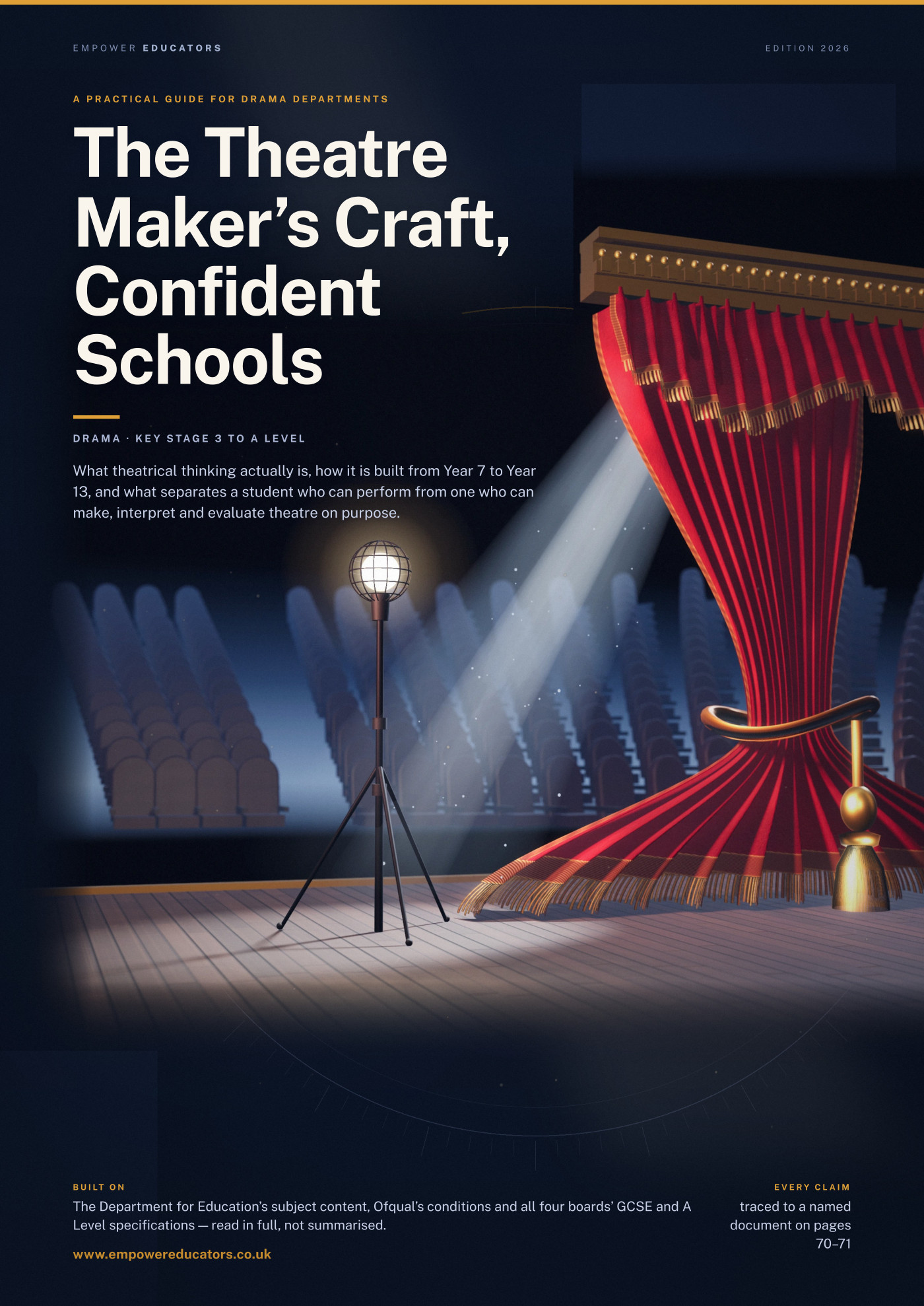
One book for the whole department: the head of drama defending curriculum time and the teacher whose Year 9 group has run the same scene four times and made it no better. What theatrical thinking actually is, how it is built from Year 7 to Year 13, and what separates a student who can perform from one who can make, interpret and evaluate theatre on purpose.
£6.99The whole playbook, 71 pages
- A4 PDF
- first 14 pages free to read
- instant download
One purchase covers the school that buys it. Print it, copy it, hand it round your department. Not for passing to other schools or uploading anywhere.
PDF download, ready straight after payment. Downloading it ends the 14-day right to cancel; a file that is faulty or not as described is always refunded. Refunds
Read before publication by serving senior leaders, in school.
5.0 from 24+ reviews on Google
Schools that have bought from Empower Educators include Nottingham High School, Northampton High School GDST and Sutton Valence School.
Everything else this site has for Drama: Drama teaching resources
- 1Intention
- 2Craft
- 3Reading
- 4Composition
- 5Rehearsal
- 6Judgement
Drama is the subject most often defended by its by-products. Confidence, teamwork and communication are real, and none of them is the reason it is on a timetable. Thirty per cent of the GCSE is knowledge, assessed in writing, and between half and three fifths of the marks on every specification are awarded for something a student writes.
This booklet is written for the whole department at once. A head of drama can read it as a curriculum and quality-assurance document; a teacher can open it at the page they need on a Tuesday. The Department for Education’s subject content, Ofqual’s conditions and all eight current specifications were read from the documents themselves rather than from summaries, and where the boards genuinely differ — one splits its practical marks differently, two set the devising stimulus and two do not, one alone permits a recorded portfolio — the difference is stated rather than blended.
- Written to
- All four GCSE and all four A Level drama specifications, read in full
- Intended for
- department CPD, planning and curriculum review
- Extent
- 71 pages · 68 sections
Look inside
Real pages, straight from the PDF
Click any page to see it full size.
Contents
All 68 sections
Taken from the book’s own contents page, so the page numbers are the real ones.