Empower
Educators

08·Art & Design · KS3 to A Level

Confident Artists,
Confident Schools

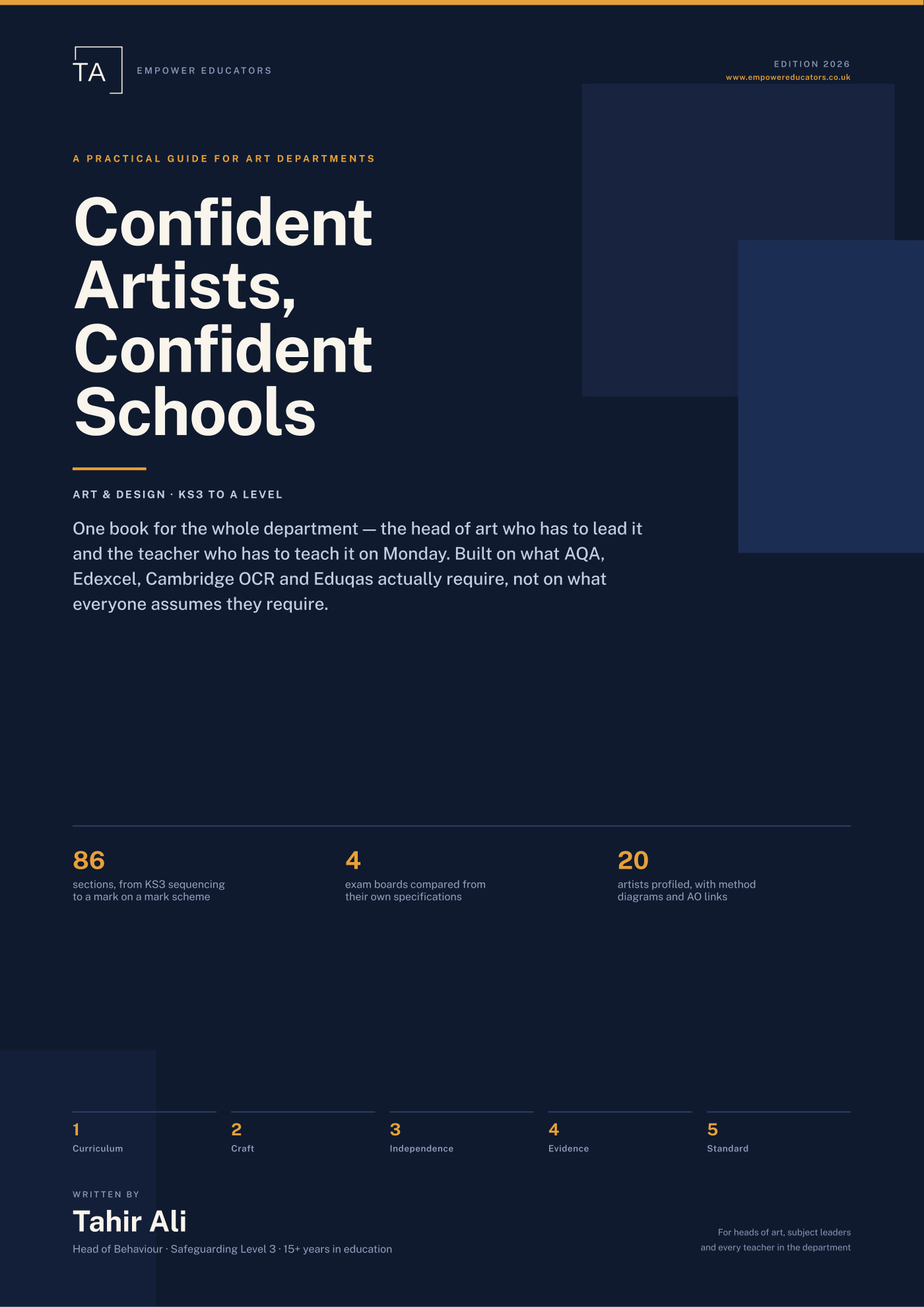
One book for the whole department — the head of art who has to lead it and the teacher who has to teach it on Monday. Built on what AQA, Edexcel, OCR and Eduqas actually require, not on what everyone assumes they require.

  1. 1Curriculum
  2. 2Craft
  3. 3Independence
  4. 4Evidence
  5. 5Standard
Download the PDF

91 pages · 86 sections · 9.3 MB

Cover of Confident Artists, Confident Schools

Art is assessed holistically, by the people who taught it, against four objectives that carry equal weight. That single fact makes it unlike almost every other subject in the building — and it is why a whole-school marking policy arriving in the art room so often measures the wrong thing.

This booklet is written for the whole department at once. A head of art can read it as a curriculum and quality-assurance document; a teacher can open it at the page they need on a Monday. The four boards are compared from their own specifications rather than from summaries, and where they differ, the difference is stated rather than blended away.

Written to
AQA, Edexcel, OCR and Eduqas specifications & the Ofsted art and design research review
Intended for
For heads of art, subject leaders and every teacher in the department
Extent
91 pages · 86 sections

·Look inside

Real pages, straight from the PDF

Click any page to see it full size.

·Contents

All 86 sections

Taken from the booklet's own contents page, so the page numbers are the real ones.

EXECUTIVE SUMMARY

The Five Daily Non-Negotiablesp3
The Architecture, at a Glancep4

THE CASE

01Art Is Not a Soft Subjectp5
02The National Picturep6
03Where Art Departments Driftp7
04What Ofsted Looks For in Artp8

THE THEORY

05How Skill Is Actually Learnedp9
06Independence Is Taught, Not Waited Forp10
07What “Personal Response” Actually Meansp11

THE PRACTICE — THE FIVE PILLARS

08The Five-Pillar Frameworkp12
09Pillar 1 — Curriculum: The Spinep13
10Pillar 2 — Craft: Showing, Not Settingp14
11Pillar 3 — From Copying to Responsep15
12Pillar 4 — Sketchbooks That Show Thinkingp16
13Pillar 5 — Knowing What Good Looks Likep17

SHOW, DON’T TELL — FOUR WAYS

14The Sketchbook Page, Four Waysp18
15Annotation, Four Waysp19
16Artist Research, Four Waysp20
17Developing Ideas, Four Waysp21
18Experimentation and Refinement, Four Waysp22
19The Final Outcome, Four Waysp23

THE OUTSTANDING ART LESSON

20What Makes an Outstanding Art Lesson?p24
21What Does Outstanding Practice Look Like?p25

ARTIST REFERENCE — TWENTY ARTISTS

22Portraiture & Identityp26
23Nature, Environment & Still Lifep27
24Architecture, Urban & Abstractp28
25Photography & Sculpturep29
26Mixed Media & Contemporaryp30
27Twenty Artists at a Glancep31
28Frida Kahlop32
29Lucian Freudp33
30Cindy Shermanp34
31Jean-Michel Basquiatp35
32Vincent van Goghp36
33Georgia O’Keeffep37
34Paul Cézannep38
35Giorgio Morandip39
36David Hockneyp40
37Rachel Whitereadp41
38Wassily Kandinskyp42
39Mark Rothkop43
40Man Rayp44
41Dorothea Langep45
42Henry Moorep46
43Barbara Hepworthp47
44Pablo Picassop48
45Robert Rauschenbergp49
46Banksyp50
47Yayoi Kusamap51
48Using an Artist Properlyp52

MEDIA, PROCESS AND TECHNIQUE

49Drawing and Observational Studyp53
50Colour, Tone and Paintingp54
51Print, Collage and Mixed Mediap55
52Photography, Digital and Graphicsp56
53Three-Dimensional Work, Ceramics and Textilesp57

GCSE ART & DESIGN

54GCSE: The Shape of the Coursep58
55Building the GCSE Portfoliop59
56The Externally Set Assignmentp60
57Where Marks Are Actually Lostp61

A LEVEL ART & DESIGN

58A Level: What Actually Changesp62
59The Personal Investigationp63
60The Written Personal Studyp64
61The A Level Externally Set Assignmentp65

THE FOUR EXAM BOARDS

62The Four Boards at a Glancep66
63AQAp67
64Pearson Edexcelp68
65Cambridge OCRp69
66WJEC Eduqasp70
67Requirement or Recommendation?p71

MARKS — WHAT A GRADE LOOKS LIKE

68The Mark Bands, Comparedp72
69AQA — What a Mark Looks Likep73
70Pearson Edexcel — What a Mark Looks Likep74
71Cambridge OCR — What a Mark Looks Likep75
72WJEC Eduqas — What a Mark Looks Likep76

ASSESSMENT & PROGRESS

73Assessing Against the Objectivesp77
74Moderation and Standardisationp78
75Tracking, Intervention and Stretchp79

EVERY ARTIST, EVERY ROOM

76SEND, Access and Every Artistp80
77The Artroom: Resources and Safetyp81

FOR LEADERS

78The Department Improvement Roadmapp82
79Quality Assurance Through the Yearp83
80Twelve Questions to Sit Withp84

THE TOOLKIT — PRINT & USE

81Template 1 — Department Self-Auditp85
82Template 2 — Sketchbook and Portfolio Reviewp86
83Template 3 — AO Evidence Trackerp87
84Template 4 — Moderation Record & the 45-Minute INSETp88

CLOSING

85The Work on the Wallp89
86References and Evidence Basep90