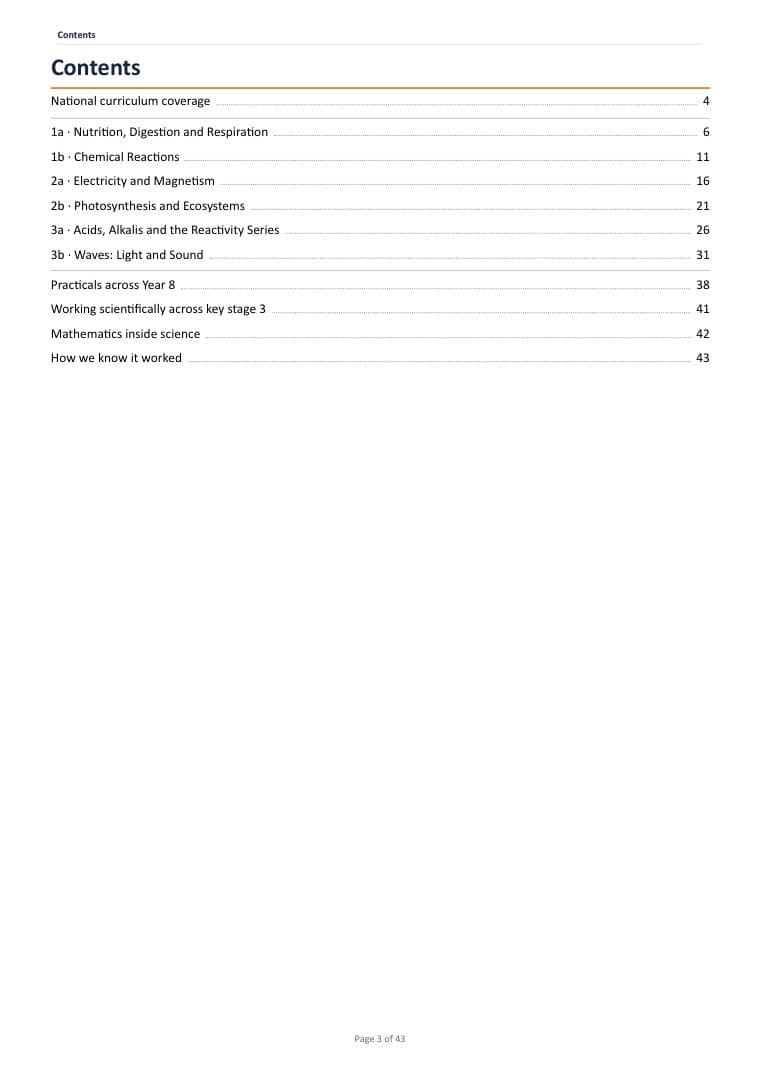
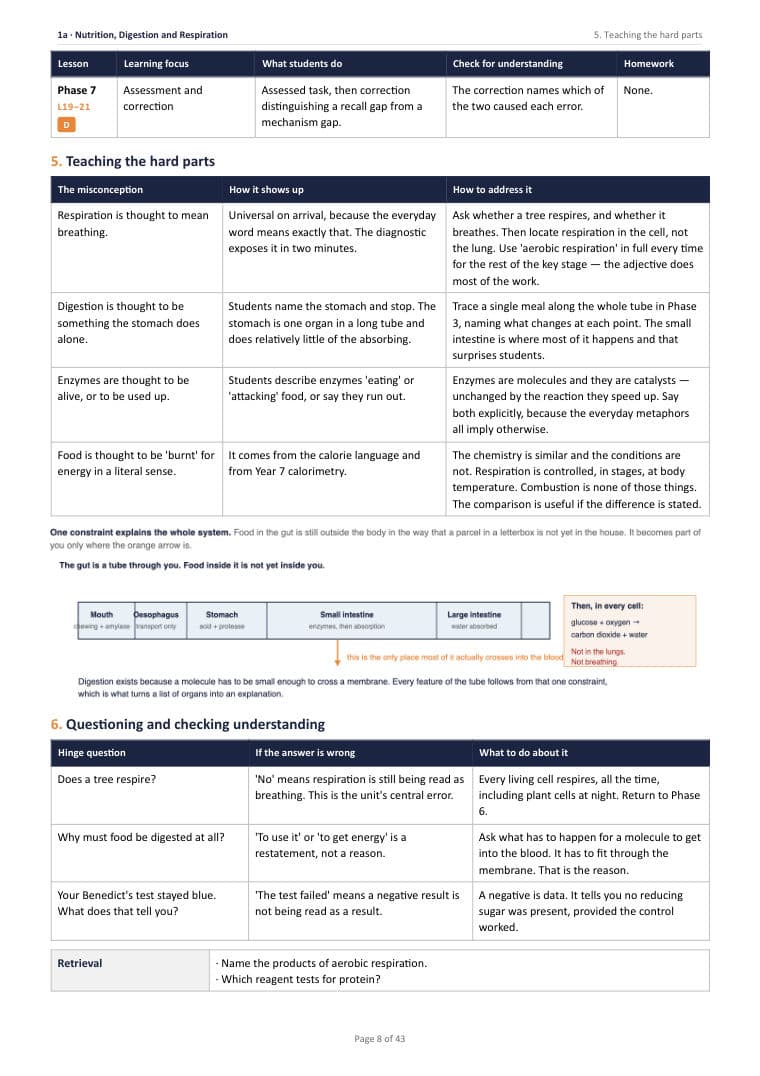
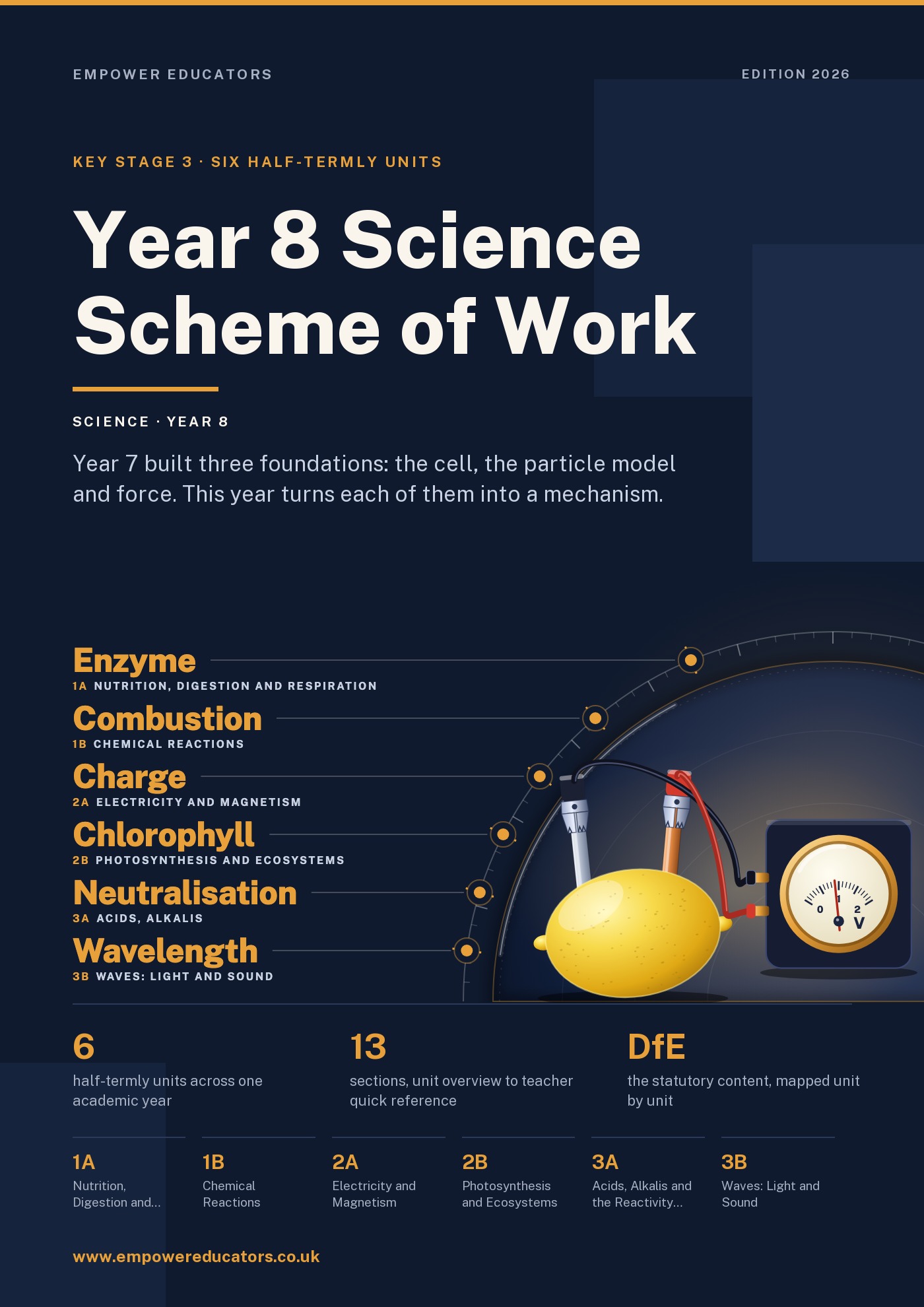
Six half-term units, two each for biology, chemistry and physics, in the order we teach them: nutrition, digestion and respiration, chemical reactions, electricity and magnetism, photosynthesis and ecosystems, acids, alkalis and the reactivity series, and light and sound. Below is the question each unit asks, what pupils produce, the representation it carries forward and the scientific skill it builds, taken from our Year 8 Science scheme of work.
Six half-termly units, two per discipline. Photosynthesis sits in Unit 2b rather than beside respiration in Unit 1a, deliberately: the two are taught as complements, and respiration has to be secure first or photosynthesis becomes a second equation to memorise backwards.
Year 8 means ages 12–13, or S1–S2 in Scotland.
The year, unit by unit
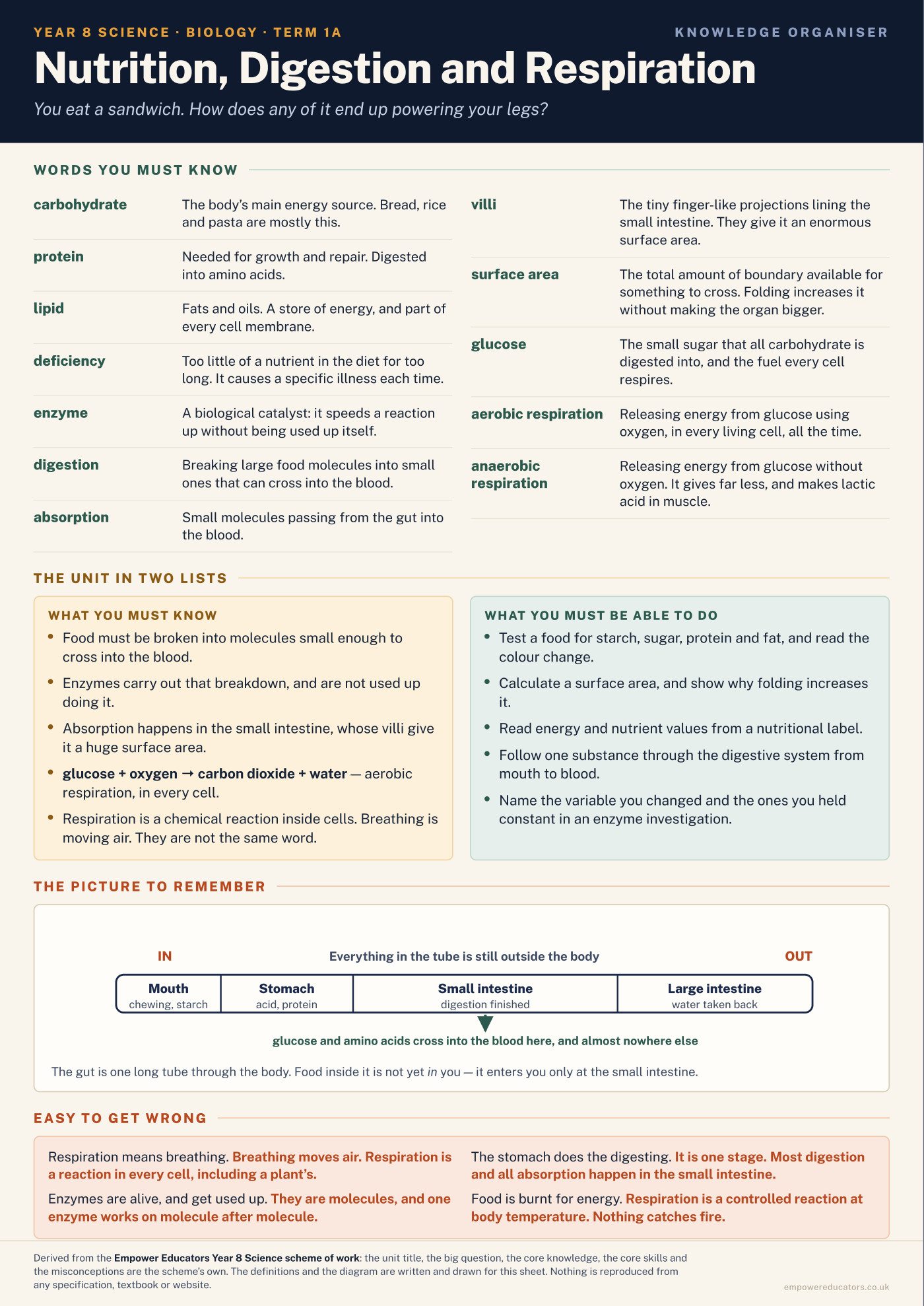
Nutrition, Digestion and Respiration
Unit 1a · Biology · Autumn 1 · approx. 7 weeks · September – October
You eat a sandwich. How does any of it end up powering your legs?
Pupils produce
A traced account of one meal from mouth to muscle, naming the organ, the change and the reason at every step.
Key representation
The tube diagram: the gut as a tube through the body, with what enters and leaves at each point.
Working scientifically
Qualitative testing with controls; recognising that a colour change is evidence and not proof.
Chemical Reactions
Unit 1b · Chemistry · Autumn 2 · approx. 7 weeks · November – December
Wood burns away to almost nothing. Where did the rest of it go?
Pupils produce
A set of word equations for reactions the class has carried out, each with a measurement or observation showing that mass was conserved.
Key representation
Before-and-after particle diagrams with the atoms counted on both sides, using the Year 7 convention unchanged.
Working scientifically
Distinguishing evidence of a reaction from evidence of a physical change; using a gas test as a positive identification.
Electricity and Magnetism
Unit 2a · Physics · Spring 1 · approx. 7 weeks · January – February
If current is not used up in a bulb, why does the battery go flat?
Pupils produce
A set of circuits built, measured and explained, with a written account of why current is the same all the way round a series circuit and energy is not.
Key representation
The circuit diagram with standard symbols, plus the loop model: charge goes round, energy goes across.
Working scientifically
Measuring with two different instruments connected in two different ways; recognising a systematic pattern across several circuits.
Photosynthesis and Ecosystems
Unit 2b · Biology · Spring 2 · approx. 7 weeks · March – April
A tree weighs several tonnes. Where did all that mass come from?
Pupils produce
An account of where the mass of a tree comes from, supported by the class's own evidence that a plant makes starch only in light.
Key representation
The two equations written one above the other, in opposite directions, with the arrows aligned.
Working scientifically
Controlling a variable over days rather than minutes; destarching as a control step and why it is necessary.
Acids, Alkalis and the Reactivity Series
Unit 3a · Chemistry · Summer 1 · approx. 7 weeks · April – May
Why can you put copper in water but not sodium?
Pupils produce
A reactivity series built from the class's own observations, used to predict the outcome of a displacement reaction the class has not carried out.
Key representation
The reactivity series as a vertical ladder, built by the class from its own results rather than issued.
Working scientifically
Building a classification from evidence; using a pattern to predict an untested case, then testing the prediction.
Waves: Light and Sound
Unit 3b · Physics · Summer 2 · approx. 7 weeks · June – July
Why can you hear round a corner but not see round one?
Pupils produce
Ray diagrams for reflection and refraction drawn to scale from the class's own measurements, with the difference between light and sound explained.
Key representation
The ray diagram: straight lines with arrows, angles always measured from the normal, never from the surface.
Working scientifically
Measuring angles precisely; recognising a constant relationship across repeated measurements.
How it meets the key stage 3 programme of study
The scheme maps each requirement of the statutory programme of study for key stage 3 (Department for Education, 2013) to the unit that teaches it. Pupils should be taught to…
Working scientifically — scientific attitudes: pay attention to objectivity and concern for accuracy, precision, repeatability and reproducibility
3a builds a classification from evidence and then tests it · 1b requires measurement to overturn an expectation
Working scientifically — experimental skills and investigations: ask questions, make predictions, select enquiry types and work safely
2b destarching as a control step · 2a prediction before every measurement · 3a predict-then-test in Phase 5
Working scientifically — analysis and evaluation: apply mathematical concepts, present data, identify patterns and assess error
1b atom counts on both sides · 2a currents added at a junction · 3b angle measurement and its precision
Working scientifically — measurement: understand and use SI units and IUPAC chemical nomenclature
Amps and volts in 2a · word equations and salt naming in 1b and 3a
Biology: structure and function of living organisms · material cycles and energy · interactions and interdependencies · genetics and evolution
1a nutrition, digestion and aerobic respiration · 2b photosynthesis, ecosystems and interdependence
Chemistry: the particulate nature of matter · atoms, elements and compounds · pure and impure substances · chemical reactions · energetics · the periodic table · materials · Earth and atmosphere
1b chemical reactions, conservation of mass, energetics · 3a acids, alkalis, the reactivity series
Physics: energy · motion and forces · waves · electricity and electromagnetism · matter · space physics
2a electricity and electromagnetism · 3b waves, light and sound
Space physics, atomic structure and the periodic table as a pattern are not covered this year, and all three are in Year 9. Each needs something Year 8 is building: space needs waves and energy resources, and the periodic table only explains anything once reactivity has been observed in Unit 3a. Earth and atmosphere remains the genuine gap across Years 7 and 8; it is covered in Year 9 Unit 2b, and if your department wants it earlier, move it rather than adding it. National curriculum coverage Page 4 of 43
The Year 8 Science resources
Two PDFs sit behind this page, and they are meant to be used together: the scheme of work to plan the year, the knowledge organisers to put in front of pupils.
The statutory programme of study for key stage 3 science (DfE, 2013)·43 pages, 13 sections·For heads of science, subject leaders, technicians and every teacher who has to deliver it
Written to Empower Educators Year 8 Science scheme of work·6 pages, 6 sections·For science teachers, technicians and heads of department. Printed one per pupil
Six half-term units, in the order they are taught: Nutrition, Digestion and Respiration, Chemical Reactions, Electricity and Magnetism, Photosynthesis and Ecosystems, Acids, Alkalis and the Reactivity Series and Waves: Light and Sound.
What do pupils produce in Year 8 Science?
A traced account of one meal from mouth to muscle, naming the organ, the change and the reason at every step; A set of word equations for reactions the class has carried out, each with a measurement or observation showing that mass was conserved; A set of circuits built, measured and explained, with a written account of why current is the same all the way round a series circuit and energy is not; An account of where the mass of a tree comes from, supported by the class's own evidence that a plant makes starch only in light; A reactivity series built from the class's own observations, used to predict the outcome of a displacement reaction the class has not carried out; Ray diagrams for reflection and refraction drawn to scale from the class's own measurements, with the difference between light and sound explained.
Does Year 8 Science meet the National Curriculum?
Yes, across the three years of key stage 3. It maps each requirement of the statutory programme of study for key stage 3 (Department for Education, 2013) to the unit that teaches it, and on this year the scheme is plain: “Space physics, atomic structure and the periodic table as a pattern are not covered this year, and all three are in Year 9.”
Cookies
This site works the same either way. Measurement — Google Analytics and Microsoft Clarity — only runs if you say yes, and it is used to see which resources people actually reach.Measurement only runs if you say yes.What is collected.