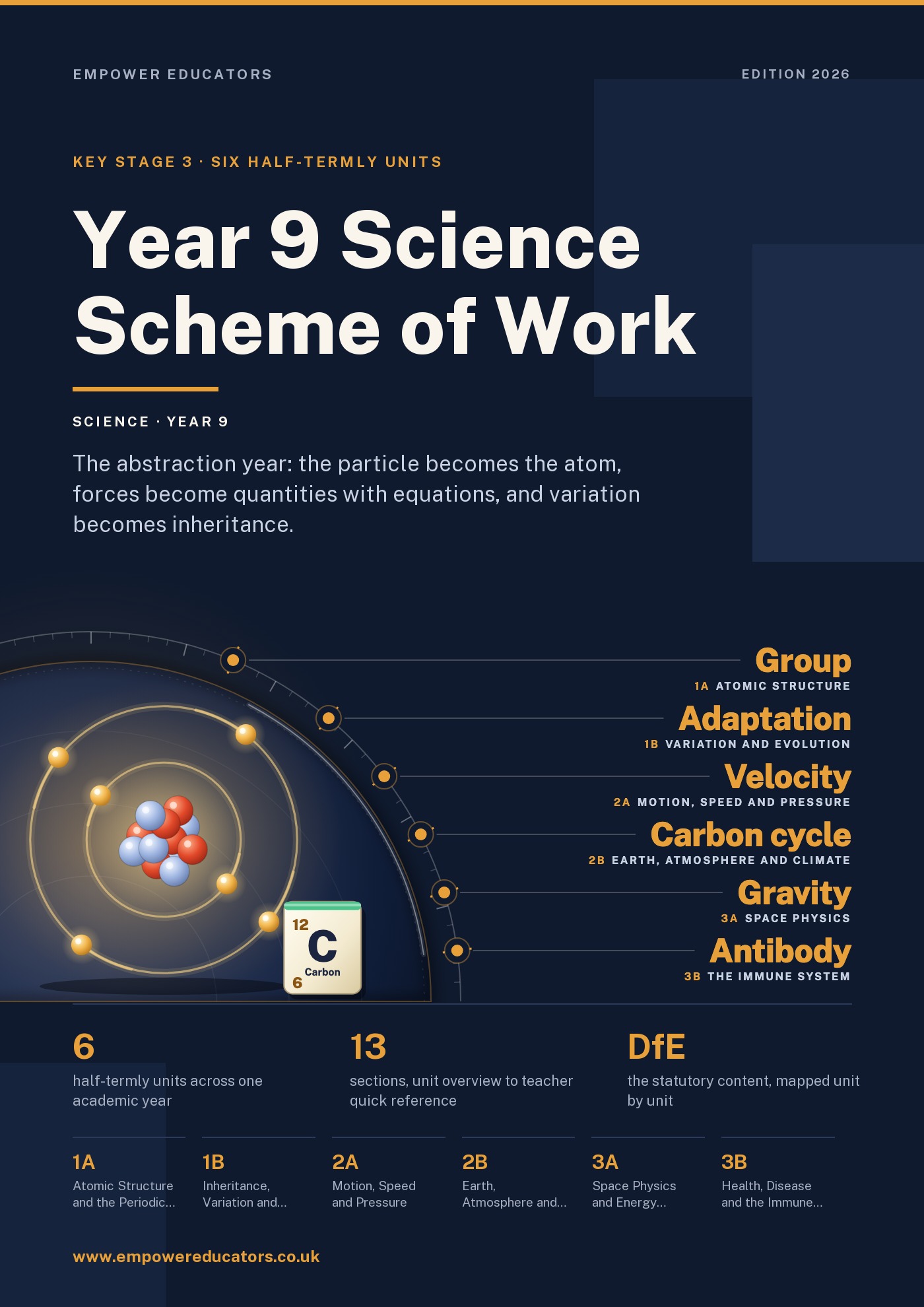
Six half-term units, in the order we teach them: atomic structure and the periodic table, inheritance, variation and evolution, motion, speed and pressure, Earth, atmosphere and climate, space physics and energy resources, and health, disease and the immune system. Below is the question each unit asks, what pupils produce, the representation it carries forward and the scientific skill it builds, taken from our Year 9 Science scheme of work.
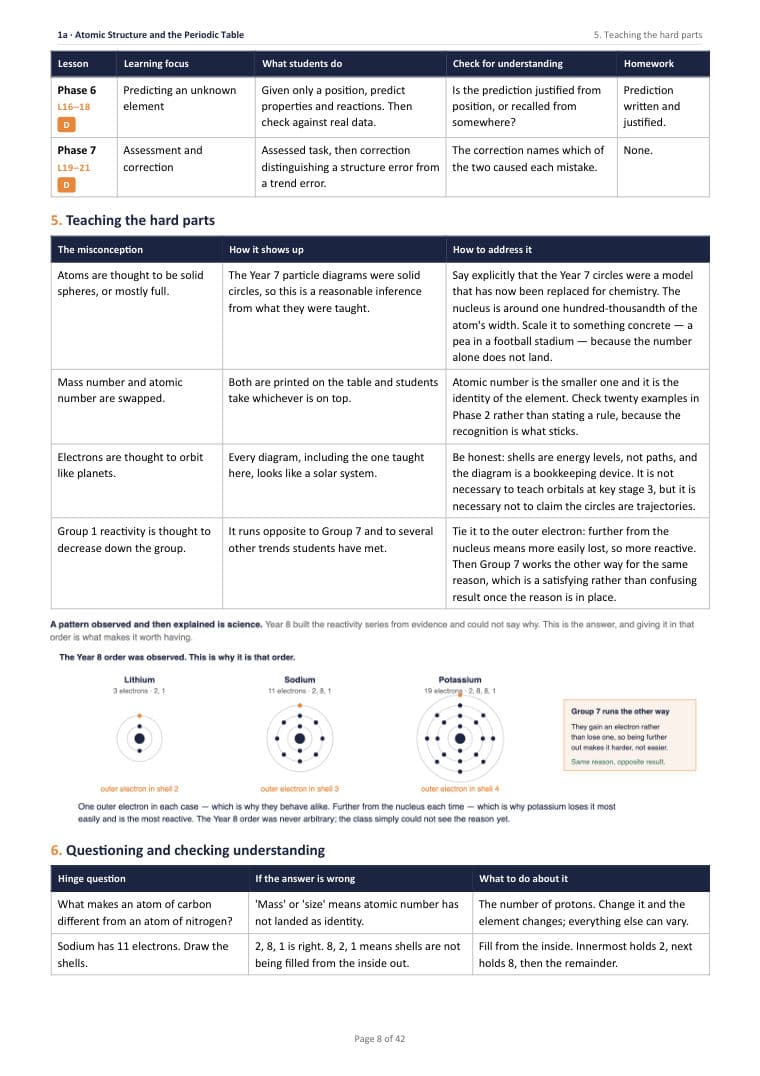
Six half-termly units, two per discipline. Unit 1a explains the reactivity series that Year 8 built from evidence, and that order is deliberate — a pattern observed and then explained is science; a pattern explained and then observed is a lesson. Unit 2a is placed after the mathematics department teaches rearranging equations.
Year 9 means ages 13–14, or S2–S3 in Scotland.
The year, unit by unit
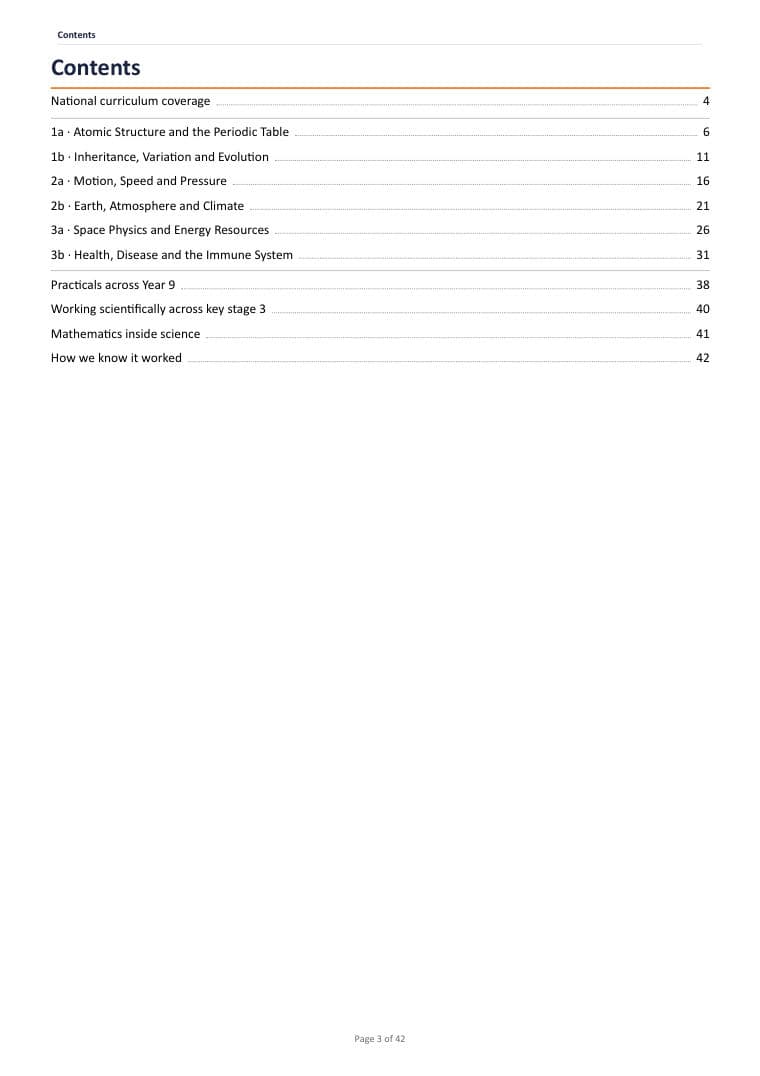
Atomic Structure and the Periodic Table
Unit 1a · Chemistry · Autumn 1 · approx. 7 weeks · September – October
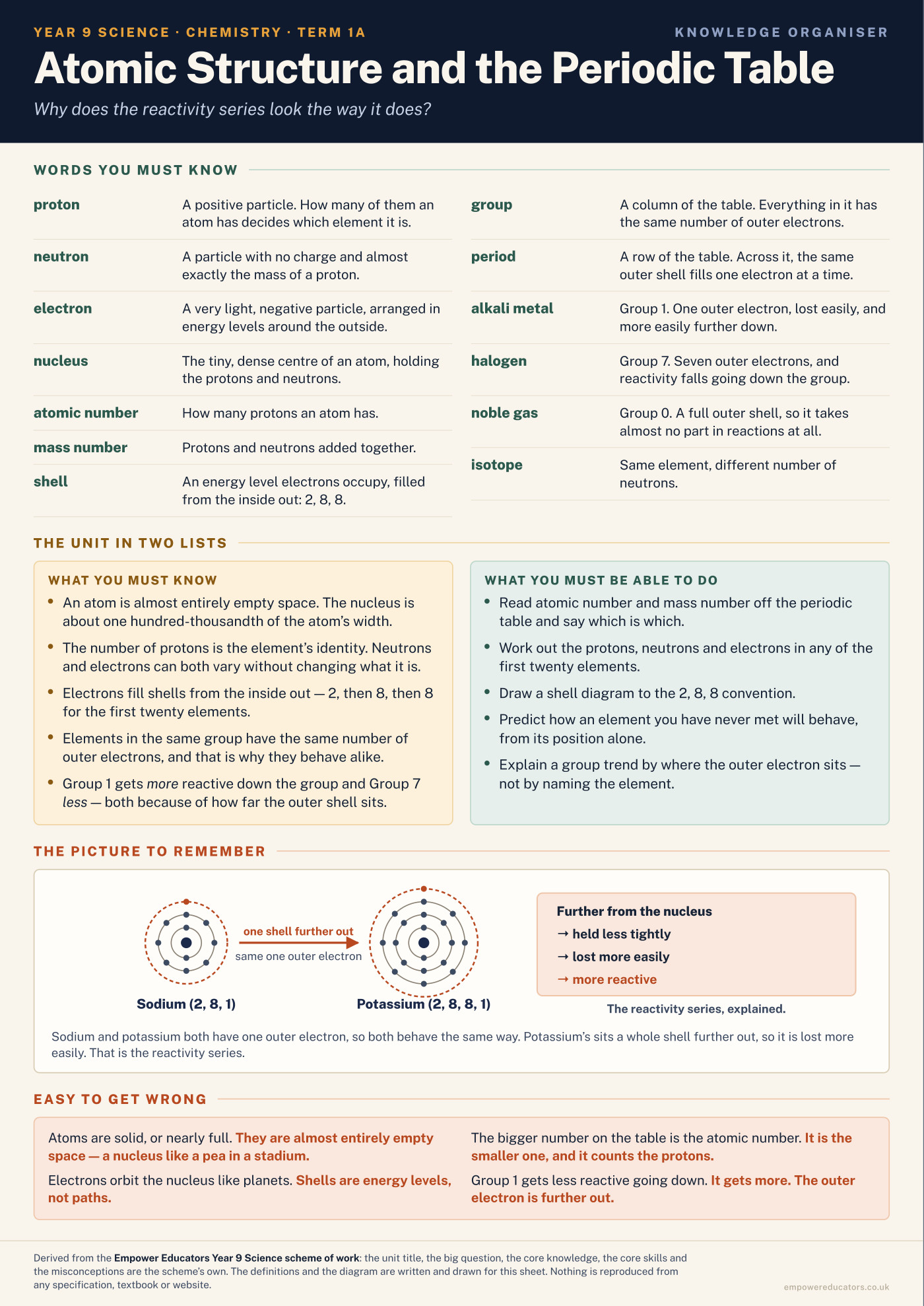
Why does the reactivity series look the way it does?
Pupils produce
A prediction of the properties and reactions of an element the class has never met, justified entirely from its position in the periodic table.
Key representation
The shell diagram, drawn to a fixed convention with the shell limits 2, 8, 8 stated as a rule for the first twenty elements only.
Working scientifically
Explaining an established pattern with a model; distinguishing a model that predicts from one that merely describes.
Inheritance, Variation and Evolution
Unit 1b · Biology · Autumn 2 · approx. 7 weeks · November – December
Why are you like your parents but not identical to them?
Pupils produce
An explanation of one real example of evolution by natural selection, in which every step is stated in terms of variation, selection and inheritance rather than intent.
Key representation
The four-step natural selection frame: variation exists → some survive better → they reproduce more → the population changes.
Working scientifically
Distinguishing evidence from inference; recognising that evolution is explained by a mechanism rather than by purpose.
Motion, Speed and Pressure
Unit 2a · Physics · Spring 1 · approx. 7 weeks · January – February
Two cars pass the same sign at the same speed. Is anything about them the same?
Pupils produce
A distance–time graph produced from the class's own measurements, interpreted in writing, with speeds calculated and quoted to a justified precision.
Key representation
The distance–time graph, with gradient read as speed — the same staircase the mathematics department teaches for gradient.
Working scientifically
Precision and resolution of instruments; quoting an answer no more precisely than the measurements justify.
Earth, Atmosphere and Climate
Unit 2b · Chemistry and Earth science · Spring 2 · approx. 7 weeks · March – April
The atmosphere is 0.04% carbon dioxide. How can that possibly matter?
Pupils produce
An evidence-based account of how the atmosphere has changed, distinguishing what is measured, what is inferred, and what is projected.
Key representation
The energy balance diagram: energy in from the Sun, energy out to space, and what happens when the outward path is obstructed.
Working scientifically
Distinguishing measured data from inferred history from modelled projection — the most useful disciplinary distinction in the whole key stage.
Space Physics and Energy Resources
Unit 3a · Physics · Summer 1 · approx. 7 weeks · April – May
Coal, wind and hydroelectricity are all stored sunlight. Which resources are not, and why?
Pupils produce
A comparison of three energy resources against stated criteria, with a recommendation that names its own trade-offs rather than concealing them.
Key representation
The Sun-trace diagram: every resource traced back to its ultimate source, with the two exceptions marked.
Working scientifically
Building an argument from criteria that are stated in advance; being explicit about what a recommendation costs.
Health, Disease and the Immune System
Unit 3b · Biology · Summer 2 · approx. 7 weeks · June – July
You meet thousands of pathogens a day and are almost never ill. Why not?
Pupils produce
An explanation of how one named disease is caught, fought and prevented, using the same three-stage structure for each part.
Key representation
The three-stage frame: how it gets in → what the body does → how it is prevented. Applied identically to every disease studied.
Working scientifically
Evaluating a health claim against evidence; recognising why a correlation in health data is especially easy to misread.
How it meets the key stage 3 programme of study
The scheme maps each requirement of the statutory programme of study for key stage 3 (Department for Education, 2013) to the unit that teaches it. Pupils should be taught to…
Working scientifically — scientific attitudes: pay attention to objectivity and concern for accuracy, precision, repeatability and reproducibility
2a precision and significant figures · 2b measured, inferred and projected · 3b evaluating health claims
Working scientifically — experimental skills and investigations: ask questions, make predictions, select enquiry types and work safely
1a predicting an untaught element · 3a comparing against stated criteria · risk assessment written by students in 2a
Working scientifically — analysis and evaluation: apply mathematical concepts, present data, identify patterns and assess error
2a rearranging equations and gradients · 3a standard form · 1b probability in Punnett squares
Working scientifically — measurement: understand and use SI units and IUPAC chemical nomenclature
SI units and precision throughout 2a · IUPAC naming and the periodic table in 1a
Biology: structure and function of living organisms · material cycles and energy · interactions and interdependencies · genetics and evolution
1b genetics, variation and evolution · 3b health, disease and the immune system
Chemistry: the particulate nature of matter · atoms, elements and compounds · pure and impure substances · chemical reactions · energetics · the periodic table · materials · Earth and atmosphere
1a atoms, the periodic table and the structure behind reactivity · 2b Earth and atmosphere
Physics: energy · motion and forces · waves · electricity and electromagnetism · matter · space physics
2a motion, forces, matter and pressure · 3a space physics and energy resources
The key stage 3 programme of study is complete across the three years by the end of this book. What this year does not do is start GCSE content, and that is a deliberate choice rather than an omission — several schools begin GCSE in Year 9, and a department doing that should treat these six units as the last chance to secure key stage 3 rather than as time to be reclaimed. The units that most repay being taught in full are 1a, which explains reactivity, and 2a, which installs the calculation habits the whole of GCSE physics assumes. National curriculum coverage Page 4 of 42
The Year 9 Science resources
Two PDFs sit behind this page, and they are meant to be used together: the scheme of work to plan the year, the knowledge organisers to put in front of pupils.
The statutory programme of study for key stage 3 science (DfE, 2013)·42 pages, 13 sections·For heads of science, subject leaders, technicians and every teacher who has to deliver it
Written to Empower Educators Year 9 Science scheme of work·6 pages, 6 sections·For science teachers, technicians and heads of department. Printed one per pupil
Six half-term units, in the order they are taught: Atomic Structure and the Periodic Table, Inheritance, Variation and Evolution, Motion, Speed and Pressure, Earth, Atmosphere and Climate, Space Physics and Energy Resources and Health, Disease and the Immune System.
What do pupils produce in Year 9 Science?
A prediction of the properties and reactions of an element the class has never met, justified entirely from its position in the periodic table; An explanation of one real example of evolution by natural selection, in which every step is stated in terms of variation, selection and inheritance rather than intent; A distance–time graph produced from the class's own measurements, interpreted in writing, with speeds calculated and quoted to a justified precision; An evidence-based account of how the atmosphere has changed, distinguishing what is measured, what is inferred, and what is projected; A comparison of three energy resources against stated criteria, with a recommendation that names its own trade-offs rather than concealing them; An explanation of how one named disease is caught, fought and prevented, using the same three-stage structure for each part.
Does Year 9 Science meet the National Curriculum?
Yes, across the three years of key stage 3. It maps each requirement of the statutory programme of study for key stage 3 (Department for Education, 2013) to the unit that teaches it, and on this year the scheme is plain: “The key stage 3 programme of study is complete across the three years by the end of this book.”
Cookies
This site works the same either way. Measurement — Google Analytics and Microsoft Clarity — only runs if you say yes, and it is used to see which resources people actually reach.Measurement only runs if you say yes.What is collected.