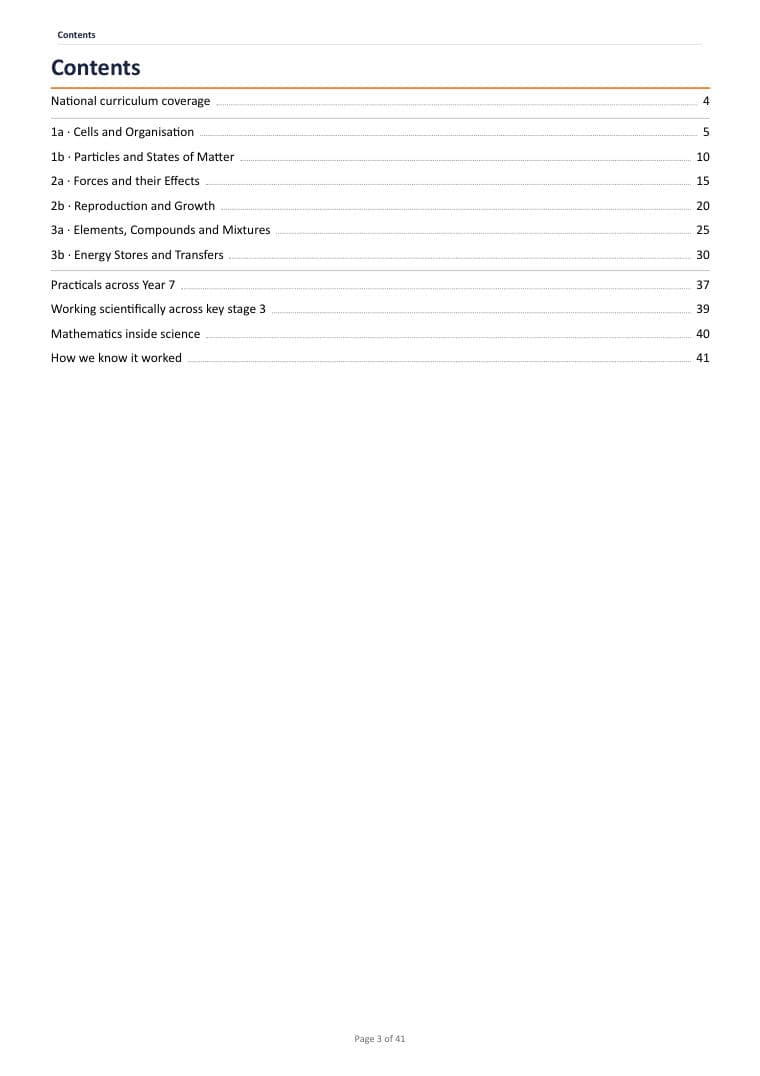
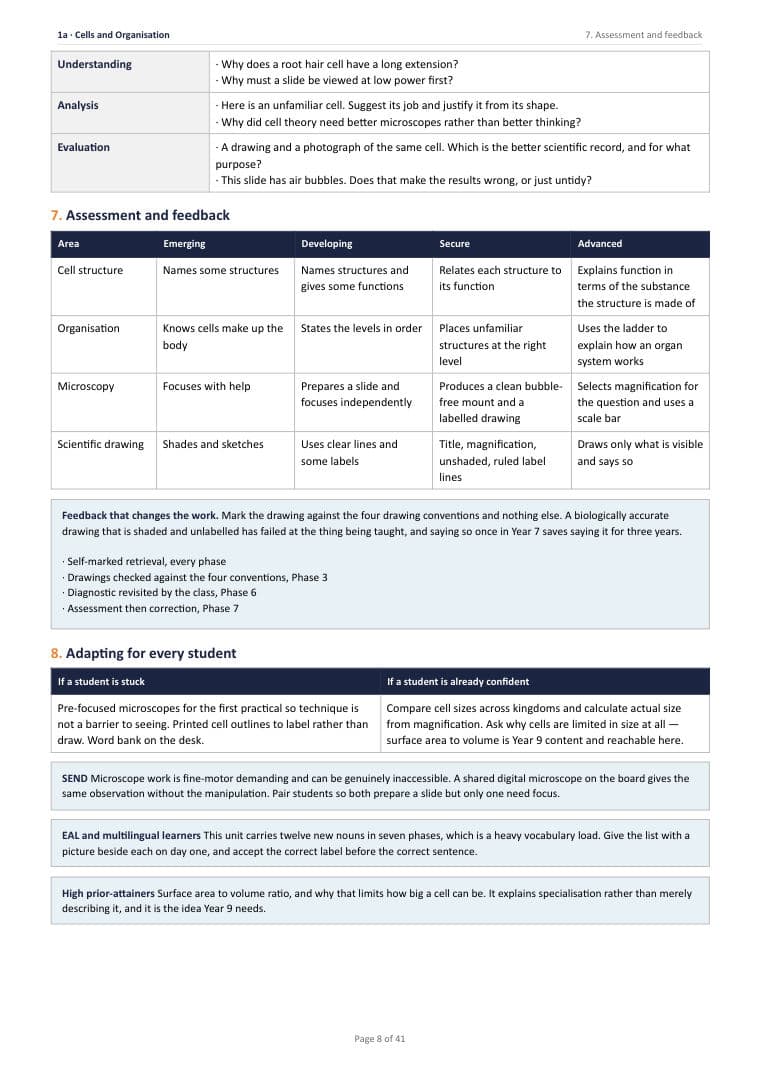
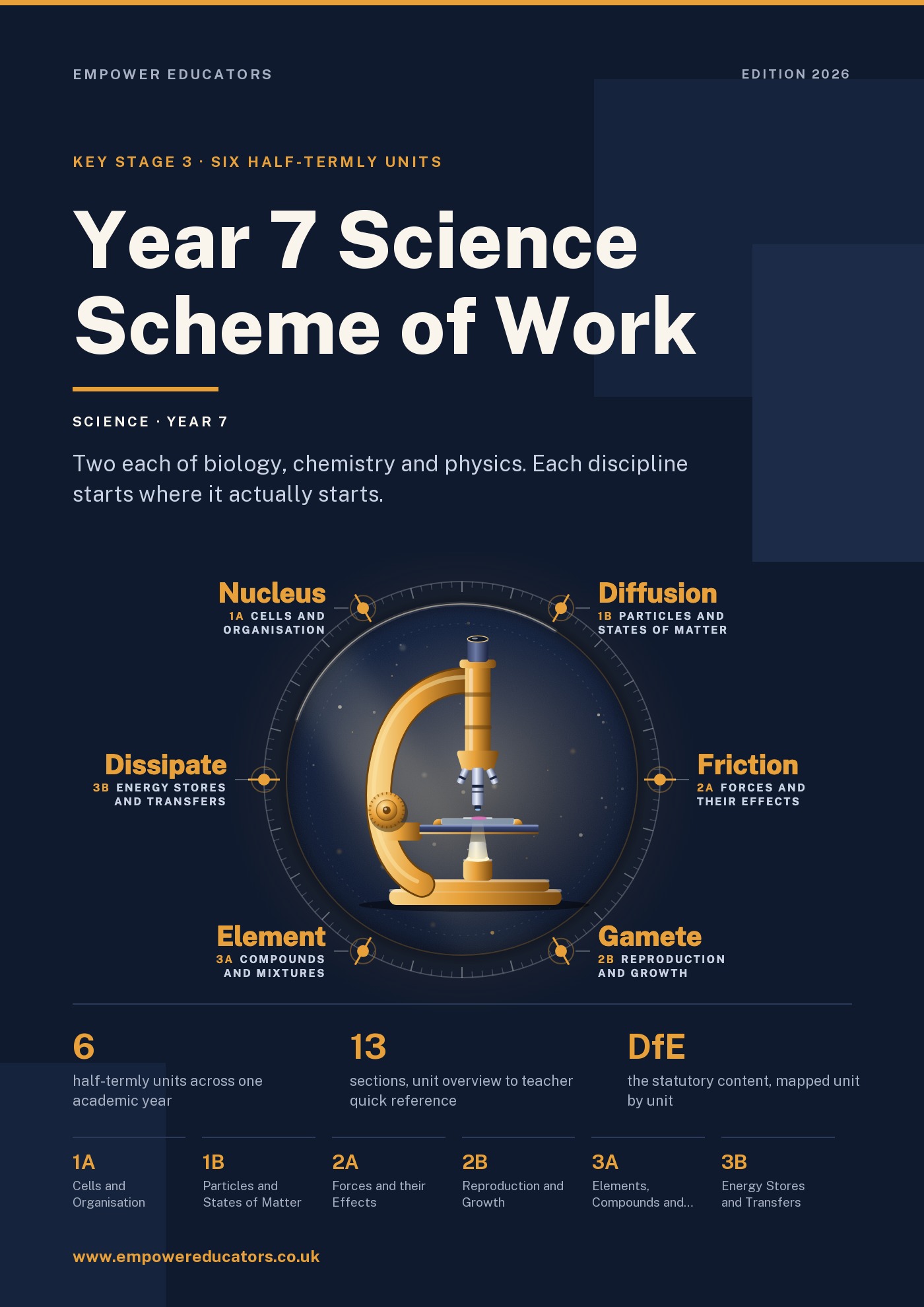
Six half-term units, two each for biology, chemistry and physics, in the order we teach them: cells and organisation, particles and states of matter, forces, reproduction and growth, elements, compounds and mixtures, and energy stores and transfers. Below is the question each unit asks, what pupils produce, the representation it carries forward and the scientific skill it builds, taken from our Year 7 Science scheme of work.
Six half-termly units, two per discipline. Each discipline starts where it actually starts: biology at the cell, chemistry at the particle model, physics at forces. Nothing else in key stage 3 works if these three are shaky.
Year 7 means ages 11–12, or S1 in Scotland.
The year, unit by unit
Cells and Organisation
Unit 1a · Biology · Autumn 1 · approx. 7 weeks · September – October
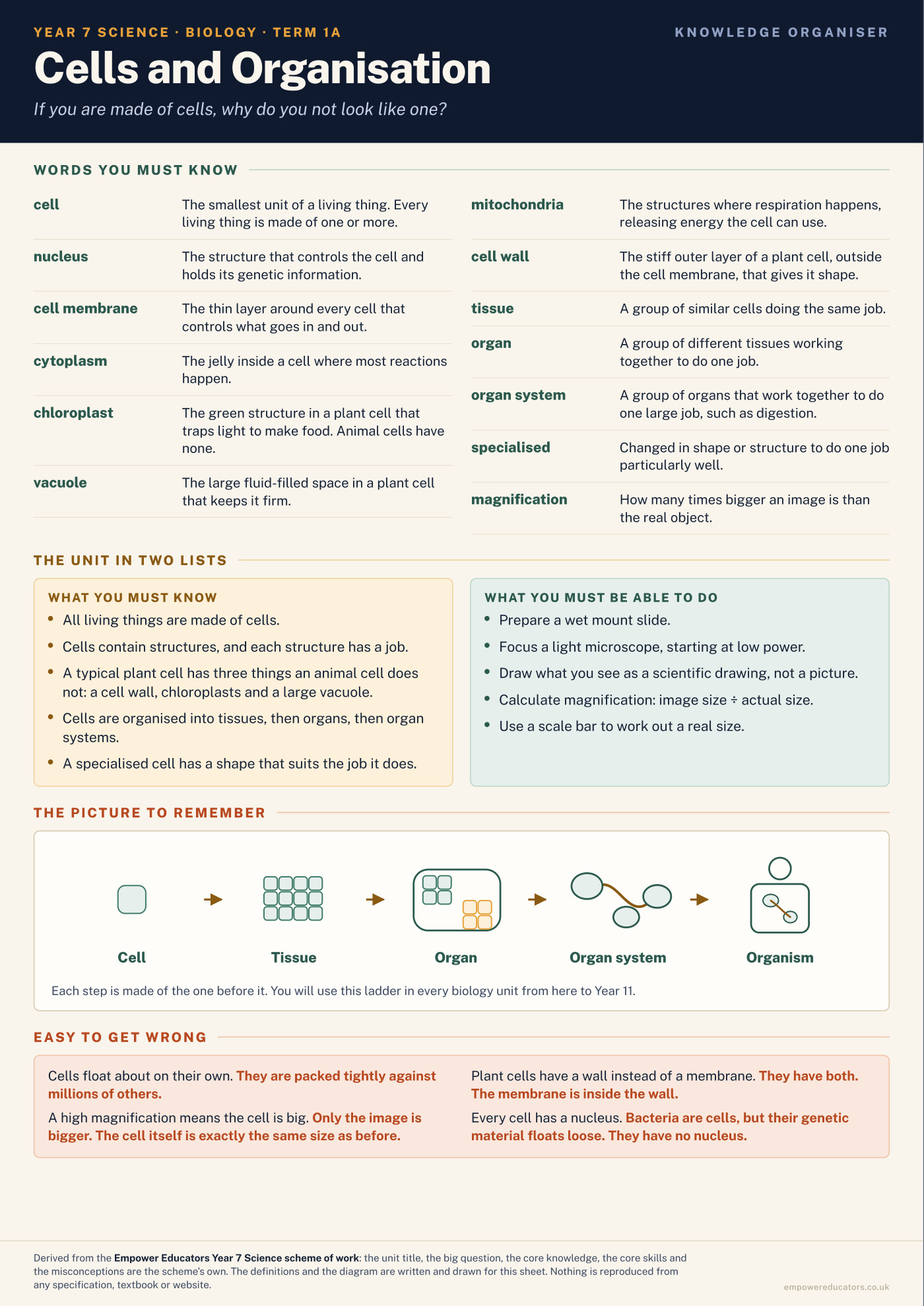
If you are made of cells, why do you not look like one?
Pupils produce
An annotated microscope drawing from the student's own slide, with a written account of how the cell's structures relate to its job.
Key representation
The levels-of-organisation ladder: cell → tissue → organ → system → organism, used in every biology unit that follows.
Working scientifically
Measuring and recording. First use of a precision instrument, and the first time a drawing is a scientific record rather than a picture.
Particles and States of Matter
Unit 1b · Chemistry · Autumn 2 · approx. 7 weeks · November – December
If nothing is added, why does a puddle disappear?
Pupils produce
A written explanation of three everyday changes of state in terms of particle arrangement, spacing and energy, with a cooling curve drawn from the class's own data.
Key representation
Particle diagrams — circles in three arrangements. Used in every chemistry unit for the next three years.
Working scientifically
Measuring and recording at intervals; plotting a line graph; using a model to explain rather than describe.
Forces and their Effects
Unit 2a · Physics · Spring 1 · approx. 7 weeks · January – February
If nothing is pushing it, why does a rolling ball stop?
Pupils produce
An investigation report on one factor affecting friction, with a results table, a graph, and a conclusion that states what the evidence does not show.
Key representation
Force arrows: length shows size, direction shows direction, drawn from the object. Used in every physics unit that follows.
Working scientifically
The first full investigation of the key stage. Independent, dependent and control variables named before any data is collected.
Reproduction and Growth
Unit 2b · Biology · Spring 2 · approx. 7 weeks · March – April
Why does a seed need a flower, and why do humans not?
Pupils produce
A comparison of human and flowering-plant reproduction, structured around the same four stages, with the adaptations of each explained rather than listed.
Key representation
The four-stage frame: make gametes → bring them together → fertilise → nourish the embryo. Applied to both organisms.
Working scientifically
Careful observation and recording during dissection; using a common framework to structure a comparison.
Elements, Compounds and Mixtures
Unit 3a · Chemistry · Summer 1 · approx. 7 weeks · April – May
Salt is made of a metal that explodes in water and a poisonous gas. Why can you eat it?
Pupils produce
A separation of a supplied mixture into its components, with each technique chosen and justified from the properties of what is being separated.
Key representation
Particle diagrams extended: one kind of circle for an element, joined circles for a compound, unjoined mixed circles for a mixture.
Working scientifically
Choosing a technique from evidence about properties, rather than following an instruction. First time the method is a decision.
Energy Stores and Transfers
Unit 3b · Physics · Summer 2 · approx. 7 weeks · June – July
If energy cannot be destroyed, why does your phone go flat?
Pupils produce
An energy transfer diagram for three everyday devices, each accounting for where the energy started, where it went, and why none of it was lost.
Key representation
Store-and-transfer diagrams: labelled boxes for stores, arrows for transfers, with the arrow widths meaning something.
Working scientifically
Accounting for a whole system; recognising that 'lost' energy has gone somewhere specific and saying where.
How it meets the key stage 3 programme of study
The scheme maps each requirement of the statutory programme of study for key stage 3 (Department for Education, 2013) to the unit that teaches it. Pupils should be taught to…
Working scientifically — scientific attitudes: pay attention to objectivity and concern for accuracy, precision, repeatability and reproducibility
Objectivity and accuracy established in 2a (variables and control) and 1b (measuring at intervals)
Working scientifically — experimental skills and investigations: ask questions, make predictions, select enquiry types and work safely
2a is the first full investigation · 3a chooses the method from properties · practicals in every unit
Working scientifically — analysis and evaluation: apply mathematical concepts, present data, identify patterns and assess error
1b cooling curves · 2a lines of best fit and anomalies · 3b efficiency as a proportion
Working scientifically — measurement: understand and use SI units and IUPAC chemical nomenclature
SI units from 1a onward, insisted on in 2a · chemical symbols and formulae in 3a
Biology: structure and function of living organisms · material cycles and energy · interactions and interdependencies · genetics and evolution
1a cells, specialisation and organisation · 2b reproduction in humans and flowering plants
Chemistry: the particulate nature of matter · atoms, elements and compounds · pure and impure substances · chemical reactions · energetics · the periodic table · materials · Earth and atmosphere
1b the particulate nature of matter · 3a atoms, elements, compounds, pure and impure substances
Physics: energy · motion and forces · waves · electricity and electromagnetism · matter · space physics
2a motion and forces · 3b energy stores, transfers and dissipation
This year deliberately does not cover chemical reactions, electricity, waves, photosynthesis, respiration or space. Each has a prerequisite that Year 7 is building: reactions need elements and compounds, electricity needs energy, photosynthesis needs both cells and reactions. All appear in Years 8 and 9, and the sequence is the reason they are not here. Earth and atmosphere is the one genuine gap in Year 7 and it is covered in Year 9 Unit 2b; if your department teaches it earlier, take it from Year 9 rather than adding it to an already full year.
The Year 7 Science resources
Two PDFs sit behind this page, and they are meant to be used together: the scheme of work to plan the year, the knowledge organisers to put in front of pupils.
The statutory programme of study for key stage 3 science (DfE, 2013)·41 pages, 13 sections·For heads of science, subject leaders, technicians and every teacher who has to deliver it
Written to Empower Educators Year 7 Science scheme of work·6 pages, 6 sections·For science teachers, technicians and heads of department. Printed one per pupil
Six half-term units, in the order they are taught: Cells and Organisation, Particles and States of Matter, Forces and their Effects, Reproduction and Growth, Elements, Compounds and Mixtures and Energy Stores and Transfers.
What do pupils produce in Year 7 Science?
An annotated microscope drawing from the student's own slide, with a written account of how the cell's structures relate to its job; A written explanation of three everyday changes of state in terms of particle arrangement, spacing and energy, with a cooling curve drawn from the class's own data; An investigation report on one factor affecting friction, with a results table, a graph, and a conclusion that states what the evidence does not show; A comparison of human and flowering-plant reproduction, structured around the same four stages, with the adaptations of each explained rather than listed; A separation of a supplied mixture into its components, with each technique chosen and justified from the properties of what is being separated; An energy transfer diagram for three everyday devices, each accounting for where the energy started, where it went, and why none of it was lost.
Does Year 7 Science meet the National Curriculum?
Yes, across the three years of key stage 3. It maps each requirement of the statutory programme of study for key stage 3 (Department for Education, 2013) to the unit that teaches it, and on this year the scheme is plain: “This year deliberately does not cover chemical reactions, electricity, waves, photosynthesis, respiration or space.”
Cookies
This site works the same either way. Measurement — Google Analytics and Microsoft Clarity — only runs if you say yes, and it is used to see which resources people actually reach.Measurement only runs if you say yes.What is collected.