Chemistry · KS3 to A Level · £4.99
Chemistry
Key Terms
Every word a chemistry department teaches, Year 7 to A Level, in one A4 book. Each key stage gets its own pages: the terms grouped the way they are taught rather than alphabetically, a definition that fits on two lines, and a worked example beside almost every one. Each key stage opens on a genuinely different model of the atom, drawn, because the real curriculum teaches three different ones in sequence — a Dalton-style particle scene at Key Stage 3 (the national curriculum names only that model, not the electron), a nucleus and electron shells at GCSE, and an electron-configuration diagram with a mass-spectrum inset at A Level — and the numbers on each appear again beside the same words in the list; a further twenty-one pages carry a real drawn figure wherever a picture genuinely teaches faster than a sentence: a reaction profile's hump, a titration curve's end point, the three ways atoms bond, Le Chatelier's balance tipping. Then a page on using the words: the ones the assessment itself is written in, the false friends that mean something else in a chemistry classroom — a solution is not an answer to a problem, reduce is not making something smaller, a radical is not extreme — the same point written weakly and then properly, and what each word becomes at the next key stage.
£4.99The whole book, Year 7 to A Level, 12 pages
- A4 PDF
- every page shown, part-blurred
- instant download
One purchase covers the school that buys it. Print it, copy it, hand it round your department. Not for passing to other schools or uploading anywhere.
PDF download, ready straight after payment. Downloading it ends the 14-day right to cancel; a file that is faulty or not as described is always refunded. Refunds
Read before publication by the serving head of that department and by senior leaders, in school.
5.0 from 24+ reviews on Google
Schools that have bought from Empower Educators include Nottingham High School, Northampton High School GDST and Sutton Valence School.
Everything else this site has for Chemistry: Chemistry teaching resources
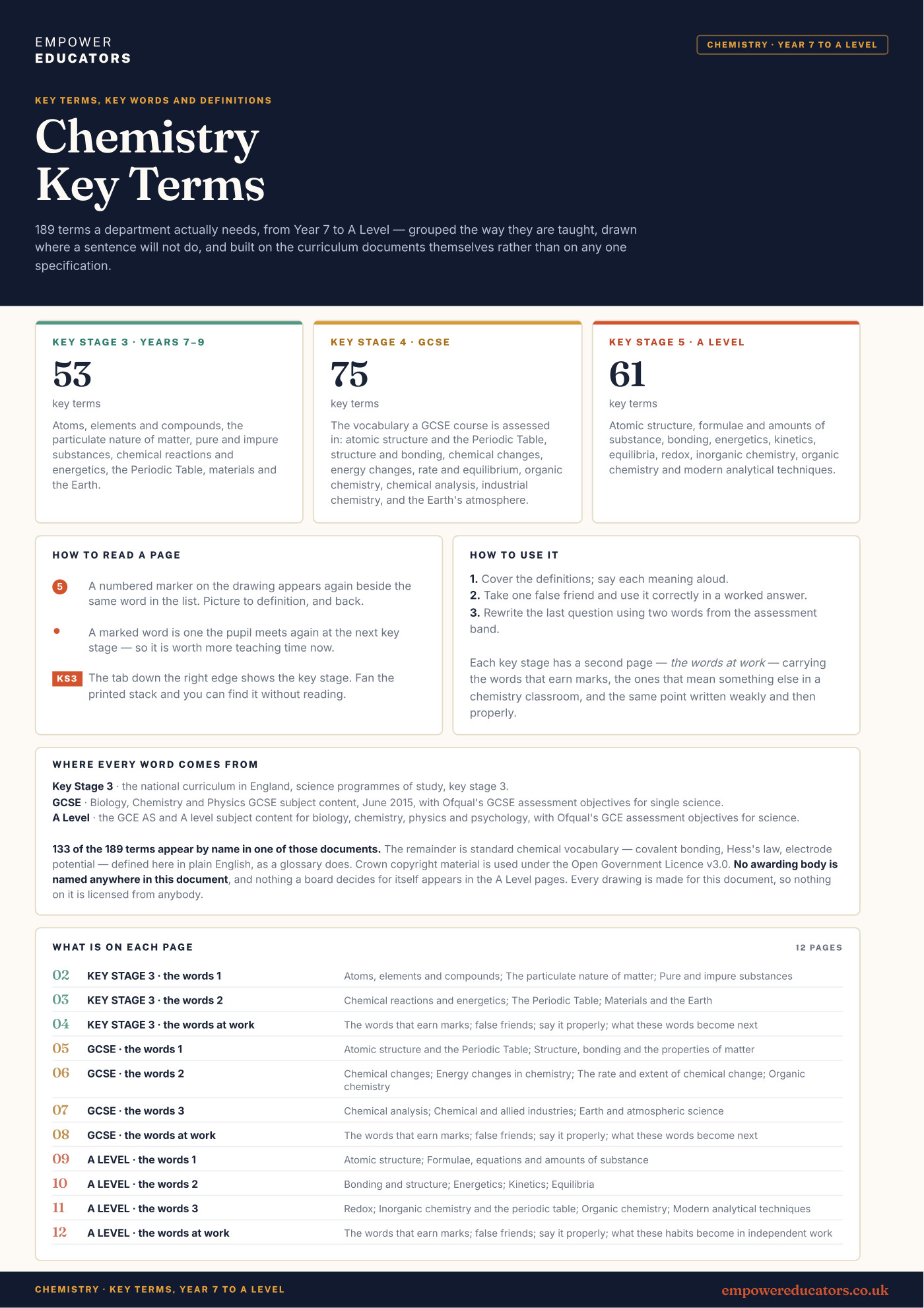
A pupil who knows a word is not yet using it. This book is built around that gap. The words for each key stage sit in the groups they are taught in, each with a short definition and a worked example, and a marked word is one the pupil meets again at the next key stage, so a department can see where its vocabulary carries forward and where it changes name. Every key stage opens on one drawing of the atom — but a genuinely different one each time, because the curriculum itself teaches three different models in sequence, not one model redrawn at increasing detail. Key Stage 3's own national curriculum names only "a simple (Dalton) atomic model" — no nucleus, no electron — so that page draws sodium and chlorine atoms joining into table salt, nothing more. GCSE is the first stage that actually introduces the nucleus and electron shells, so that is GCSE's page. A Level moves past shells to energy levels and orbitals, with a small mass-spectrum chart for isotopes. Twenty-one further pages carry a real drawn figure wherever the idea is genuinely easier to see than to read: the particle spacing behind a solid, a liquid and a gas; a filtration funnel; the three ways atoms bond, side by side; a reaction profile's hump measuring activation energy; a titration curve's sudden jump at the end point; an equilibrium's balance tipping under a stress.
Every key stage closes on a page about using the words. The words the assessment is written in, quoted from Ofqual where they are theirs — including the rule, doubled from biology's, that mathematical skills must make up at least a fifth of an A Level chemistry assessment. The false friends: a solution is a liquid with something dissolved in it, not an answer to a problem; to reduce a substance is to give it electrons, not make it smaller; a radical is a species with an unpaired electron, not an extreme view — each a word a pupil already owns in another sense, contrasted with what it actually means here. The same point written weakly and then properly. And a table of what each habit is called at the next stage, so "balancing a symbol equation" at GCSE is already "calculating reacting quantities using moles and concentrations" by the time it is assessed at A Level. Nothing a board decides for itself is in it, and no diagram is traced from a real textbook figure or exam paper: every atom, every reaction profile and every graph was drawn for the book.
- Written to
- The DfE's science programmes of study at Key Stage 3 (September 2013, DFE-00185-2013), the Biology, Chemistry and Physics GCSE subject content (June 2015, DFE-00352-2014), and the GCE AS and A level subject content for biology, chemistry, physics and psychology (April 2014, DFE-00356-2014); GCSE and A Level also follow Ofqual's subject-level conditions, which set the assessment objectives quoted on the words-at-work pages, including the rule that mathematical skills make up at least 20% of an A Level chemistry assessment, double biology's 10%; 133 of 189 terms appear by name in one of those documents and the cover says so, the rest are standard chemical vocabulary defined here in plain English; no awarding body is named, and nothing a board decides for itself appears in the A Level pages
- Intended for
- chemistry departments: printed one per pupil, kept in the front of an exercise book, or put on the wall by key stage
- Extent
- 12 pages · 11 sections
Look inside
Real pages, straight from the PDF
Click any page to see it full size.
Contents
All 11 sections
Taken from the book’s own contents page, so the page numbers are the real ones.