New · Free · AQA GCSE Biology
Biology Paper 1: a free revision guide, built from AQA’s own papers
Written for AQA GCSE Biology (8461), Paper 1. Every topic on two pages, exam questions answered and marked in red pen, the graph and maths skills the paper really tests, a six-mark planning page and a practice paper with answers. Print it as a class set and use it from tomorrow.
Thank you. Your download is ready.
Download the PDF — 4.1MB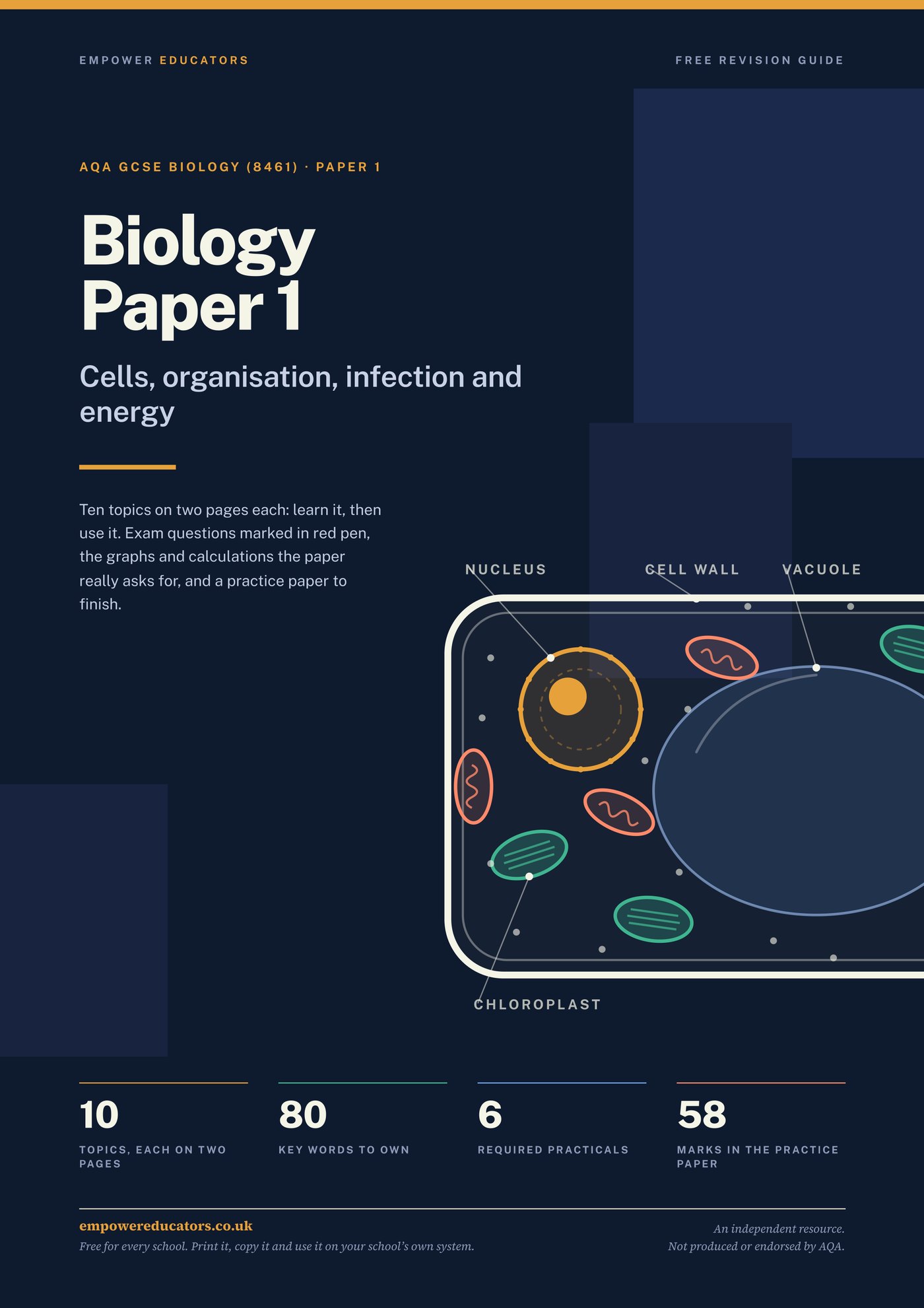
Look inside before you download
The first eight pages, free to read here with no watermark. Click a page to read it larger.
A guide that asks pupils to do something
1
Learn it
Every topic opens with sixty seconds of the topic, then the facts to know. Each fact has a circle to colour: know it, shaky, missed. The key words sit beside them with a box to tick, and a Spot it question on a sticky note tests one idea.
2
Use it
Then the page turns to a diagram or table, an exam question answered and marked in red pen (a few lose marks, so pupils see why), the ways the topic could be asked, and a blank box. Cover both pages and write the answer from memory.
3
Test it
Pages for the maths the paper tests, graphs and data, the six required practicals and planning an investigation. Two six-mark answers, marked, and a page of what AQA’s examiners saw students get wrong. Then a practice paper with its answers, and a tracker.
Every Paper 1 topic, and the skills
- Inside the cell
- Mitosis and stem cells
- Diffusion, osmosis and active transport
- Enzymes and digestion
- The heart and blood
- Risk factors and cancer
- Water and sugar in plants
- Pathogens, defence and medicines
- Photosynthesis
- Respiration and metabolism
That is topics 1 to 4 of the specification: cell biology, organisation, infection and response, and bioenergetics. Paper 2 is not in this guide.
Built from AQA’s own documents
- The facts follow AQA’s GCSE Biology specification (8461).
- The exam advice comes from AQA’s own Paper 1 papers, mark schemes and examiners’ reports (November 2021, June 2022 and June 2023), and its command words list.
- No AQA question or mark scheme is copied. Every question in the guide was written for it.
- It is an independent resource, not produced or endorsed by AQA.
This is the first edition, and a serving science teacher has not read it through yet. If you teach GCSE Biology and spot anything that should change, tell us at info@empowereducators.co.uk and we will fix it.
The six required practicals, and what AQA asks about each
Page 26 of the guide covers six required practicals: the aim as the specification words it, and what AQA’s papers have asked about each one. An extract of each:
| Practical | The aim | What gets asked |
|---|---|---|
| 1. Microscopy | Observe, draw and label plant and animal cells, with a magnification scale. | Why thin (see single cells), why iodine (stain the structures), why the angle (no air bubbles). |
| 2. Antibiotics on bacteria (Biology only) | Investigate antiseptics or antibiotics on bacterial growth using agar plates and zones of inhibition. | A disc with no antibiotic is the control. Bigger clear zone, more effective: compare areas (πr²). |
| 3. Osmosis | Investigate a range of salt or sugar concentrations on the mass of plant tissue. | Dry the surface before weighing, or liquid adds mass. Percentage change. |
| 4. Food tests | Use qualitative reagents on carbohydrates, lipids and proteins. | Benedict's (heat) for sugars. Iodine for starch. Biuret for protein (it turns purple). |
| 5. pH and amylase | Effect of pH on the rate of reaction of amylase. Continuous sampling. | Iodine every 30 seconds, until it stays orange-brown. Water bath for temperature. Time taken is the measure. |
| 6. Light and photosynthesis | Effect of light intensity on the rate of photosynthesis with an aquatic organism such as pondweed. | Vary the lamp distance. Count bubbles or measure oxygen. |
A marked question from the guide
An image of a cell is 3.6 cm long. The magnification is ×1200. Calculate the real length of the cell in micrometres (µm).
[3 marks] 1 for the rearranged formula. 2 for the working, in matching units. 3 for 30 µm.
From page 5, Topic 1, Inside the cell. Every topic in the guide gets a spread like this: the facts on one page, an exam question answered and marked in red pen on the other.
Why it is free
We write exam board books for heads of department, and we sell them. This guide is one we give away. It shows how we work: the content follows the exam board’s own list, the exam advice comes from its own papers, and nothing is there to pad the page count.
If it helps your pupils, the rest of the Biology shelf is below. If it does not, you have lost nothing.
For the teacher printing it
Print it double-sided. Black and white works, though the cover is navy and the red pen shows as grey. Use it as a class set, or put it on your school’s own system. The contents page has a four-week plan, and the tracker at the back lets a pupil see what they have revisited.
Please do not pass it to other schools or put it on public websites.
Questions teachers ask
- Is it really free?
- Yes. We ask for a name and an email address, and one question: would you like to hear about new resources? Yes or no, you get the guide either way.
- Which course does it cover?
- AQA GCSE Biology (8461), Paper 1: cell biology, organisation, infection and response, and bioenergetics. Paper 2 (homeostasis, inheritance and ecology) is not in it.
- Is it for Combined Science?
- AQA Combined Science: Trilogy (8464) shares much of this content, but its papers are different. Items marked Biology only in the guide are not in Trilogy, so check your own specification.
- Is it for Foundation or Higher tier?
- Both. Content for Higher tier only is marked HT, so Foundation pupils can skip it.
- Is it written by AQA?
- No. It is independent and is not produced or endorsed by AQA.
The rest of the Biology shelf
-
 The Science playbook The science department’s playbook, with Biology inside it.
-
 Schemes of work Year 10 to Year 11, unit by unit and in teaching order.
-
 Exam board playbooks The science department’s books, one for each board.
-
 GCSE questions and answers A hundred questions, each answered weak, middling and strong.
-
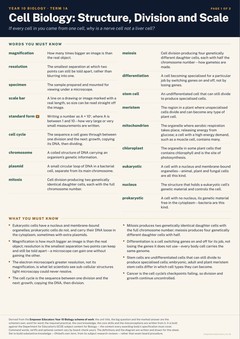 Knowledge organisers Year 10 to Year 11. Two A4 pages a unit.
-
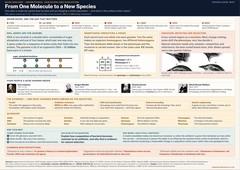 GCSE knowledge mats One landscape sheet a topic.
-
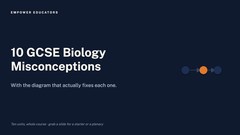 GCSE PowerPoints Ten misconceptions, one to a slide, each fixed with its own diagram.
-
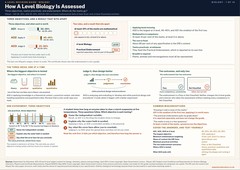 A Level revision guide The core ideas beside a figure, worked examples and the misconceptions that cost marks.
- Free exam questions and answers Exam-style questions with the answer to check against, on the page. No sign-up.
-
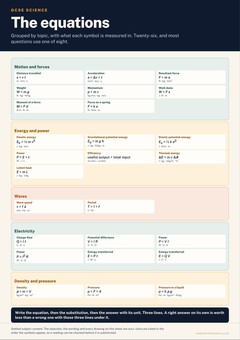 Free A3 science posters Six posters for the laboratory wall: equations, units, hazard symbols and the rules for a graph.