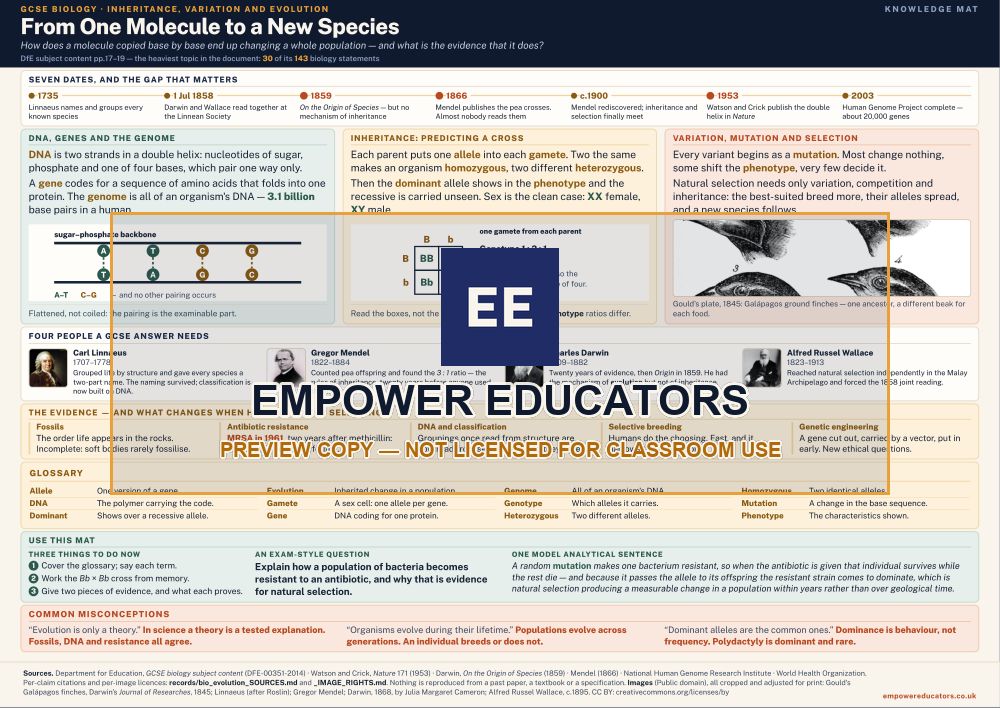
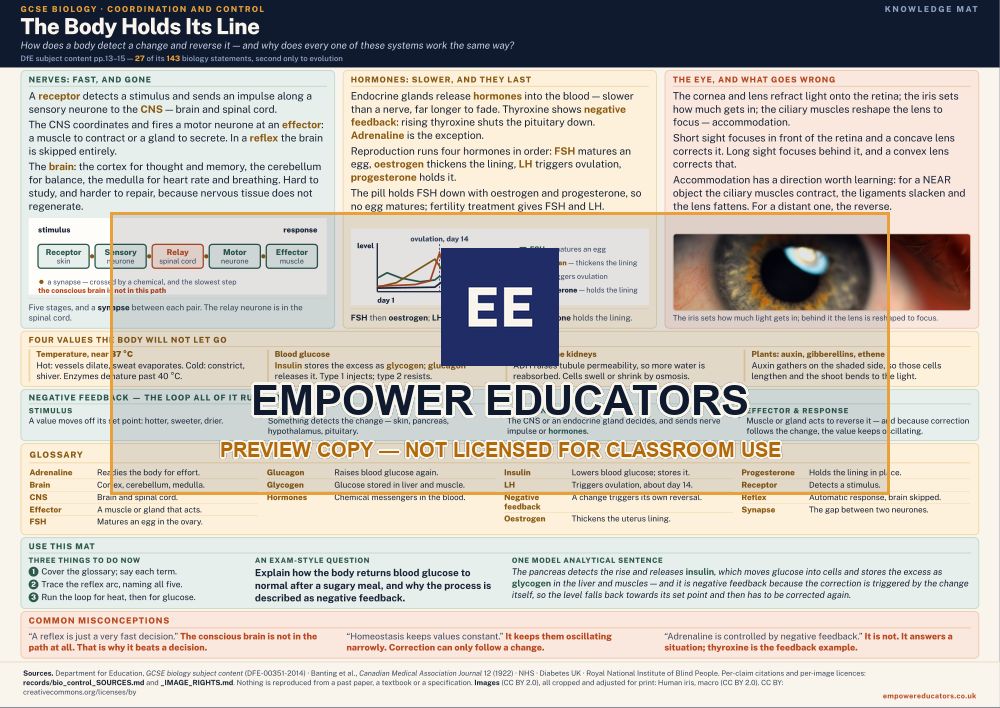
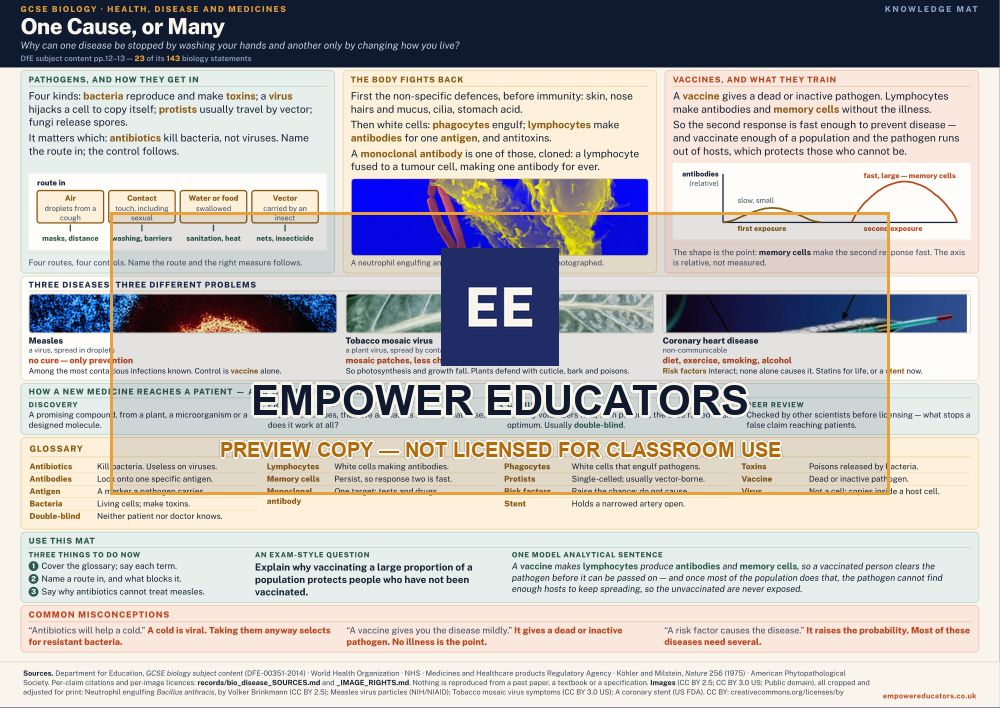
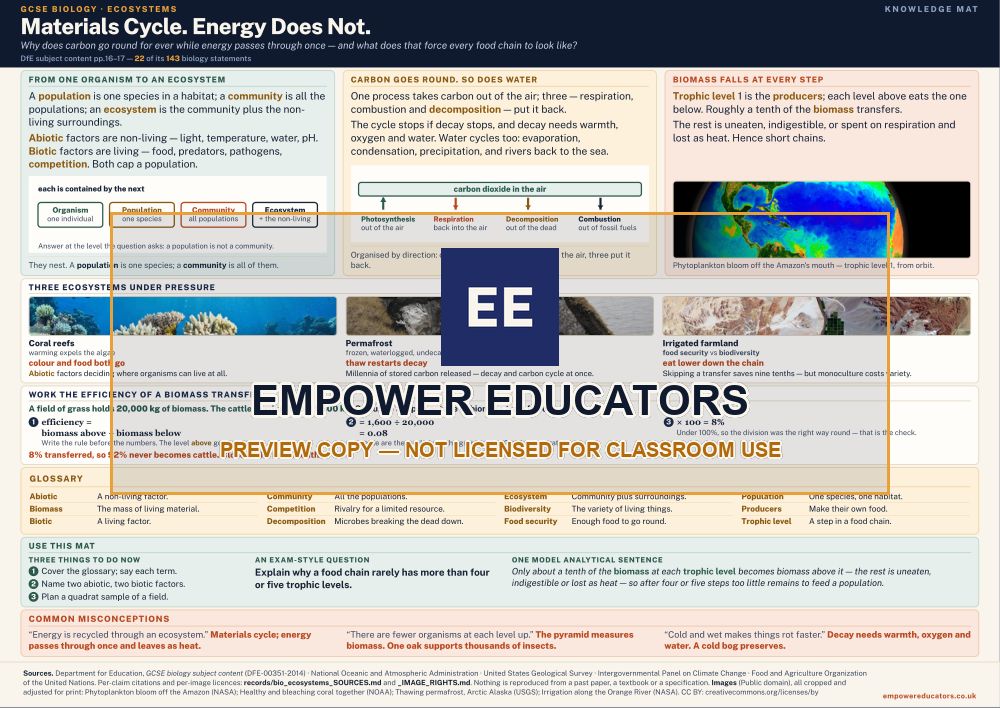
All 4 sheets — Inheritance, variation and evolution, Coordination and control, Health, disease and medicines and Ecosystems — for £3.99. One landscape page per topic,
every claim sourced and every image licensed.
4 sheets · one A4 landscape PDF each · instant download
Bought once for the set, not per sheet. Photocopy them for your classes freely — keep
the running foot on the page, which carries the image credits the licences require.
How a molecule copied base by base ends up changing a whole population — and the evidence that it does. Seven dates across the top, from Linnaeus to the Human Genome Project; DNA and the genome; predicting a cross with a Punnett square; variation, mutation and selection under Gould's finches; the four people a GCSE answer needs; the evidence, from fossils to MRSA, and what changes when humans do the selecting. Twelve terms to define, a model answer on antibiotic resistance, and the misconceptions that cost marks.
How a body detects a change and reverses it — and why every one of these systems works the same way. Nerves and the reflex arc; the brain; hormones, with the menstrual cycle drawn as four hormones across 28 days, contraception and fertility treatment; the eye and its defects; the four values the body will not let go — temperature, glucose with insulin and glucagon, water, and plant hormones — and the negative-feedback loop that runs all of it. Sixteen terms to define, a model answer on blood glucose, and the misconceptions that cost marks.
Why one disease can be stopped by washing your hands and another only by changing how you live. Four pathogens and four routes in, each with the control that blocks it; the body's defences, from skin to lymphocytes, and monoclonal antibodies; vaccines and the immune response drawn as a graph; measles, tobacco mosaic virus and coronary heart disease side by side; how a new medicine reaches a patient, from discovery to peer review. Fifteen terms to define, a model answer on herd immunity, and the misconceptions that cost marks.
Why carbon goes round for ever while energy passes through once — and what that forces every food chain to look like. Organism to ecosystem, abiotic and biotic factors; the carbon and water cycles and what stops decay; biomass falling at every trophic level, with a worked efficiency calculation; coral reefs, permafrost and irrigated farmland under pressure. Twelve terms to define, a model answer on why food chains are short, and the misconceptions that cost marks.
The previews above are the full sheets, watermarked. Where a sheet carries photographs,
every one is public domain worldwide or licensed CC BY, verified per image against the
licence itself rather than a label, and the running foot names every creator, records that
the images have been cropped and adjusted for print, and links the licence; figures are
drawn in code for the sheet, and extracts are written for it or verified against a
public-domain text. Nothing on any sheet is reproduced
from a past paper, a mark scheme, an examiner report or a specification, and Empower
Educators is not affiliated with any awarding body.
Cookies
This site works the same either way. Measurement — Google Analytics and Microsoft
Clarity — only runs if you say yes, and it is used to see which resources people
actually reach. What is collected.