Biology · GCSE · £6.99
GCSE Biology
Questions
& Answers
Six marks in ten on a biology paper are for applying and analysing, and the commonest way to lose them is to write something true — a sentence about mitochondria that would be just as correct on a page about a muscle cell. Every page here names what the question demanded and the answer never touched. The mark schemes carry the allow and do not accept lines a real scheme has and a textbook never does; at six marks they become level descriptors, with the one move that lifts a response from one band to the next written out in a sentence.
£6.99100 questions, each answered three times (weak, middling, strong), 107 pages
- A4 PDF
- first 14 pages free to read
- instant download
One purchase covers the school that buys it. Print it, copy it, hand it round your department. Not for passing to other schools or uploading anywhere.
PDF download, ready straight after payment. Downloading it ends the 14-day right to cancel; a file that is faulty or not as described is always refunded. Refunds
Read before publication by the serving head of that department and by senior leaders, in school.
5.0 from 24+ reviews on Google
Schools that have bought from Empower Educators include Nottingham High School, Northampton High School GDST and Sutton Valence School.
Complete your Biology

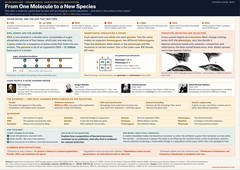
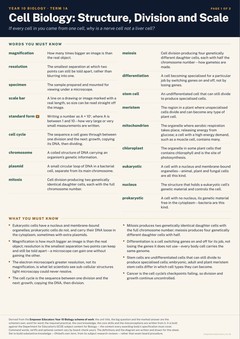
Everything else this site has for Biology: Biology teaching resources
Also teaching biology lower down the school, or the exam itself? Biology scheme of work · GCSE Biology assessment objectives
- 1Cell biology and microscopy
- 2Organisation and transport
- 3Infection and response
- 4Bioenergetics
- 5Homeostasis and response
- 6Inheritance, variation and evolution
- 7Ecology
- 8Apparatus and techniques
- 9Working scientifically
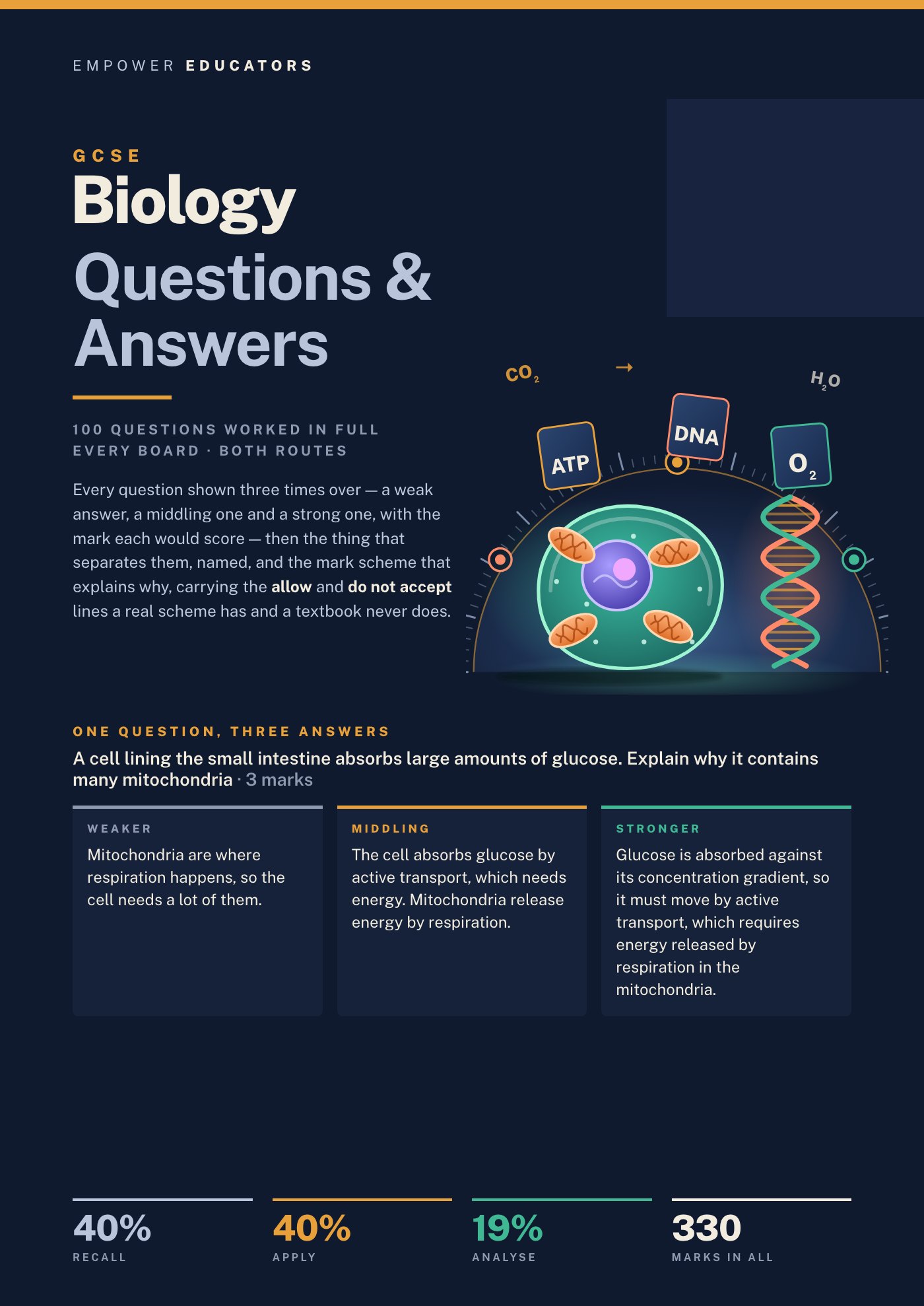
Not a bank of questions with the answers printed underneath. The three banded responses are the starting point, not the output: what follows each one is the discriminator, named out loud, then the questions you actually ask to move a student from the first answer to the last, then the mark scheme that shows what each line was worth. That combination is the part no mark scheme contains on its own.
The mark schemes are the reason this book is longer to read than the others in the series. Below six marks a science question is point marked, and every page carries the two lines that decide most borderline answers: what is allowed (the wordings a marker still credits) and what is not accepted, which is where a mark goes for a word rather than for the biology. At six marks the scheme becomes level marked, with three descriptors and one sentence on what actually lifts a response a band, which is never a further fact and always a further move.
Every question is written to a statement in the Department for Education’s subject content for GCSE biology, the document all four boards build their specifications on. That is checked on every build rather than asserted here. No board is named anywhere in the book. Nothing is copied from a past paper, a mark scheme or an examiner report, no candidate’s script appears in it, and every figure is drawn in code, so there is no picture credit to clear before teaching from any page.
Tier and route are marked on the page rather than split into separate books. Eight questions are Higher tier and ten are required only by the separate biology GCSE; combined science is a subset of separate and Higher includes all of Foundation, so one book serves every class and each simply skips the pages its route does not need. The last sixteen questions are about apparatus and about working scientifically: reading an anomaly, telling accuracy from precision, and saying what a set of results will and will not support.
- Written to
- The GCSE subject content for biology published by the Department for Education, which every board builds its specification on, and the three assessment objectives set by Ofqual
- Intended for
- biology and science teachers and heads of department. Used with a class, not a student revision guide
- Extent
- 107 pages · 9 sections
Sample questions
Sample GCSE Biology questions and answers
Eight questions from the book, printed exactly as they appear in it: the question, the answers it works through, and the mark each one scores. All of them are in the free preview.
Question 1·Cell biology and microscopy·1 mark
Name the structure that controls what enters and leaves an animal cell.
Weaker0 marks
The cell wall.
Middling1 mark
The membrane.
Stronger1 mark
The cell membrane.
What separates them
A one-mark Name question has no partial credit and no room to recover, which makes it the purest test of whether a fact is known or nearly known. The first answer is a plant structure given for an animal cell, and it is the commonest wrong answer here because both words begin with cell and both sit at the outside. The second is accepted: mark schemes credit the shortened form where no other membrane in the question could be meant. Note what the command does not ask for — no function, no explanation. Anything written after the name is time spent for nothing.
The full-mark answer1 mark
Cell membrane.
Question 2·Cell biology and microscopy·2 marks
Give two structures found in a plant cell that are not found in an animal cell.
Weaker1 mark
Chloroplasts and a nucleus.
Middling2 marks
Cell wall and chloroplast.
Stronger2 marks
A cell wall made of cellulose, and a permanent vacuole containing cell sap.
What separates them
One correct structure and one that both cells have, so it scores one. That is the shape of nearly every lost mark on this question: not ignorance of plant cells, but forgetting that the question is a difference question. A nucleus is in both, so naming it answers nothing. The third answer earns no more than the second — the detail is free — but it is worth seeing, because permanent vacuole is the word that separates it from the small temporary vacuoles an animal cell can have.
The full-mark answer2 marks
Cell wall and permanent vacuole. (Chloroplast is also accepted.)
Question 3·Cell biology and microscopy·2 marks
Describe the function of the mitochondria.
Weaker0 marks
They make energy for the cell.
Middling2 marks
Mitochondria release energy from glucose. This happens by respiration.
Stronger2 marks
Aerobic respiration takes place in the mitochondria. Glucose reacts with oxygen and the energy transferred is used by the cell for movement, warmth and building larger molecules.
What separates them
‘They make energy’ is not badly expressed — it is scientifically wrong, and it is the single most common wrong answer in GCSE biology. Energy is not made. It is not created, produced or generated; it is transferred from one store to another, and a mark scheme that says reject 'produces energy' means the word costs the mark however good the rest of the sentence is. The middling answer earns both marks in eleven words. The stronger answer is worth reading not because it scores more — it cannot — but because it is what the same knowledge looks like when the question is worth four.
The full-mark answer2 marks
Aerobic respiration takes place in the mitochondria, releasing energy from glucose for the cell to use.
Question 4·Cell biology and microscopy·3 marks
Describe how a light microscope and an electron microscope differ.
Weaker0 marks
An electron microscope is better than a light microscope because you can see more with it.
Middling2 marks
An electron microscope has a much higher magnification than a light microscope, so it can show smaller structures. It uses electrons rather than light.
Stronger3 marks
A light microscope uses light and has a magnification of up to about ×2000; an electron microscope uses a beam of electrons and reaches around ×2,000,000. The electron microscope also has much higher resolving power, so two points close together are still seen as two points and sub-cellular structures such as ribosomes become visible. It is, however, large, expensive and cannot be used on living specimens.
What separates them
‘Better’ is not a difference; it is a verdict, and a mark scheme cannot credit it because it does not say what is different. The middling answer scores well and stops one idea short of the mark that most students miss: resolution. Magnification and resolution are not the same property. Magnification makes an image bigger; resolution decides whether making it bigger reveals anything new. A photograph enlarged past its resolution is a larger blur, and that is precisely why a light microscope cannot show a ribosome however far you magnify it.
The full-mark answer3 marks
A light microscope uses light and magnifies up to about ×2000. An electron microscope uses a beam of electrons and magnifies up to about ×2,000,000. It also has a much higher resolving power, so it reveals sub-cellular structures such as ribosomes that a light microscope cannot resolve.
Question 5·Cell biology and microscopy·4 marks
Describe what happens to the chromosomes during mitosis.
Weaker1 mark
The chromosomes split in half and go into the two new cells, which are identical.
Middling3 marks
The chromosomes line up in the middle of the cell and the copies are pulled to opposite ends by the spindle fibres. The cell then divides into two identical cells.
Stronger4 marks
Before mitosis begins the DNA replicates, so each chromosome consists of two identical copies joined together. The chromosomes then line up along the centre of the cell, and the spindle fibres pull one copy of each chromosome to each pole. The nucleus divides, and finally the cytoplasm and cell membrane divide to form two genetically identical daughter cells.
What separates them
‘Split in half’ is a specific and damaging error, not a loose phrase. Chromosomes are not halved in mitosis — they are copied, and each daughter cell receives a full set. A student who writes split here will write it again in meiosis, where it is closer to true, and never be able to tell the two processes apart. The middling answer has the sequence right but omits the replication happening before division, which is the step that makes the answer make sense: without it, two identical full sets appearing from one is impossible.
The full-mark answer4 marks
Before mitosis begins the DNA replicates, so each chromosome becomes two identical copies joined together. The chromosomes line up along the centre of the cell. Spindle fibres pull one copy of each chromosome to each end of the cell. The nucleus divides, then the cytoplasm and membrane divide, forming two genetically identical cells.
Question 7·Cell biology and microscopy·2 marks
Convert 0.008 mm into micrometres.
Weaker1 mark
0.008 ÷ 1000 = 0.000008 µm
Middling2 marks
1 mm = 1000 µm, so 0.008 × 1000 = 8 µm
Stronger2 marks
There are 1000 µm in 1 mm. A micrometre is smaller than a millimetre, so the number must get bigger: 0.008 × 1000 = 8 µm.
What separates them
Both wrong and right answers here used the same conversion factor. The only difference is the direction, and direction is decided by one question: is the new unit bigger or smaller than the old one? Smaller unit, bigger number — a rope is fewer metres long than it is centimetres. The first answer earns a mark for knowing the factor of 1000 and loses the second for multiplying the wrong way, which produced a length far smaller than an atom without the student noticing.
The full-mark answer2 marks
1 mm = 1000 µm, so 0.008 mm = 0.008 × 1000 = 8 µm
Question 8·Cell biology and microscopy·3 marks
A cell lining the small intestine absorbs large amounts of glucose. Explain why this cell contains many mitochondria.
Weaker1 mark
Mitochondria are where respiration happens, so the cell needs a lot of them.
Middling3 marks
The cell absorbs glucose by active transport, which needs energy. Mitochondria release energy by respiration, so having many of them supplies the energy the cell needs.
Stronger3 marks
Glucose is absorbed against its concentration gradient, from a lower concentration in the gut to a higher concentration in the cell, so it must move by active transport. Active transport requires energy, which is released by aerobic respiration in the mitochondria. Many mitochondria therefore release energy at the rate this cell needs it.
What separates them
Entirely true, and an answer to a different question. It says what mitochondria do, which is recall, and never mentions glucose, absorption or this particular cell — it would be exactly as true written on a page about a muscle cell or a root hair. That is the defining failure of an AO2 question: a correct sentence that does not touch the situation in front of it. The test is blunt. If the answer would be unchanged had the question described a different cell, it has not applied anything.
The full-mark answer3 marks
Glucose is absorbed against the concentration gradient, so it moves by active transport. Active transport requires energy. That energy is released by respiration in the mitochondria, so a cell doing a great deal of it needs many mitochondria.
Question 50·Homeostasis and response·3 marks
Describe the effect of ADH on the kidney.
Weaker1 mark
ADH makes the kidney produce less urine when you need to save water.
Middling3 marks
ADH increases the permeability of the kidney tubules to water. More water is reabsorbed back into the blood, so a smaller volume of more concentrated urine is produced.
Stronger3 marks
ADH is released by the pituitary gland when the water content of the blood is too low. It increases the permeability of the walls of the kidney tubules, so more water is reabsorbed from the filtrate back into the blood. A smaller volume of more concentrated urine is produced, and the water content of the blood returns towards normal.
What separates them
Outcome given, mechanism skipped — which is what happens when a topic is learned from what it achieves rather than from what it does. The word that carries the marks here is permeability: ADH does not pump water and does not create urine, it changes how easily water passes through a tubule wall. Everything else — less urine, more concentrated urine, more water in the blood — follows from that one change, and an answer that reaches the outcome without passing through it has described a result rather than an effect.
The full-mark answer3 marks
ADH increases the permeability of the kidney tubules to water. More water is therefore reabsorbed from the filtrate into the blood, and a smaller volume of more concentrated urine is produced.
Look inside
Real pages, straight from the PDF
Click any page to see it full size.
Contents
All 9 sections
Taken from the book’s own contents page, so the page numbers are the real ones.