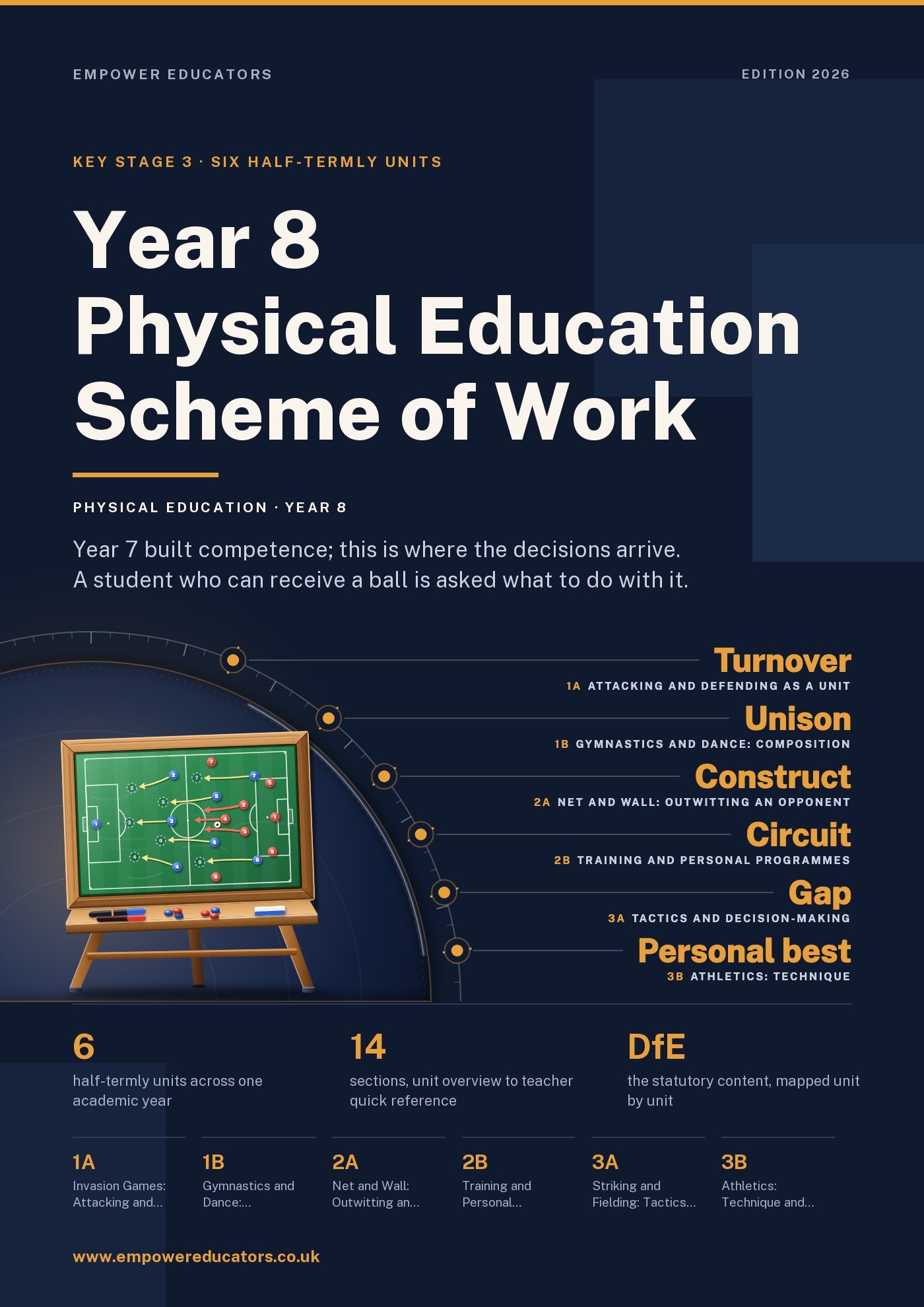
Six half-term blocks, one per strand, each naming the Year 7 block it assumes: attacking and defending as a unit, gymnastics and dance composition, outwitting an opponent at net and wall, training and personal programmes, striking and fielding tactics, and athletics technique. Below is the activity each block uses, what pupils achieve by the end of it and the skills it teaches, taken from our Year 8 PE scheme of work.
Six half-termly blocks, one per strand. The order down the page is one workable rotation, not an instruction. Every block here names the Year 7 block it assumes, and that dependency is the one thing a rotation must not break.
Year 8 means ages 12–13, or S1–S2 in Scotland.
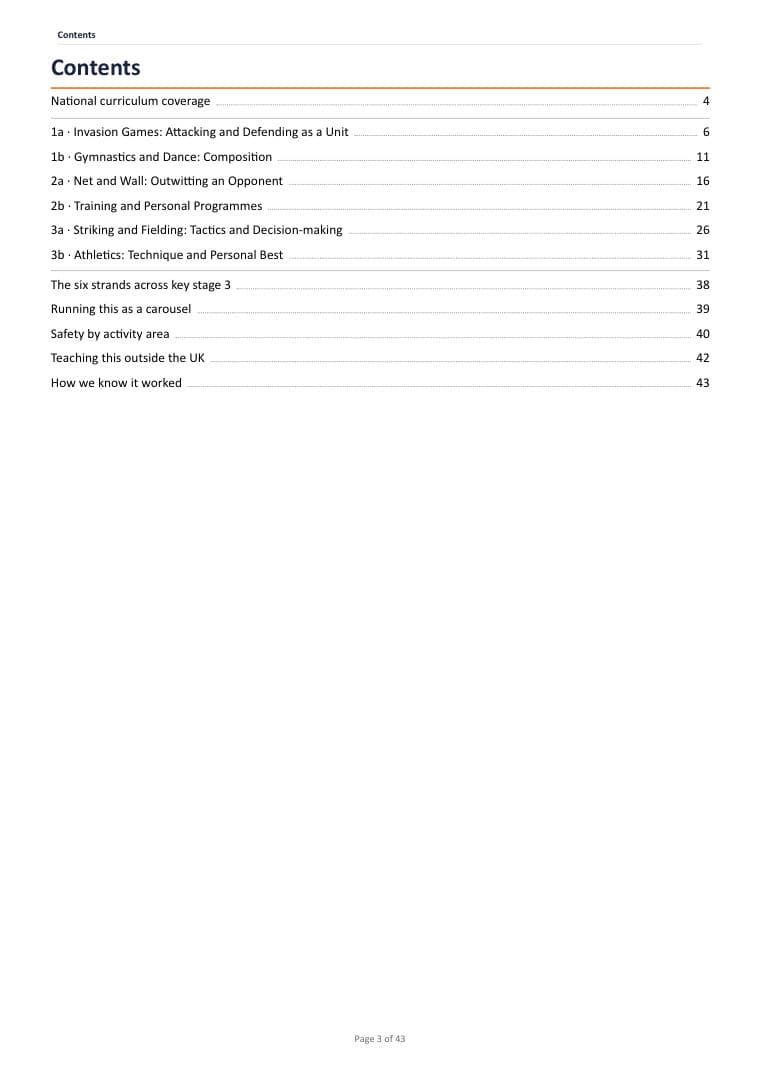
The year, unit by unit
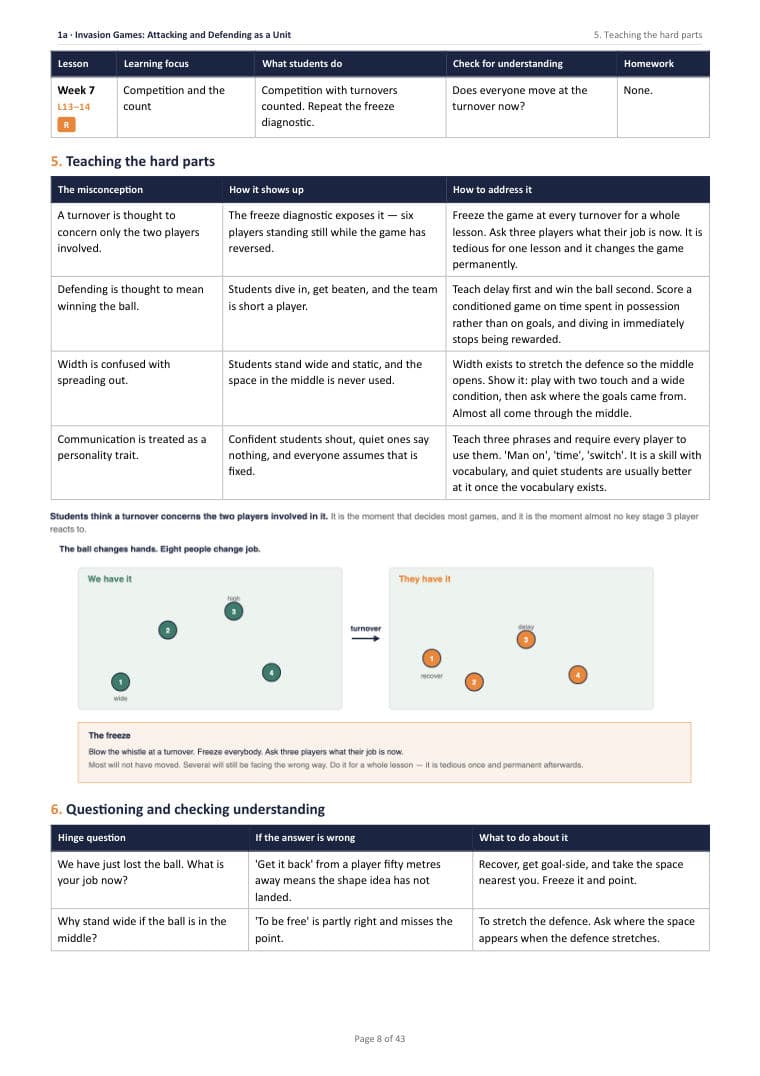
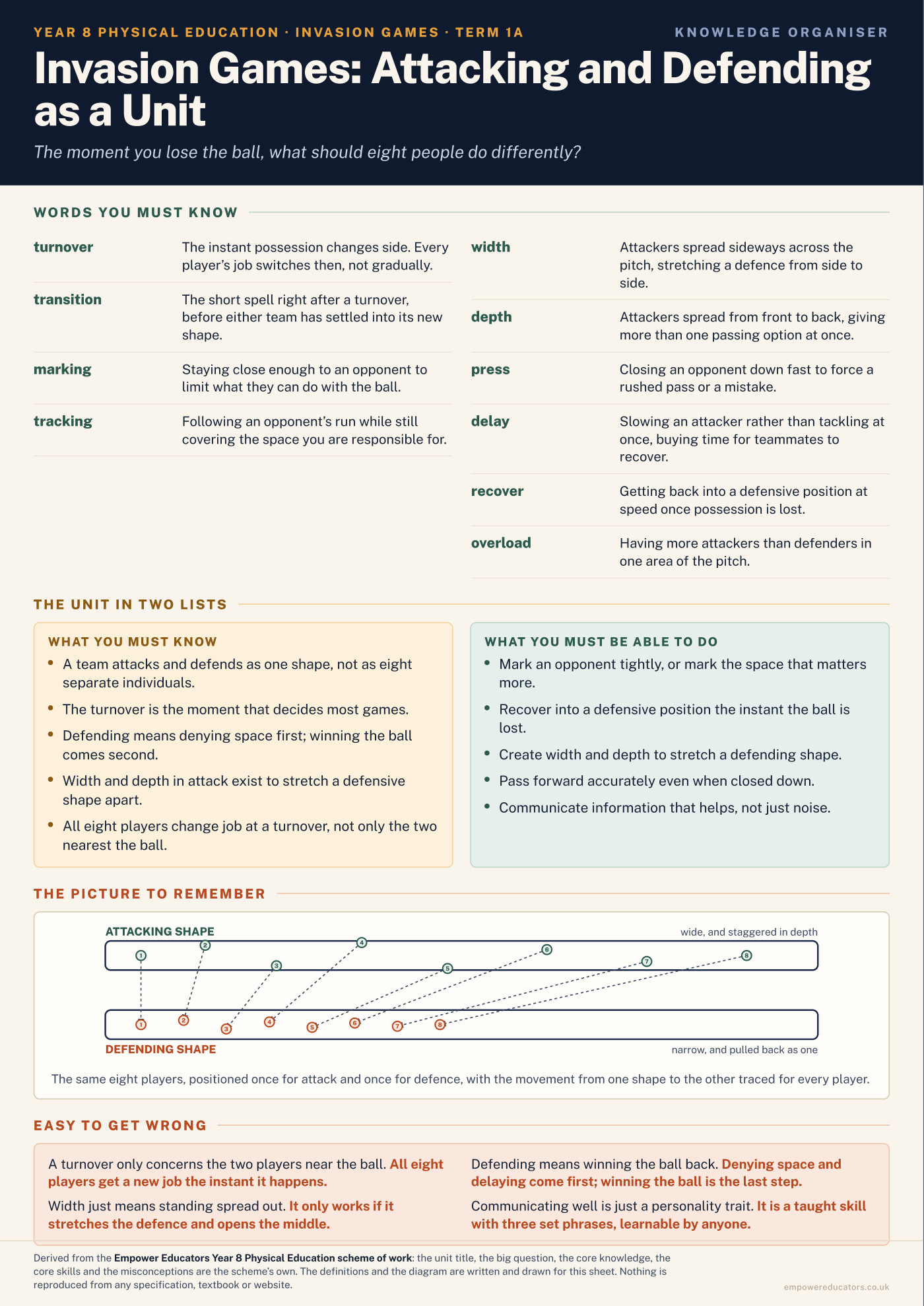
Invasion Games: Attacking and Defending as a Unit
Unit 1a · One half-term block · approx. 7 weeks · rotate to suit facilities
The moment you lose the ball, what should eight people do differently?
Activities
Invasion games. The activity is the department's choice; the principles are the content.
By the end
A small-sided game in which the student switches between attacking and defending roles at the turnover without being told, and can explain what changed.
Core skills
Marking an opponent and marking space · Recovering into position at the turnover · Creating width and depth · Passing forward under pressure · Communicating in a way that helps rather than shouts
Gymnastics and Dance: Composition
Unit 1b · One half-term block · approx. 7 weeks · rotate to suit facilities
Two groups perform the same six moves. Why is one worth watching?
Activities
Gymnastics and dance. Composition is the content, and it is the same content whichever of the two the department runs.
By the end
A group sequence composed to a brief, using changes of level, direction, timing and formation, performed twice with the same result.
Core skills
Composing to a brief · Working in unison and in canon · Changing formation without a pause · Rehearsing deliberately rather than repeating · Giving a peer a specific improvement
Net and Wall: Outwitting an Opponent
Unit 2a · One half-term block · approx. 7 weeks · rotate to suit facilities
How do you win a point three shots before it ends?
Activities
Net and wall. Badminton, volleyball, tennis or table tennis, chosen by the department.
By the end
A singles match in which the student can describe a point they constructed — what they did first, what it forced, and how they finished it.
Core skills
Varying length — deep and short · Varying direction from the same preparation · Testing an opponent deliberately · Finishing when the opening arrives · Scoring and officiating a full match
Training and Personal Programmes
Unit 2b · One half-term block · approx. 7 weeks · rotate to suit facilities
Two people train for six weeks. Why does only one of them improve?
Activities
Fitness and health. The one block a year with genuine written work, and the one where it is worth marking.
By the end
A six-week personal training programme, written by the student for a goal they chose, with the principle behind each decision named.
Core skills
Setting a specific and measurable goal · Choosing a method that matches the goal · Applying overload safely · Recording sessions honestly · Adjusting a plan that is not working
Striking and Fielding: Tactics and Decision-making
Unit 3a · One half-term block · approx. 7 weeks · rotate to suit facilities
A new striker walks in. What do you change before they have faced a ball?
Activities
Striking and fielding — cricket, rounders or softball, chosen by the department.
By the end
A game in which the student sets and adjusts a field for a specific striker and can justify each change from what they have observed.
Core skills
Setting a field from observation · Adjusting during an innings · Striking to a plan · Judging a run · Communicating between fielders
Athletics: Technique and Personal Best
Unit 3b · One half-term block · approx. 7 weeks · schedule for usable weather
You changed one thing and got better. What else could you change?
Activities
Athletics. Year 7 met all three disciplines; this year students choose where to specialise and refine.
By the end
A personal best in a chosen event, with a written account of the technical change made, the effect measured, and what the student would try next.
Core skills
Breaking an event into phases · Isolating and changing one phase · Measuring precisely enough to detect a small change · Officiating an event to the rules · Recording and interpreting a series of attempts
How it meets the key stage 3 programme of study
The scheme maps each requirement of the statutory programme of study for key stage 3 (Department for Education, 2013) to the unit that teaches it. Pupils should be taught to…
use a range of tactics and strategies to overcome opponents in direct competition through team and individual games
1a attacking and defending as a unit · 2a constructing a point · 3a setting and adjusting a field
develop their technique and improve their performance in other competitive sports
3b athletics — one phase of a chosen event refined and measured
perform dances using advanced dance techniques within a range of dance styles and forms
1b composition to a brief, using level, direction, timing and formation. Run as dance where the department has a specialist.
take part in outdoor and adventurous activities which present intellectual and physical challenges and be encouraged to work in a team, building on trust and developing skills to solve problems, either individually or as a group
Not met this year. Outdoor and adventurous activity is Year 9 Unit 1b.
analyse their performances compared to previous ones and demonstrate improvement to achieve their personal best
3b is built entirely on it — one variable changed, measured across attempts, against the Year 7 baseline · 2b reviews a programme against its own goal
take part in competitive sports and activities outside school through community links or sports clubs
Every block ends with named local provision, and 2b sets two sessions a week outside lessons.
Outdoor and adventurous activity is not met this year and is held until Year 9 Unit 1b, where the problem-solving and trust work can be genuine rather than a game. Advanced dance technique remains the line this scheme meets least fully: Unit 1b teaches composition properly, which is most of what a dance assessment rewards, but a department with a dance specialist should run 1b as dance rather than gymnastics and consider swapping the Year 9 OAA block for a third dance block. Say which you have done rather than implying both happened.
The Year 8 PE resources
Two PDFs sit behind this page, and they are meant to be used together: the scheme of work to plan the year, the knowledge organisers to put in front of pupils.
The statutory programme of study for key stage 3 physical education (DfE, 2013)·43 pages, 14 sections·For heads of PE, subject leaders and every teacher who has to deliver it
Written to Empower Educators Year 8 Physical Education scheme of work·6 pages, 6 sections·For PE teachers and heads of department. Printed one per pupil
Six half-term units, in the order they are taught: Invasion Games: Attacking and Defending as a Unit, Gymnastics and Dance: Composition, Net and Wall: Outwitting an Opponent, Training and Personal Programmes, Striking and Fielding: Tactics and Decision-making and Athletics: Technique and Personal Best.
What do pupils produce in Year 8 PE?
A small-sided game in which the student switches between attacking and defending roles at the turnover without being told, and can explain what changed; A group sequence composed to a brief, using changes of level, direction, timing and formation, performed twice with the same result; A singles match in which the student can describe a point they constructed — what they did first, what it forced, and how they finished it; A six-week personal training programme, written by the student for a goal they chose, with the principle behind each decision named; A game in which the student sets and adjusts a field for a specific striker and can justify each change from what they have observed; A personal best in a chosen event, with a written account of the technical change made, the effect measured, and what the student would try next.
Does Year 8 PE meet the National Curriculum?
It maps each requirement of the statutory programme of study for key stage 3 (Department for Education, 2013) to the unit that teaches it, and on this year the scheme is plain: “Outdoor and adventurous activity is not met this year and is held until Year 9 Unit 1b, where the problem-solving and trust work can be genuine rather than a game.”
Cookies
This site works the same either way. Measurement — Google Analytics and Microsoft Clarity — only runs if you say yes, and it is used to see which resources people actually reach.Measurement only runs if you say yes.What is collected.