Six half-term blocks, one per strand, in one workable rotation that a department can reorder to suit its facilities: invasion games, gymnastics, net and wall, fitness and how the body responds, striking and fielding, and athletics. Below is the activity each block uses, what pupils achieve by the end of it and the skills it teaches, taken from our Year 7 PE scheme of work.
Six half-termly blocks, one per strand. The order down the page is one workable rotation, not an instruction. No Year 7 block assumes another Year 7 block has been taught, so a department may rotate these in any order its facilities require. What must not be reordered is the strand across years.
Year 7 means ages 11–12, or S1 in Scotland.
The year, unit by unit
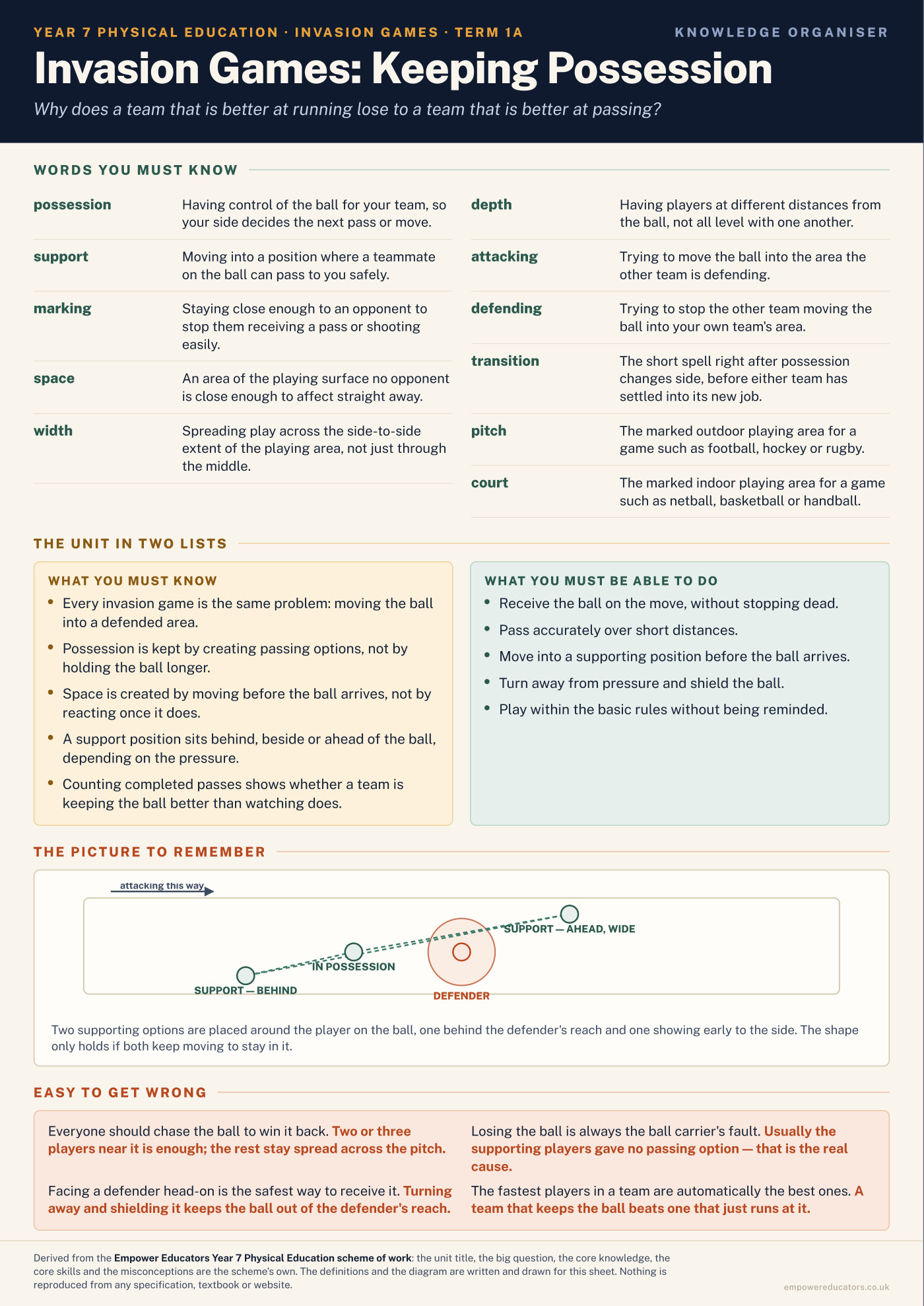
Invasion Games: Keeping Possession
Unit 1a · One half-term block · approx. 7 weeks · rotate to suit facilities
Why does a team that is better at running lose to a team that is better at passing?
Activities
Invasion games — football, netball, basketball, handball, hockey or rugby. The principles are the same; the department chooses the activity from its facilities and staffing.
By the end
A small-sided game in which the student can receive, keep and release the ball under light pressure, and can name what they did to create the space.
Core skills
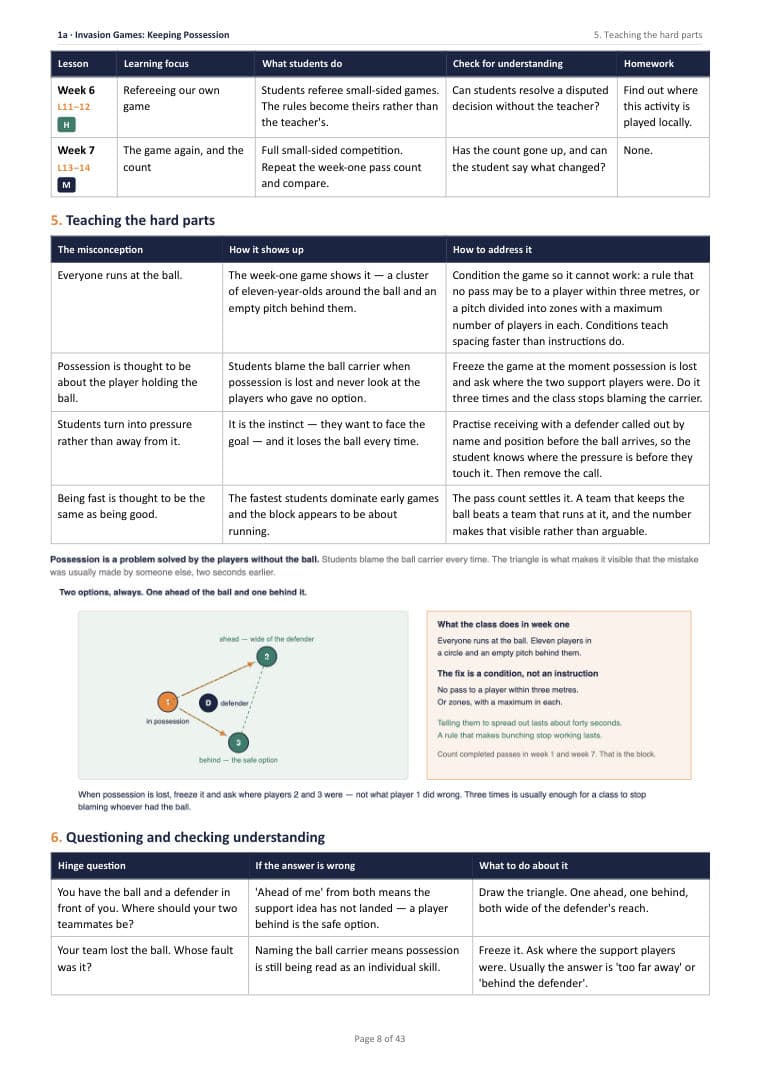
Receiving on the move · Passing accurately over short distances · Moving into a supporting position · Turning away from pressure · Playing within the basic rules without being told them each time
Gymnastics: Body Management and Control
Unit 1b · One half-term block · approx. 7 weeks · rotate to suit facilities
Why can some people hold a shape still and others cannot?
Activities
Gymnastics and dance. This block is gymnastics; a department with a dance specialist may run the same objectives through dance and should.
By the end
A short paired sequence containing balance, travel, flight and a controlled finish, performed twice with the same result.
Core skills
Holding a balance for five seconds · Travelling in different ways at different levels · Taking weight on hands · Landing under control · Linking movements without a pause
Net and Wall: Creating Space
Unit 2a · One half-term block · approx. 7 weeks · rotate to suit facilities
If your opponent is standing in the middle, where do you hit it?
Activities
Net and wall — badminton, volleyball, tennis or table tennis. Badminton is the usual choice indoors because the shuttle is slow enough to think with.
By the end
A singles rally-and-point game in which the student consistently returns to a central base and can name the space they were aiming for.
Core skills
A consistent serve that starts a rally · Returning to base between shots · Sending the object to a chosen area · Moving to the object rather than reaching for it · Scoring and calling honestly
Fitness and How the Body Responds
Unit 2b · One half-term block · approx. 7 weeks · rotate to suit facilities
Why are you out of breath, and why does it stop happening so quickly?
Activities
Fitness and health. The one block a year with genuine written work in it, because there is finally something worth writing down.
By the end
A personal record of four fitness measures taken twice, with a written account of what changed and what the student did that caused it.
Core skills
Taking a pulse accurately · Recording and comparing personal measures · Warming up independently and appropriately · Working at a sustained effort · Reading a simple graph of their own data
Striking and Fielding: Roles in the Field
Unit 3a · One half-term block · approx. 7 weeks · rotate to suit facilities
Nine people are standing still. What is each of them actually doing?
Activities
Striking and fielding — cricket, rounders or softball. The roles and the tactical idea are the same; the department chooses from its facilities and its season.
By the end
A small-sided game in which the student can bat with a controlled technique and can take a named fielding role and explain what that role is for.
Core skills
A controlled batting or striking technique · Throwing accurately over a distance · Receiving a ball moving towards you at speed · Taking a named position and knowing its job · Backing up
Athletics: Run, Jump, Throw
Unit 3b · One half-term block · approx. 7 weeks · schedule for usable weather
You cannot get much stronger in six weeks. So how does anyone get faster?
Activities
Athletics. Run, jump and throw, with technique as the route to improvement rather than effort.
By the end
A personal best recorded in one running, one jumping and one throwing event, with the technical change that produced it named by the student.
Core skills
Sprint start and acceleration · Pacing a middle-distance run · A jumping technique with an approach and a take-off · A throwing technique using the whole body · Measuring and recording accurately
How it meets the key stage 3 programme of study
The scheme maps each requirement of the statutory programme of study for key stage 3 (Department for Education, 2013) to the unit that teaches it. Pupils should be taught to…
use a range of tactics and strategies to overcome opponents in direct competition through team and individual games
1a invasion games, possession and support · 2a net and wall, base and placement · 3a striking and fielding, roles and gaps
develop their technique and improve their performance in other competitive sports
3b athletics — run, jump and throw, each measured twice
perform dances using advanced dance techniques within a range of dance styles and forms
1b is written as gymnastics; a department with a dance specialist runs the same objectives through dance. Advanced dance technique is not met this year.
take part in outdoor and adventurous activities which present intellectual and physical challenges and be encouraged to work in a team, building on trust and developing skills to solve problems, either individually or as a group
Not met this year. Outdoor and adventurous activity is Year 9 Unit 1b.
analyse their performances compared to previous ones and demonstrate improvement to achieve their personal best
2b four personal measures taken twice · 3b personal bests with the technical change named
take part in competitive sports and activities outside school through community links or sports clubs
Every block ends with named local provision for that activity, and the fitness block sets one activity a week outside lessons.
Two lines of the programme of study are not met in Year 7. Outdoor and adventurous activity is deliberately held until Year 9 Unit 1b, where students are old enough for the problem-solving and trust work to be genuine rather than a game. Advanced dance technique is the one line this three-year scheme meets least fully — Year 7 builds body control and Year 8 builds composition, but a department wanting advanced dance in Year 9 should swap it for the OAA block and run OAA as an off-timetable day, which is how most schools deliver it anyway. Swimming is statutory at key stage 2 and appears at key stage 3 only for students who did not meet it; where your school has a pool and students who need it, that provision replaces one block rather than being added to six.
The Year 7 PE resources
Two PDFs sit behind this page, and they are meant to be used together: the scheme of work to plan the year, the knowledge organisers to put in front of pupils.
The statutory programme of study for key stage 3 physical education (DfE, 2013)·43 pages, 14 sections·For heads of PE, subject leaders and every teacher who has to deliver it
Written to Empower Educators Year 7 Physical Education scheme of work·6 pages, 6 sections·For PE teachers and heads of department. Printed one per pupil
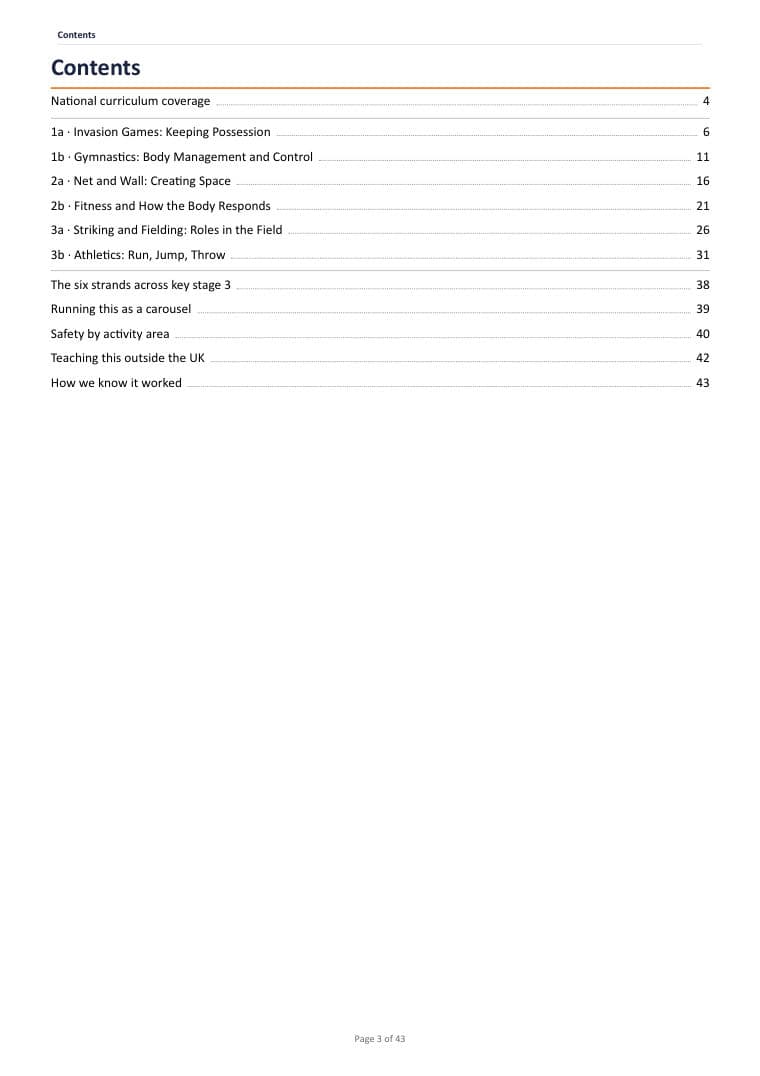
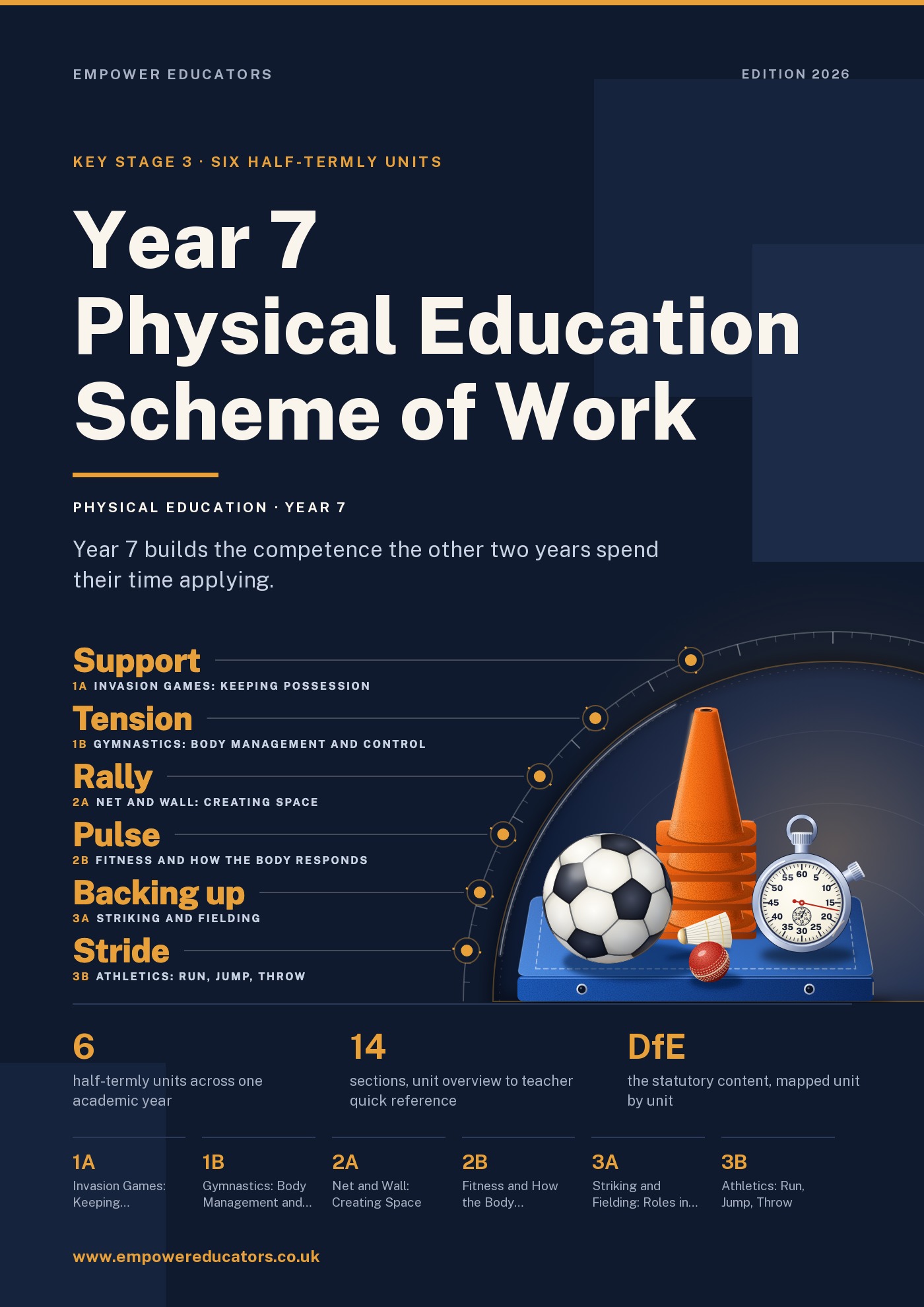
Six half-term units, in the order they are taught: Invasion Games: Keeping Possession, Gymnastics: Body Management and Control, Net and Wall: Creating Space, Fitness and How the Body Responds, Striking and Fielding: Roles in the Field and Athletics: Run, Jump, Throw.
What do pupils produce in Year 7 PE?
A small-sided game in which the student can receive, keep and release the ball under light pressure, and can name what they did to create the space; A short paired sequence containing balance, travel, flight and a controlled finish, performed twice with the same result; A singles rally-and-point game in which the student consistently returns to a central base and can name the space they were aiming for; A personal record of four fitness measures taken twice, with a written account of what changed and what the student did that caused it; A small-sided game in which the student can bat with a controlled technique and can take a named fielding role and explain what that role is for; A personal best recorded in one running, one jumping and one throwing event, with the technical change that produced it named by the student.
Does Year 7 PE meet the National Curriculum?
It maps each requirement of the statutory programme of study for key stage 3 (Department for Education, 2013) to the unit that teaches it, and on this year the scheme is plain: “Two lines of the programme of study are not met in Year 7.”
Cookies
This site works the same either way. Measurement — Google Analytics and Microsoft Clarity — only runs if you say yes, and it is used to see which resources people actually reach.Measurement only runs if you say yes.What is collected.