Physical Education · Key Stage 3 · £4.99
Year 8
Physical Education
Scheme of Work
The same six strands, one block of each. Year 7 built competence; this is where the decisions arrive. A student who can receive a ball is asked what to do with it, and one who can rally is asked to construct a point.
£4.99The Year 8 scheme: 6 half-termly units, 43 pages
- A4 PDF
- first 8 pages free to read
- instant download
Teaching all of Key Stage 3? Year 7, Year 8 and Year 9 as one set: £11.99, saving £2.98.
One purchase covers the school that buys it. Print it, copy it, hand it round your department. Not for passing to other schools or uploading anywhere.
PDF download, ready straight after payment. Downloading it ends the 14-day right to cancel; a file that is faulty or not as described is always refunded. Refunds
Read before publication by serving senior leaders, in school.
5.0 from 24+ reviews on Google
Schools that have bought from Empower Educators include Nottingham High School, Northampton High School GDST and Sutton Valence School.
Complete your Physical Education
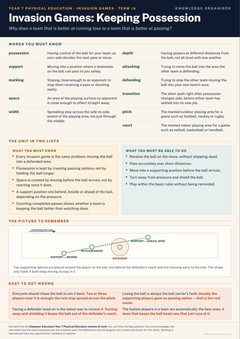
The whole key stage: KS3 PE scheme of work
Everything else this site has for Physical Education: Physical Education teaching resources
- 1aInvasion Games: Attacking and Defending as a Unit
- 1bGymnastics and Dance: Composition
- 2aNet and Wall: Outwitting an Opponent
- 2bTraining and Personal Programmes
- 3aStriking and Fielding: Tactics and Decision-making
- 3bAthletics: Technique and Personal Best
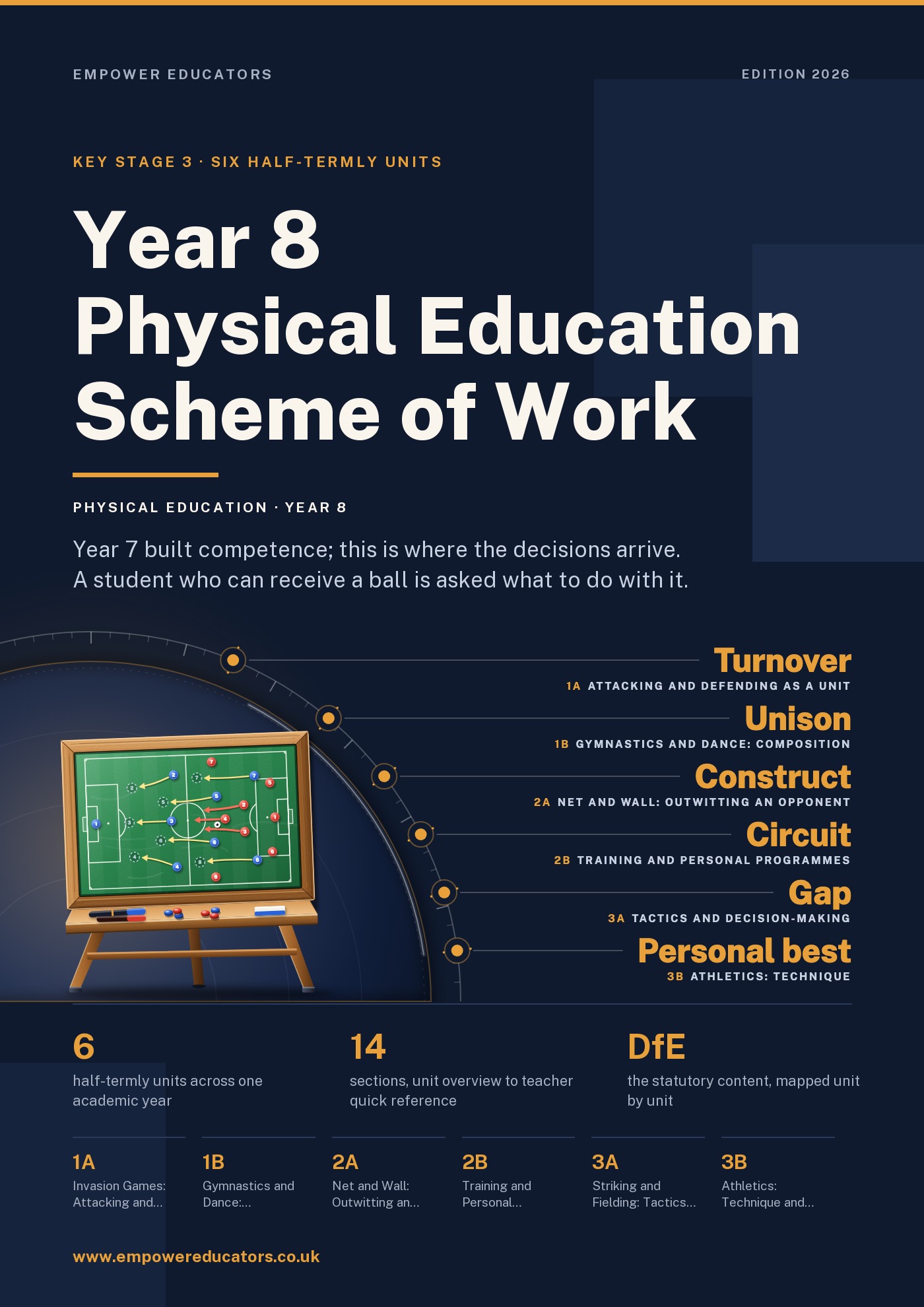
Ten sections per block, in the same order every time. Weeks rather than lessons, because PE is timetabled at about two hours a week.
Every block names the Year 7 block it assumes, and that dependency is the one thing a facilities rotation must not break. Rotate freely within a year; never let a student take the Year 9 block of a strand without the Year 8 one.
Two blocks carry the ideas that transfer furthest. Unit 1a teaches the turnover — the moment that decides most games and the one almost no Key Stage 3 player reacts to. Unit 2b has students write a six-week training programme they could actually follow, with the principle named beside every decision, which is the most directly useful thing PE can hand an adult.
Every duration and activity is a strong default rather than a fixed rule. The activity named in each block is the department’s choice; what is fixed is the strand.
- Written to
- The statutory programme of study for key stage 3 physical education (DfE, 2013)
- Intended for
- heads of PE, subject leaders and every teacher who has to deliver it
- Extent
- 43 pages · 14 sections
The sequence
What this scheme of work covers, unit by unit
The 6 units of the Year 8 Physical Education Scheme of Work, in teaching order, with the term each one runs in and the question it is built to answer.
1a
Invasion Games: Attacking and Defending as a Unit
One half-term block · approx. 7 weeks · rotate to suit facilities
The moment you lose the ball, what should eight people do differently?
1b
Gymnastics and Dance: Composition
One half-term block · approx. 7 weeks · rotate to suit facilities
Two groups perform the same six moves. Why is one worth watching?
2a
Net and Wall: Outwitting an Opponent
One half-term block · approx. 7 weeks · rotate to suit facilities
How do you win a point three shots before it ends?
2b
Training and Personal Programmes
One half-term block · approx. 7 weeks · rotate to suit facilities
Two people train for six weeks. Why does only one of them improve?
3a
Striking and Fielding: Tactics and Decision-making
One half-term block · approx. 7 weeks · rotate to suit facilities
A new striker walks in. What do you change before they have faced a ball?
3b
Athletics: Technique and Personal Best
One half-term block · approx. 7 weeks · schedule for usable weather
You changed one thing and got better. What else could you change?
Look inside
Real pages, straight from the PDF
Click any page to see it full size.
Contents
All 14 sections
Taken from the book’s own contents page, so the page numbers are the real ones.