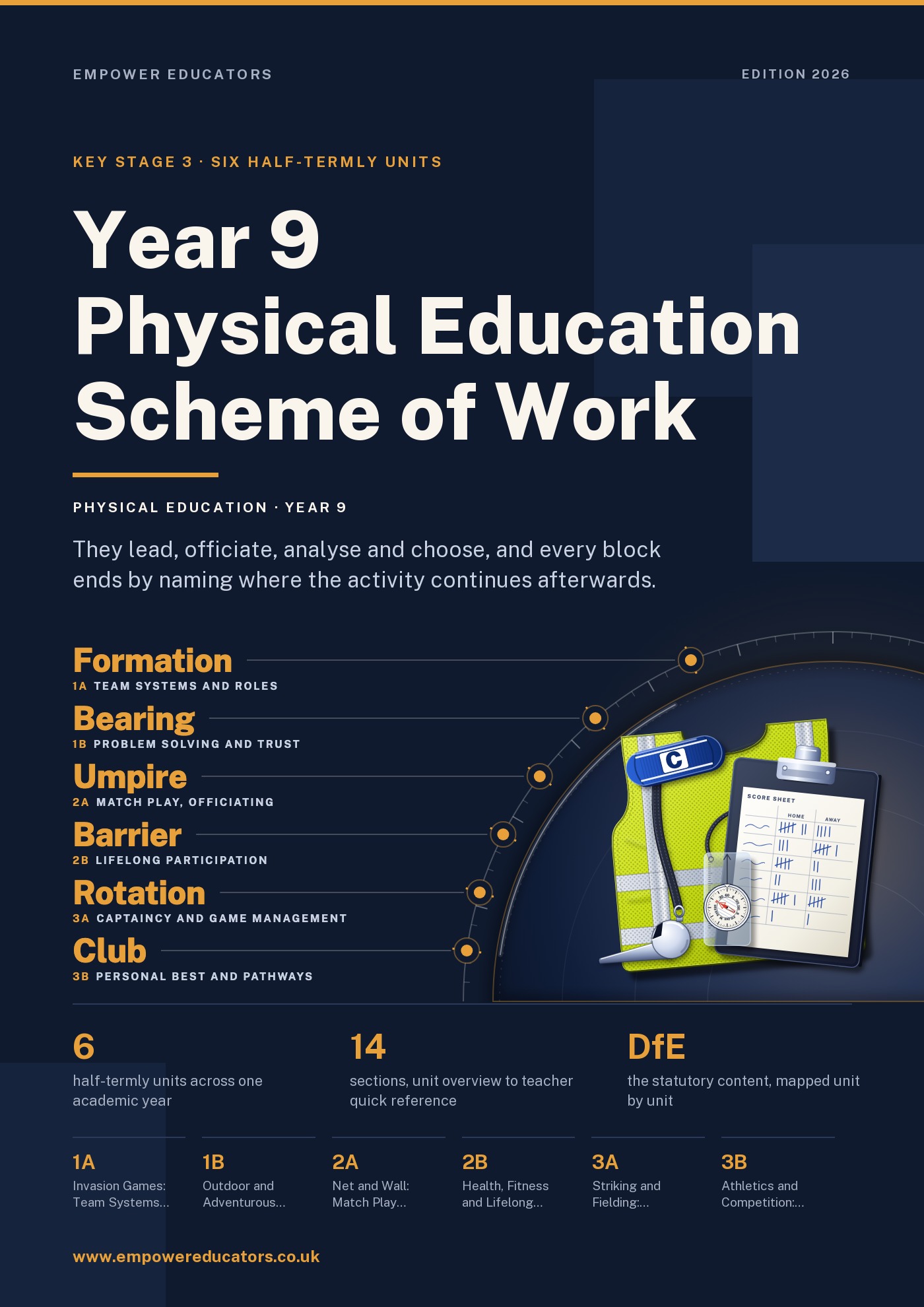
Six half-term blocks: team systems and roles in invasion games, outdoor and adventurous activity, match play and officiating at net and wall, health, fitness and lifelong participation, captaincy in striking and fielding, and athletics with a route to keep competing. Below is the activity each block uses, what pupils achieve by the end of it and the skills it teaches, taken from our Year 9 PE scheme of work.
Six half-termly blocks. Gymnastics and dance step aside this year for outdoor and adventurous activity, which the programme of study requires and which Years 7 and 8 deliberately deferred until the problem-solving could be genuine. The order down the page is one workable rotation; the strand across years is the part that is fixed.
Year 9 means ages 13–14, or S2–S3 in Scotland.
The year, unit by unit
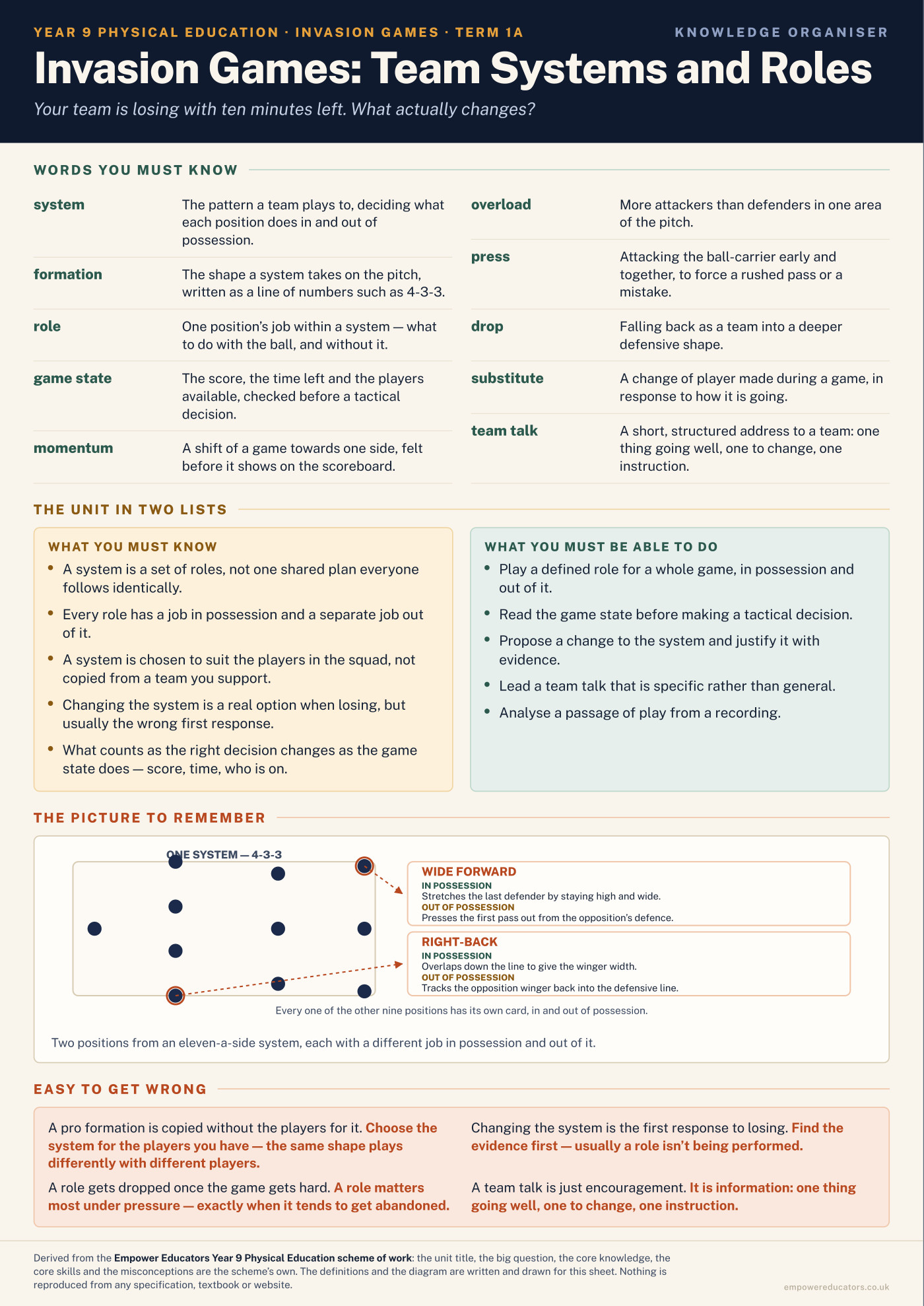
Invasion Games: Team Systems and Roles
Unit 1a · One half-term block · approx. 7 weeks · rotate to suit facilities
Your team is losing with ten minutes left. What actually changes?
Activities
Invasion games. The activity is the department's choice; the systems thinking is the content.
By the end
A game in which the student plays a defined role within a chosen system and can explain what they would change, and why, when the game state changes.
Core skills
Playing a defined role for a whole game · Reading the game state · Proposing and justifying a change · Leading a team talk · Analysing a passage of play from a recording
Outdoor and Adventurous Activity: Problem Solving and Trust
Unit 1b · One half-term block · approx. 7 weeks · or one off-timetable day plus follow-up
Your group has failed the task three times. What do you change — the plan, or how you are talking to each other?
Activities
Outdoor and adventurous activity. Deferred from Years 7 and 8 deliberately, so the problem-solving and trust work is genuine rather than a game.
By the end
A group problem solved under a constraint, with a written account of how the group organised itself and what it would do differently.
Core skills
Planning as a group under time pressure · Listening and being heard · Reading a map and orienting it · Using a compass to take and follow a bearing · Reviewing honestly without blame
Net and Wall: Match Play, Officiating and Analysis
Unit 2a · One half-term block · approx. 7 weeks · rotate to suit facilities
You lost. Was it your technique, your tactics, or your decisions?
Activities
Net and wall. The strand with the strongest lifelong participation prospects, which is why the block ends by naming where to keep playing.
By the end
A full match played and officiated, with a written analysis identifying one technical and one tactical priority for the student's own game.
Core skills
Playing a full match under pressure · Officiating to the full rules · Recording evidence about a performance · Identifying a priority from evidence · Coaching a peer on one specific thing
Health, Fitness and Lifelong Participation
Unit 2b · One half-term block · approx. 7 weeks · rotate to suit facilities
Most people stop exercising within a year of leaving school. What would have to be different for you?
Activities
Fitness and health. The last compulsory fitness block most students will ever have, which is what it is built around.
By the end
A realistic personal plan for staying active after school, built around an activity the student has actually tried and can access, with the barriers named and answered.
Core skills
Evaluating an activity for keepability · Identifying and answering a personal barrier · Finding and assessing local provision · Planning realistically around a life · Trying something unfamiliar without embarrassment
Striking and Fielding: Captaincy and Game Management
Unit 3a · One half-term block · approx. 7 weeks · rotate to suit facilities
You are twenty runs ahead with four overs left. What is your job now?
Activities
Striking and fielding — cricket, rounders or softball.
By the end
An innings captained from start to finish, with the decisions recorded and justified against the state of the game.
Core skills
Reading the game state · Managing an innings · Rotating and supporting players · Making a decision under time pressure · Justifying a decision that did not work
Athletics and Competition: Personal Best and Pathways
Unit 3b · One half-term block · approx. 7 weeks · schedule for usable weather
This is the last athletics you have to do. What would make you do it again?
Activities
Athletics. The last compulsory block of the strand, which shapes what it is for.
By the end
A personal best in a chosen event, an officiated competition run largely by students, and a named route by which this student could continue.
Core skills
Refining technique against three years of personal data · Officiating a track or field event fully · Organising and running a competition · Competing under pressure · Identifying a genuine next step
How it meets the key stage 3 programme of study
The scheme maps each requirement of the statutory programme of study for key stage 3 (Department for Education, 2013) to the unit that teaches it. Pupils should be taught to…
use a range of tactics and strategies to overcome opponents in direct competition through team and individual games
1a systems and roles · 2a full match play and analysis · 3a captaincy and game management
develop their technique and improve their performance in other competitive sports
3b athletics refined against three years of the student's own data
perform dances using advanced dance techniques within a range of dance styles and forms
Not met this year. Dance is taught in Years 7 and 8; see the coverage note.
take part in outdoor and adventurous activities which present intellectual and physical challenges and be encouraged to work in a team, building on trust and developing skills to solve problems, either individually or as a group
1b — problem solving, trust and navigation, held until Year 9 deliberately
analyse their performances compared to previous ones and demonstrate improvement to achieve their personal best
2a analysis against a recorded tally · 3b three years of personal bests read as evidence about a method
take part in competitive sports and activities outside school through community links or sports clubs
2b is built on it — every student leaves with a named club, a time, a cost and a first step. Also in 1a, 2a, 3a and 3b.
Dance is not taught in Year 9, and this is the one line of the programme of study this three-year scheme meets least fully. Years 7 and 8 build body control and composition, which is most of what a dance assessment rewards, but 'advanced dance technique in a range of styles and forms' is not met by two blocks of gymnastics-led work. A department with a dance specialist should run Year 7 and Year 8 Unit 1b as dance and consider replacing this year's Unit 1b with a third dance block, delivering outdoor and adventurous activity as an off-timetable day or residential — which is how most schools deliver it anyway. Whichever you choose, say which, rather than implying both happened.
The Year 9 PE resources
Two PDFs sit behind this page, and they are meant to be used together: the scheme of work to plan the year, the knowledge organisers to put in front of pupils.
The statutory programme of study for key stage 3 physical education (DfE, 2013)·43 pages, 14 sections·For heads of PE, subject leaders and every teacher who has to deliver it
Written to Empower Educators Year 9 Physical Education scheme of work·6 pages, 6 sections·For PE teachers and heads of department. Printed one per pupil
Six half-term units, in the order they are taught: Invasion Games: Team Systems and Roles, Outdoor and Adventurous Activity: Problem Solving and Trust, Net and Wall: Match Play, Officiating and Analysis, Health, Fitness and Lifelong Participation, Striking and Fielding: Captaincy and Game Management and Athletics and Competition: Personal Best and Pathways.
What do pupils produce in Year 9 PE?
A game in which the student plays a defined role within a chosen system and can explain what they would change, and why, when the game state changes; A group problem solved under a constraint, with a written account of how the group organised itself and what it would do differently; A full match played and officiated, with a written analysis identifying one technical and one tactical priority for the student's own game; A realistic personal plan for staying active after school, built around an activity the student has actually tried and can access, with the barriers named and answered; An innings captained from start to finish, with the decisions recorded and justified against the state of the game; A personal best in a chosen event, an officiated competition run largely by students, and a named route by which this student could continue.
Does Year 9 PE meet the National Curriculum?
It maps each requirement of the statutory programme of study for key stage 3 (Department for Education, 2013) to the unit that teaches it, and on this year the scheme is plain: “Dance is not taught in Year 9, and this is the one line of the programme of study this three-year scheme meets least fully.”
Cookies
This site works the same either way. Measurement — Google Analytics and Microsoft Clarity — only runs if you say yes, and it is used to see which resources people actually reach.Measurement only runs if you say yes.What is collected.