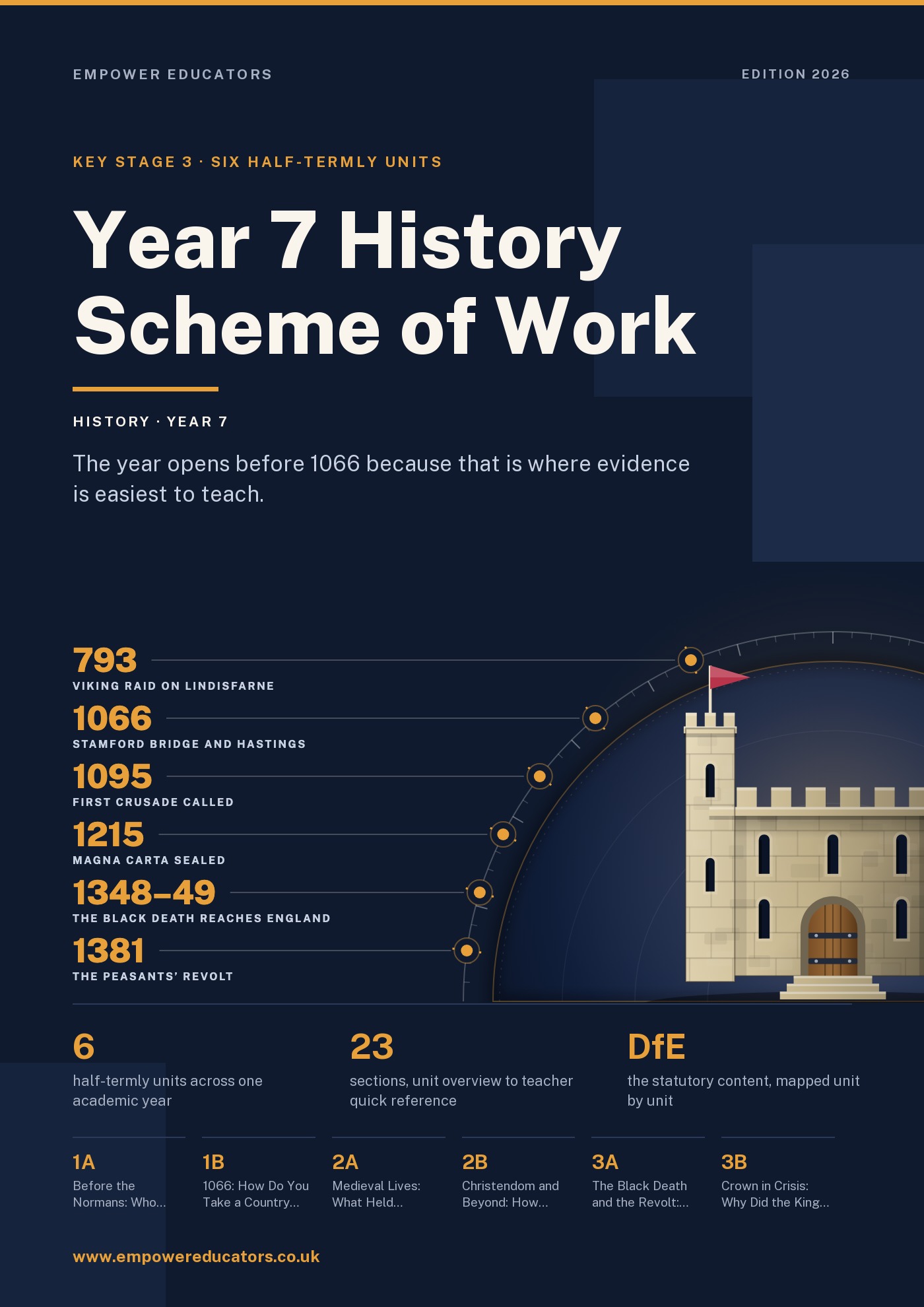
Six half-term units, in chronological order: Britain before the Normans and how we know; 1066 and the twenty years after it; medieval lives; Christendom and the wider medieval world; the Black Death and the revolt that followed; and the crown in crisis, from Becket to Bosworth. Below is what each unit asks pupils to produce, the people and the events it names, taken from our Year 7 History scheme of work.
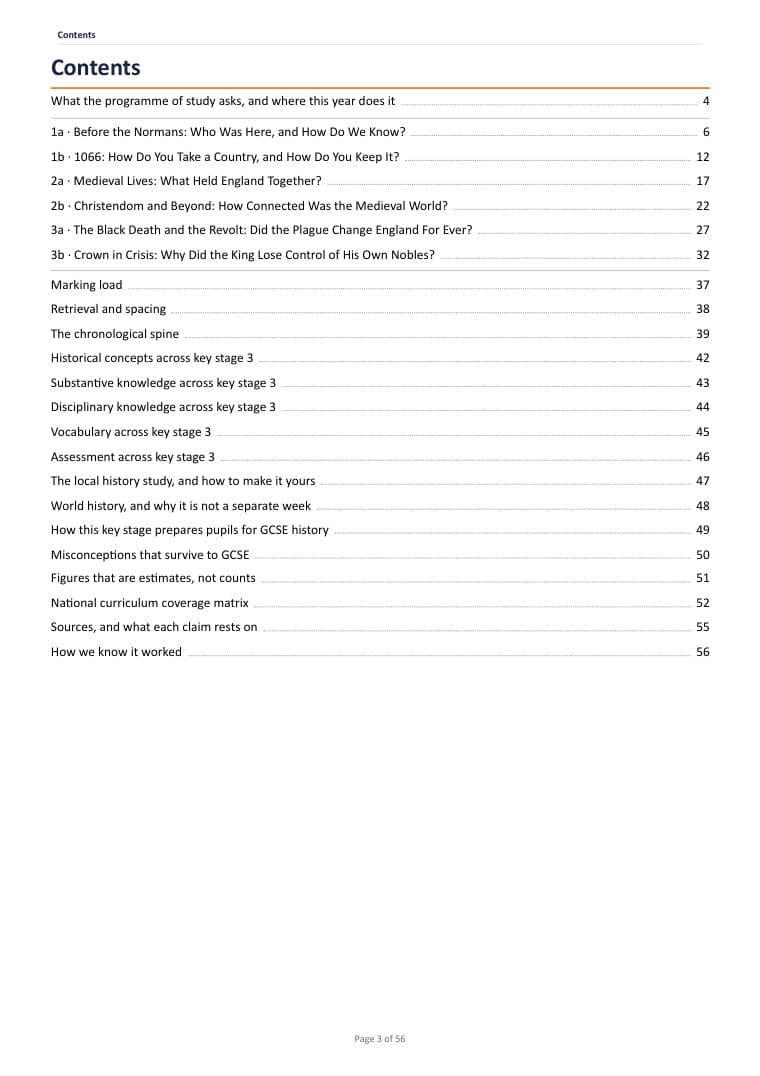
Six units, one academic year, in chronological order — which is not a stylistic choice in this subject but the thing the curriculum is for.
Year 7, ages 11–12.
The year, unit by unit
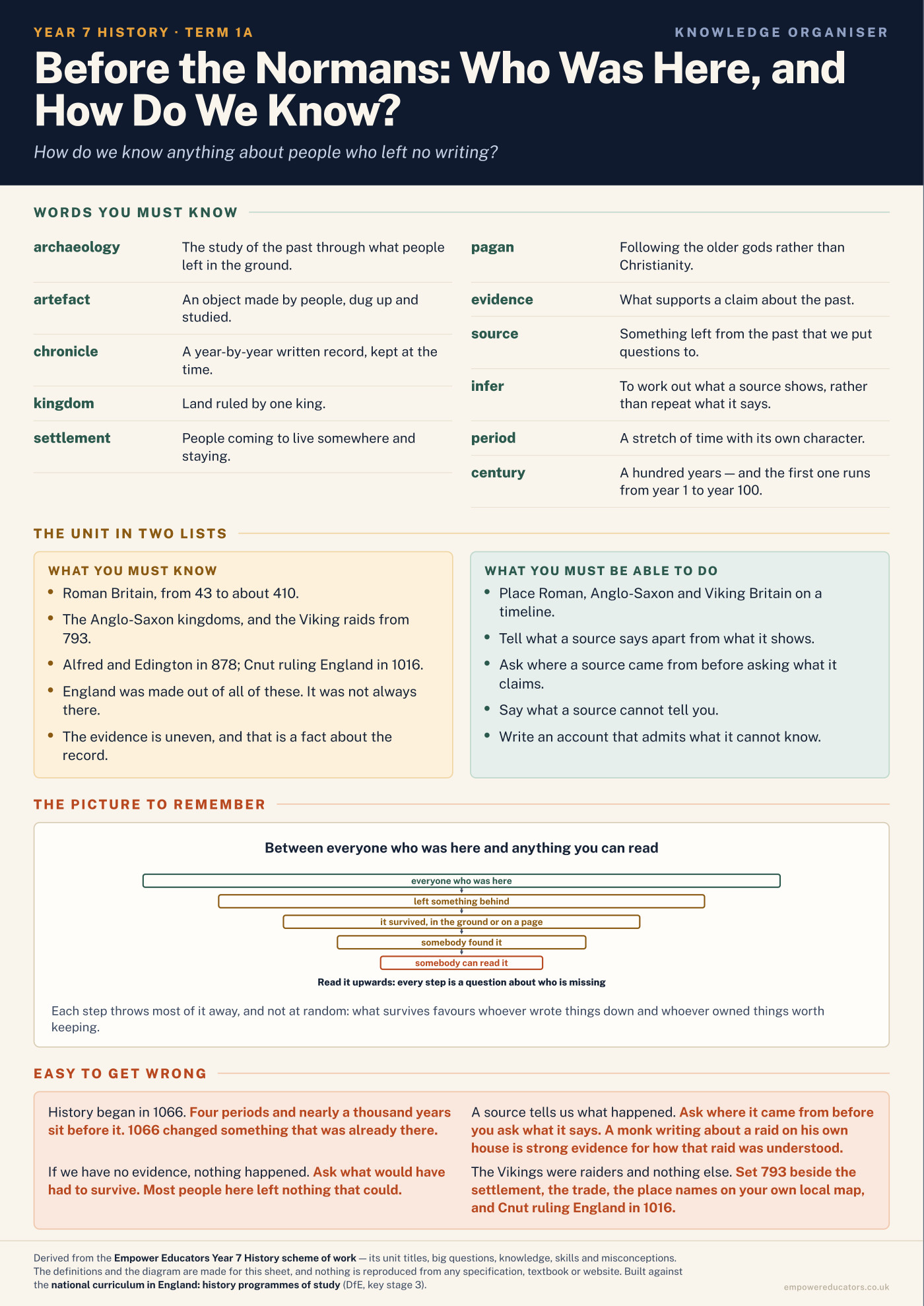
Before the Normans: Who Was Here, and How Do We Know?
Unit 1a · Autumn 1 · 6 lessons · September – October
How do we know anything about people who left no writing?
Pupils produce
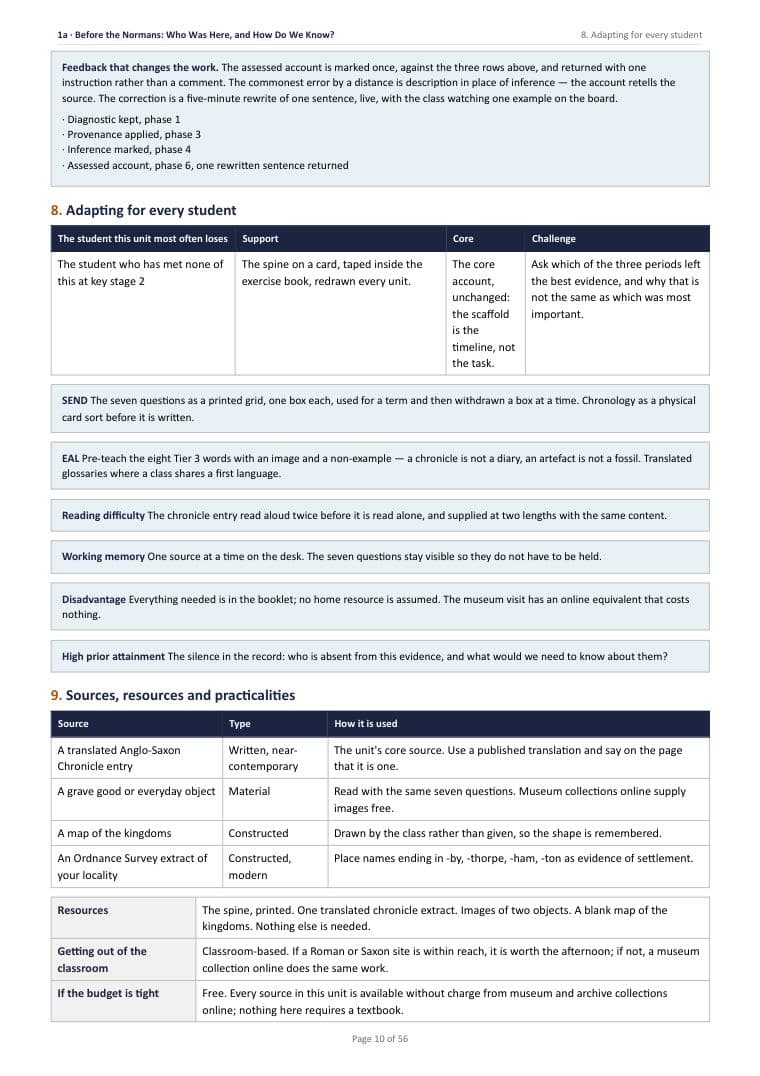
A structured account answering the enquiry, using one written and one material source and saying what each cannot tell us.
People
Alfred; Cnut. Two only, deliberately: the unit is about how we know, not about who ruled.
Events
The Roman invasion; the end of Roman rule; Augustine's mission; the Lindisfarne raid; Edington; Cnut's accession.
1066: How Do You Take a Country, and How Do You Keep It?
Unit 1b · Autumn 2 · 6 lessons · November – December
Was the Conquest a victory, or an occupation that lasted twenty years?
Pupils produce
A causal explanation of why William won, followed by a change-and-continuity table covering 1066 to 1086.
People
William I. Harold Godwinson and Harald Hardrada as claimants.
Events
The succession crisis; Stamford Bridge; Hastings; the castle-building programme; the harrying of the North; Domesday.
Medieval Lives: What Held England Together?
Unit 2a · Spring 1 · 6 lessons · January – February
If there was no police force and no standing army, why did most people obey?
Pupils produce
An explanation of how obedience was produced, using evidence from land, faith and law.
People
None named. The unit is deliberately about structures and ordinary lives, and a class that can only do history through kings has a problem.
Events
No single events: the unit teaches a system, and says so.
Christendom and Beyond: How Connected Was the Medieval World?
Unit 2b · Spring 2 · 6 lessons · February – March
Was medieval Europe the centre of the world, or the edge of someone else's?
Pupils produce
A comparison of two societies on the same criteria, with a judgement about connection supported by evidence.
People
Mansa Musa. Named because his pilgrimage of 1324 is documented from several directions, which makes it good evidence as well as a good story.
Events
The calling of the First Crusade, 1095; the trans-Saharan trade; Mansa Musa's pilgrimage.
The Black Death and the Revolt: Did the Plague Change England For Ever?
Unit 3a · Summer 1 · 6 lessons · April – May
Did the Black Death change England, or did it only speed up what was already happening?
Pupils produce
A significance judgement against given criteria, supported by evidence from before and after 1348.
People
Wat Tyler, as a leader whose end is recorded and whose beginning is not — which is itself a lesson about the record.
Events
The arrival of the plague; the Statute of Labourers; the three poll taxes; the revolt and its suppression.
Crown in Crisis: Why Did the King Lose Control of His Own Nobles?
Unit 3b · Summer 2 · 6 lessons · June – July
How does a crown that had conquered a country end up unable to govern it?
Pupils produce
An explanation of the decline and restoration of royal authority, using the whole of Year 7's chronology.
People
Thomas Becket; King John; Simon de Montfort; Henry VII.
Events
Becket's murder; Magna Carta; the parliament of 1265; Bannockburn; the Hundred Years War; Bosworth.
How it meets the key stage 3 programme of study
The scheme maps each requirement of the key stage 3 programme of study (National curriculum in England: history programmes of study, key stage 3, Department for Education, DFE-00194-2013, September 2013) to the unit that teaches it. Pupils should be taught to…
Chronological security: extend and deepen their chronologically secure knowledge and understanding of British, local and world history, so that it provides a well-informed context for wider learning
1a — the pre-1066 theme, and the spine drawn for the first time; retrieved in the first lesson of every unit after it.
Connections and trends: identify significant events, make connections, draw contrasts, and analyse trends within periods and over long arcs of time
1b — twenty years of the Conquest read as a trend rather than an event; 3b — three centuries of Crown and Parliament held in one unit.
Historical terms and concepts: use historical terms and concepts in increasingly sophisticated ways
2a — the vocabulary of a medieval society (feudalism, tithe, manor, villein) taught explicitly and required in the assessed explanation.
Enquiry and structured accounts: pursue historically valid enquiries including some they have framed themselves, and create relevant, structured and evidentially supported accounts in response
3a — the first enquiry answered with evidence the student chooses between; every unit's assessment is a structured account.
Sources and interpretations: understand how different types of historical sources are used rigorously to make historical claims and discern how and why contrasting arguments and interpretations of the past have been constructed
1a — provenance and inference, taught explicitly and used in every unit after it; 2b — why Latin and Arabic accounts of one siege differ.
Overview and depth — the planning requirement teachers should combine overview and depth studies to help pupils understand both the long arc of development and the complexity of specific aspects of the content
Overview in 3b, which runs from Becket to Bosworth in one unit; depth in 1b (twenty years) and 3a (thirty years).
This year deliberately does not cover anything after 1509. The Reformation is Year 8 and the twentieth century is Year 9, and the reason is the spine: a class that has not held one period steady cannot compare two. The local history study is held to Year 8, where industrialisation makes almost every English locality legible in the record. The full three-year mapping is in the coverage matrix.
The Year 7 History resources
Two PDFs sit behind this page, and they are meant to be used together: the scheme of work to plan the year, the knowledge organisers to put in front of pupils.
The statutory programme of study for key stage 3 history (DfE, 2013)·56 pages, 23 sections·For heads of history, subject leaders and every teacher who has to deliver it
Six half-term units, in the order they are taught: Before the Normans: Who Was Here, and How Do We Know?, 1066: How Do You Take a Country, and How Do You Keep It?, Medieval Lives: What Held England Together?, Christendom and Beyond: How Connected Was the Medieval World?, The Black Death and the Revolt: Did the Plague Change England For Ever? and Crown in Crisis: Why Did the King Lose Control of His Own Nobles?.
What do pupils produce in Year 7 History?
A structured account answering the enquiry, using one written and one material source and saying what each cannot tell us; A causal explanation of why William won, followed by a change-and-continuity table covering 1066 to 1086; An explanation of how obedience was produced, using evidence from land, faith and law; A comparison of two societies on the same criteria, with a judgement about connection supported by evidence; A significance judgement against given criteria, supported by evidence from before and after 1348; An explanation of the decline and restoration of royal authority, using the whole of Year 7's chronology.
Does Year 7 History meet the National Curriculum?
It maps each requirement of the key stage 3 programme of study (National curriculum in England: history programmes of study, key stage 3, Department for Education, DFE-00194-2013, September 2013) to the unit that teaches it, and on this year the scheme is plain: “This year deliberately does not cover anything after 1509.”
Cookies
This site works the same either way. Measurement — Google Analytics and Microsoft Clarity — only runs if you say yes, and it is used to see which resources people actually reach.Measurement only runs if you say yes.What is collected.