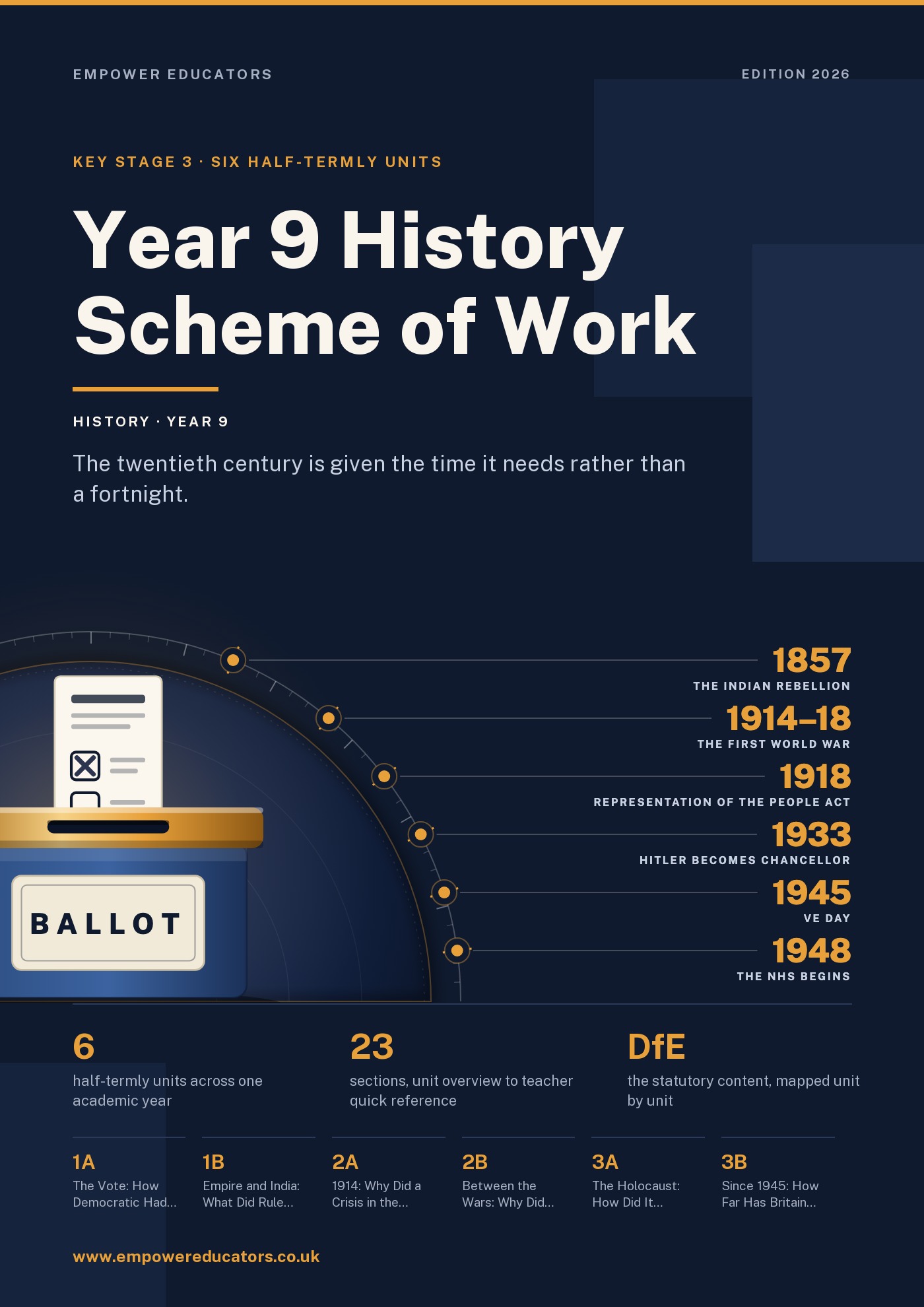
Six half-term units, in chronological order to the present: the vote, and how democratic Britain had become by 1918; empire and India; 1914; why people voted for dictators between the wars; the Holocaust; and Britain since 1945, ending in an enquiry the student frames. Below is what each unit asks pupils to produce, the people and the events it names, taken from our Year 9 History scheme of work.
Six units, one academic year, in chronological order, closing at the present. The last unit is the students' own enquiry, which is the end point of three years of disciplinary teaching rather than a topic.
Year 9, ages 13–14.
The year, unit by unit
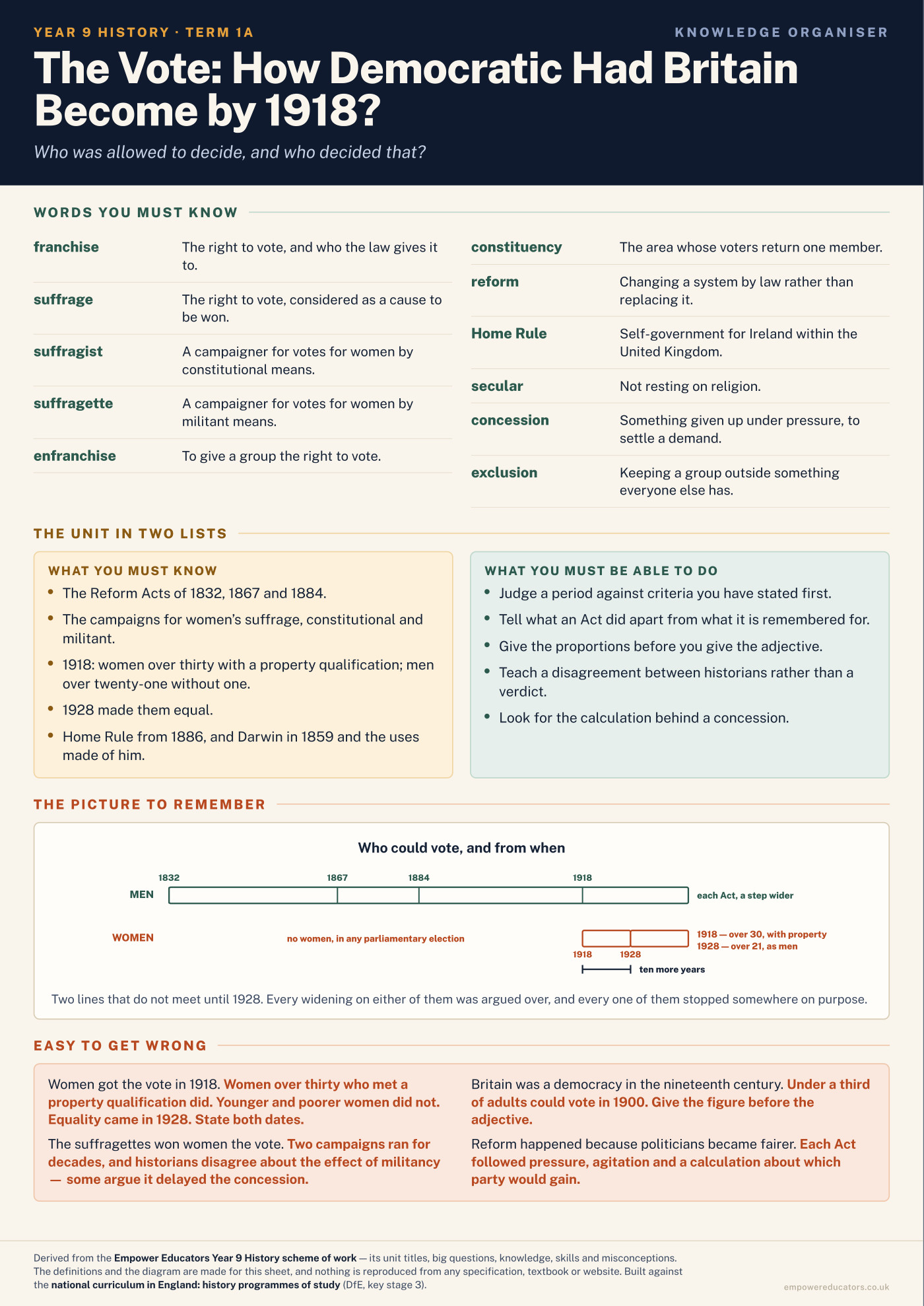
The Vote: How Democratic Had Britain Become by 1918?
Unit 1a · Autumn 1 · 6 lessons · September – October
Who was allowed to decide, and who decided that?
Pupils produce
A judgement — how democratic had Britain become by 1918? — argued against stated criteria.
People
Emmeline Pankhurst; Millicent Fawcett; Charles Darwin.
Events
The three Reform Acts; the suffrage campaigns; the 1918 Act; the 1928 Act; the Home Rule Bills.
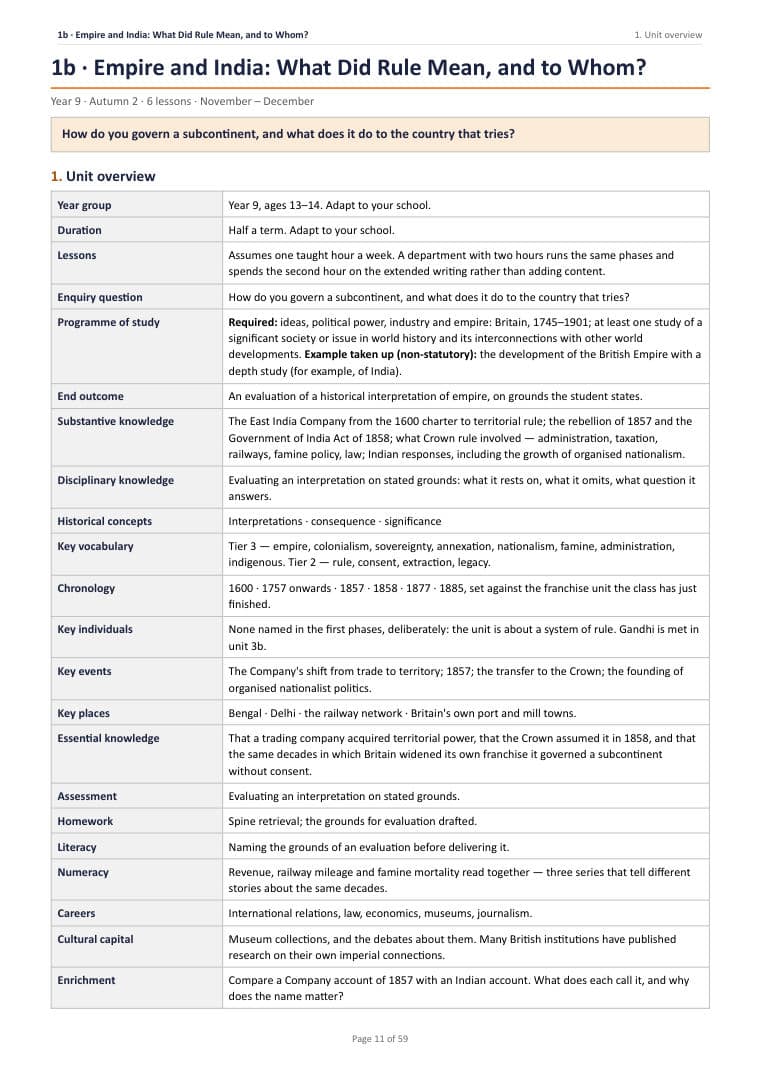
Empire and India: What Did Rule Mean, and to Whom?
Unit 1b · Autumn 2 · 6 lessons · November – December
How do you govern a subcontinent, and what does it do to the country that tries?
Pupils produce
An evaluation of a historical interpretation of empire, on grounds the student states.
People
None named in the first phases, deliberately: the unit is about a system of rule. Gandhi is met in unit 3b.
Events
The Company's shift from trade to territory; 1857; the transfer to the Crown; the founding of organised nationalist politics.
1914: Why Did a Crisis in the Balkans Become a World War?
Unit 2a · Spring 1 · 6 lessons · January – February
How does a local assassination become a war on four continents in five weeks?
Pupils produce
A causal argument with a conceded and answered counter-case.
People
None named as decisive, deliberately. The unit is about a system and the choices made inside it.
Events
The July crisis; mobilisation; the war's global reach; the armistice; the Treaty of Versailles.
Between the Wars: Why Did People Vote for Dictators?
Unit 2b · Spring 2 · 6 lessons · February – March
How does a democracy end — and does it always end the same way?
Pupils produce
A comparison of two cases on shared criteria, with a judgement about what the comparison reveals and conceals.
People
Adolf Hitler, as Chancellor from 1933.
Events
The Crash; the collapse of coalition government; the appointment of 1933; the consolidation of power.
The Holocaust: How Did It Become Possible?
Unit 3a · Summer 1 · 6 lessons · April – May
How did a European state come to murder six million people, and why is understanding the sequence the whole of the work?
Pupils produce
An extended written account of the Holocaust as a process, assessed on accuracy and sequence.
People
Named victims and survivors whose testimony is used, identified properly. Perpetrators are named as people who made decisions.
Events
Exclusion by law; the Nuremberg Laws; the November pogrom; ghettoisation; the mass shootings; the death camps; Wannsee; liberation.
Since 1945: How Far Has Britain Changed — and How Would You Find Out?
Unit 3b · Summer 2 · 6 lessons · June – July
What kind of country came out of the war, and what kind is it now?
Pupils produce
An independent enquiry: a question the student frames, with a plan for the evidence that could answer it, and an answer.
People
William Beveridge; Clement Attlee; Mohandas K. Gandhi.
Events
The Beveridge Report; independence and partition; the founding of the NHS; the arrival of the Windrush; Suez; joining the EEC; leaving the EU.
How it meets the key stage 3 programme of study
The scheme maps each requirement of the key stage 3 programme of study (National curriculum in England: history programmes of study, key stage 3, Department for Education, DFE-00194-2013, September 2013) to the unit that teaches it. Pupils should be taught to…
Chronological security: extend and deepen their chronologically secure knowledge and understanding of British, local and world history, so that it provides a well-informed context for wider learning
3b — the whole key stage timeline drawn from memory and set beside the Year 7 diagnostic, which is where chronological security is finally tested.
Connections and trends: identify significant events, make connections, draw contrasts, and analyse trends within periods and over long arcs of time
1a — a century of franchise reform analysed as a trend; 3b — Britain since 1945 read for turning points across long data series.
Historical terms and concepts: use historical terms and concepts in increasingly sophisticated ways
3a — 'genocide', 'pogrom' and 'deportation' taught with exactness; 2b — 'decree', 'coalition' and 'enabling' taught with their 1933 instance.
Enquiry and structured accounts: pursue historically valid enquiries including some they have framed themselves, and create relevant, structured and evidentially supported accounts in response
3b — the enquiry the student frames, plans and answers, which is the key stage's end point; 3a — a structured account assessed on accuracy and sequence.
Sources and interpretations: understand how different types of historical sources are used rigorously to make historical claims and discern how and why contrasting arguments and interpretations of the past have been constructed
1b — evaluating an interpretation of empire on stated grounds; 2a — two modern interpretations of the war's origins read against the evidence.
Overview and depth — the planning requirement teachers should combine overview and depth studies to help pupils understand both the long arc of development and the complexity of specific aspects of the content
Overview in 1a (a century) and 3b (since 1945); depth in 2a (five weeks of July 1914) and 3a.
This year completes the programme of study's content for key stage 3, with the exceptions the coverage matrix at the back lists by name: the Enlightenment and the French Revolutionary wars in Year 8's period, and the Second World War as a unit of its own — the war is the setting of units 3a and 3b, and Churchill's wartime leadership is not covered. The Holocaust is the one item the programme of study requires by name — it is not among the examples offered under the twentieth-century heading — and it has a full unit. Where the programme offers content under 'Examples (non-statutory)', the matrix marks it as an example rather than a requirement.
The Year 9 History resources
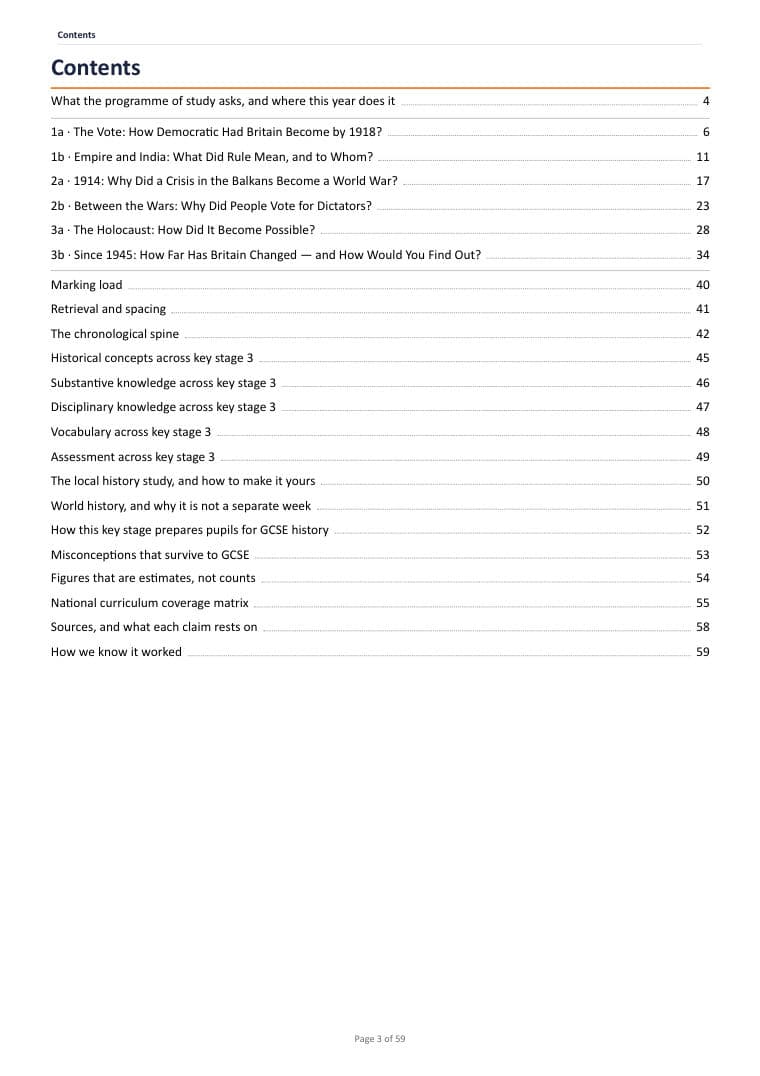
Two PDFs sit behind this page, and they are meant to be used together: the scheme of work to plan the year, the knowledge organisers to put in front of pupils.
The statutory programme of study for key stage 3 history (DfE, 2013)·59 pages, 23 sections·For heads of history, subject leaders and every teacher who has to deliver it
Six half-term units, in the order they are taught: The Vote: How Democratic Had Britain Become by 1918?, Empire and India: What Did Rule Mean, and to Whom?, 1914: Why Did a Crisis in the Balkans Become a World War?, Between the Wars: Why Did People Vote for Dictators?, The Holocaust: How Did It Become Possible? and Since 1945: How Far Has Britain Changed — and How Would You Find Out?.
What do pupils produce in Year 9 History?
A judgement — how democratic had Britain become by 1918? — argued against stated criteria; An evaluation of a historical interpretation of empire, on grounds the student states; A causal argument with a conceded and answered counter-case; A comparison of two cases on shared criteria, with a judgement about what the comparison reveals and conceals; An extended written account of the Holocaust as a process, assessed on accuracy and sequence; An independent enquiry: a question the student frames, with a plan for the evidence that could answer it, and an answer.
Does Year 9 History meet the National Curriculum?
It maps each requirement of the key stage 3 programme of study (National curriculum in England: history programmes of study, key stage 3, Department for Education, DFE-00194-2013, September 2013) to the unit that teaches it, and on this year the scheme is plain: “This year completes the programme of study's content for key stage 3, with the exceptions the coverage matrix at the back lists by name: the Enlightenment and the French Revolutionary wars in Year 8's period, and the Second World War as a unit of its own — the war is the setting of units 3a and 3b, and Churchill's wartime leadership is not covered.”
Cookies
This site works the same either way. Measurement — Google Analytics and Microsoft Clarity — only runs if you say yes, and it is used to see which resources people actually reach.Measurement only runs if you say yes.What is collected.