History · KS3 to A Level · £4.99
History
Key Terms
Every word a history department teaches, Year 7 to A Level, in one A4 book. Each key stage gets its own pages: the terms grouped the way they are taught rather than alphabetically, a definition that fits on two lines, and a worked example beside almost every one. Each key stage opens on one invented source extract, annotated — historical enquiry and sources, the one skill every other band in the book assumes — and the numbers on it appear again beside the same words in the list; a further four pages carry a real drawn figure wherever a picture genuinely teaches faster than a sentence: a timeline across the three eras, a long-term-cause-to-consequence chain, two sources either confirming or contradicting each other, an orthodox view challenged by a revisionist one. Then a page on using the words: the ones the assessment itself is written in — GCSE History carries four assessment objectives, not the three most subjects share — the false friends that mean something else in a history classroom, the same point written weakly and then properly, and what each word becomes at the next key stage.
£4.99The whole book, Year 7 to A Level, 11 pages
- A4 PDF
- every page shown, part-blurred
- instant download
One purchase covers the school that buys it. Print it, copy it, hand it round your department. Not for passing to other schools or uploading anywhere.
PDF download, ready straight after payment. Downloading it ends the 14-day right to cancel; a file that is faulty or not as described is always refunded. Refunds
Read before publication by serving senior leaders, in school.
5.0 from 24+ reviews on Google
Schools that have bought from Empower Educators include Nottingham High School, Northampton High School GDST and Sutton Valence School.
Everything else this site has for History: History teaching resources
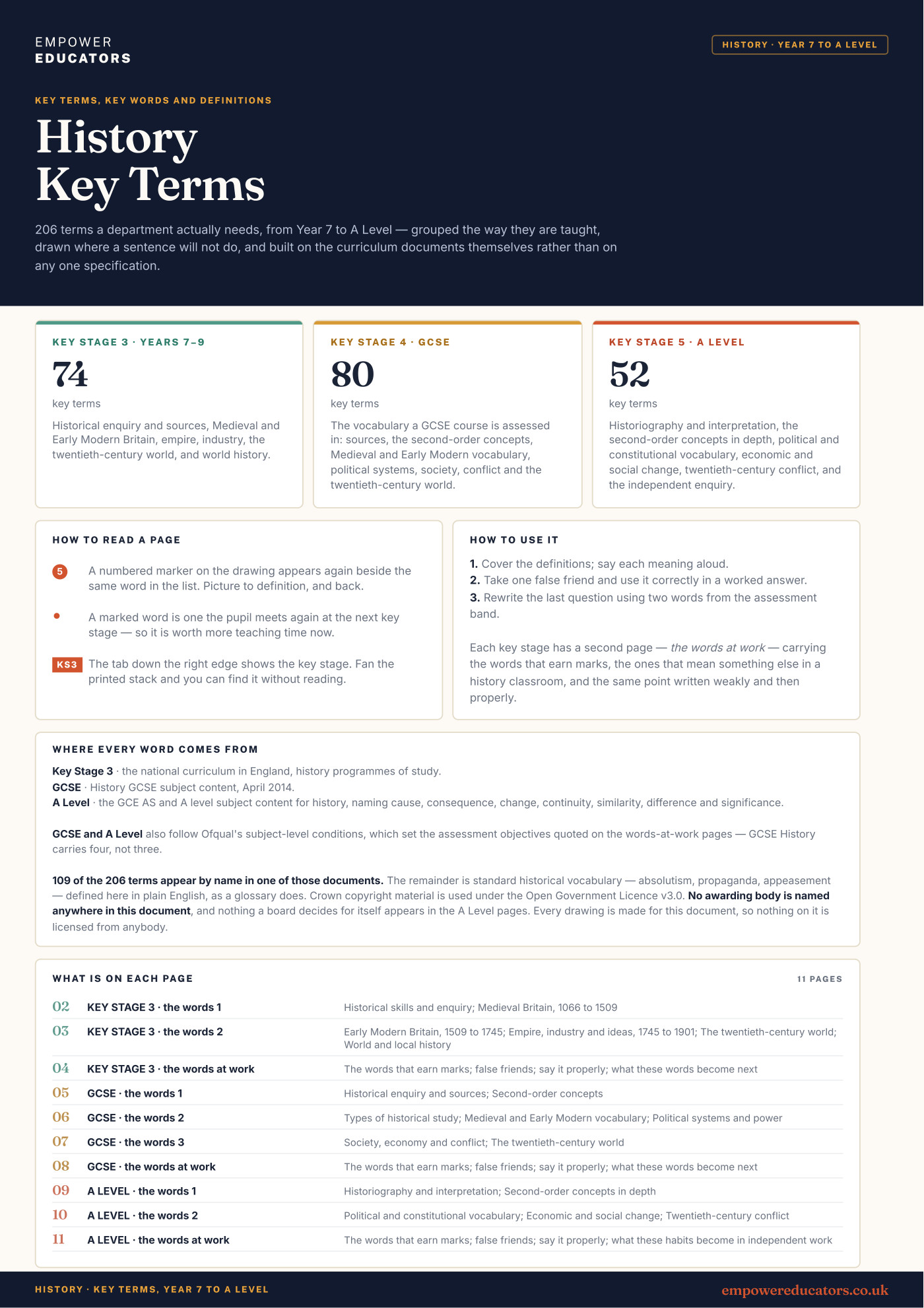
A pupil who knows a word is not yet using it. This book is built around that gap. The words for each key stage sit in the groups they are taught in, each with a short definition and a worked example, and a marked word is one the pupil meets again at the next key stage, so a department can see where its vocabulary carries forward and where it changes name. Every key stage opens on one annotated source, because band one is always historical enquiry and sources — primary source, evidence, interpretation and bias at Key Stage 3; provenance, utility and corroboration at GCSE; historiography, orthodox and revisionist at A Level — because reading and weighing evidence is the one skill the rest of the subject assumes a pupil already has. No source on any page is real: every extract and every historian's view was invented for the book, never attributed to an actual document or person, which matters more on a sheet that exists to teach source criticism than anywhere else in the series.
Every key stage closes on a page about using the words. The words the assessment is written in, quoted from Ofqual where they are theirs. The false friends: scale is not fish skin, a charter is not a travel booking, a legacy can be a warning as easily as an achievement — words a pupil already owns in another sense, contrasted with what they actually mean here. The same point written weakly and then properly. And a table of what each habit is called at the next stage, so "listing causes of an event" at GCSE is already "evaluating causation as multi-causal and contingent" by the time it is assessed at A Level. Nothing a board decides for itself is in it: this book runs a little shorter than its siblings in the series, because the national curriculum and GCSE subject content for history define skills and structure rather than naming the vocabulary itself, and the honest word count follows from that rather than from any specification's choice of period.
- Written to
- The DfE's national curriculum programmes of study for history at Key Stage 3, the History GCSE subject content (April 2014, DFE-00346-2014), and the GCE AS and A level subject content for history (DFE-00364-2014), which names cause, consequence, change, continuity, similarity, difference and significance as the concepts every specification must assess; GCSE and A Level also follow Ofqual's subject-level conditions and guidance, which set the assessment objectives quoted on the words-at-work pages; 109 of 206 terms appear by name in one of those documents and the cover says so, the rest are standard historical vocabulary defined here in plain English; no awarding body is named, and nothing a board decides for itself appears in the A Level pages
- Intended for
- history departments: printed one per pupil, kept in the front of an exercise book, or put on the wall by key stage
- Extent
- 11 pages · 10 sections
Look inside
Real pages, straight from the PDF
Click any page to see it full size.
Contents
All 10 sections
Taken from the book’s own contents page, so the page numbers are the real ones.