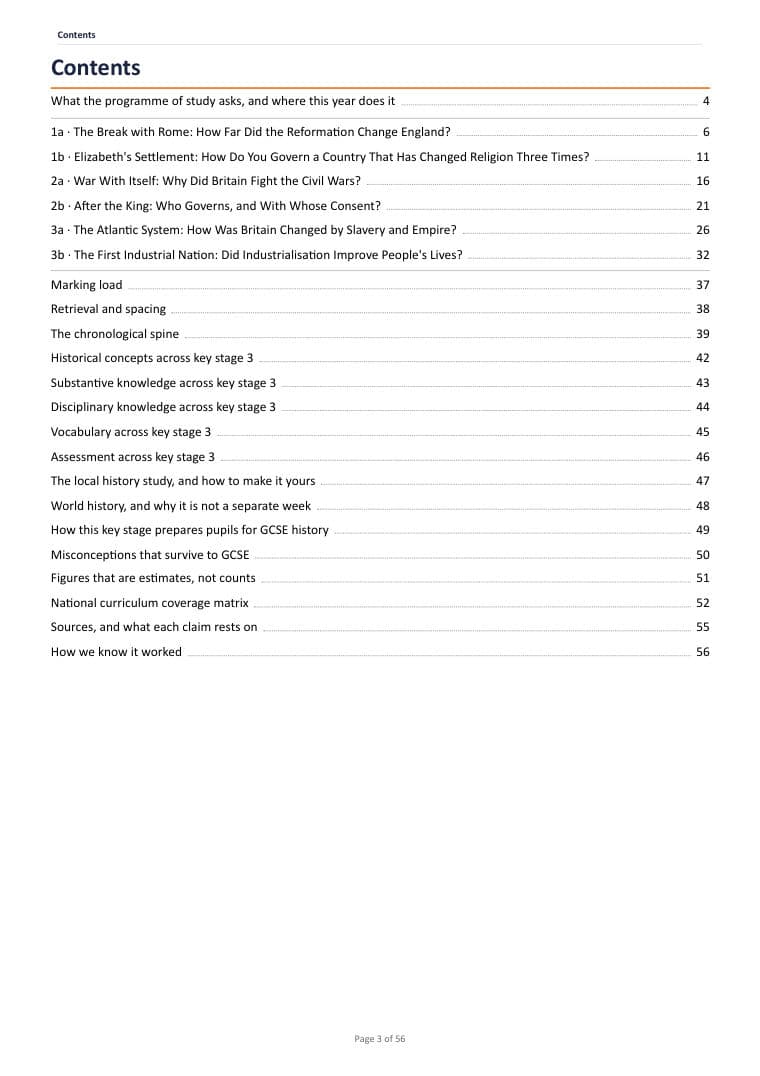
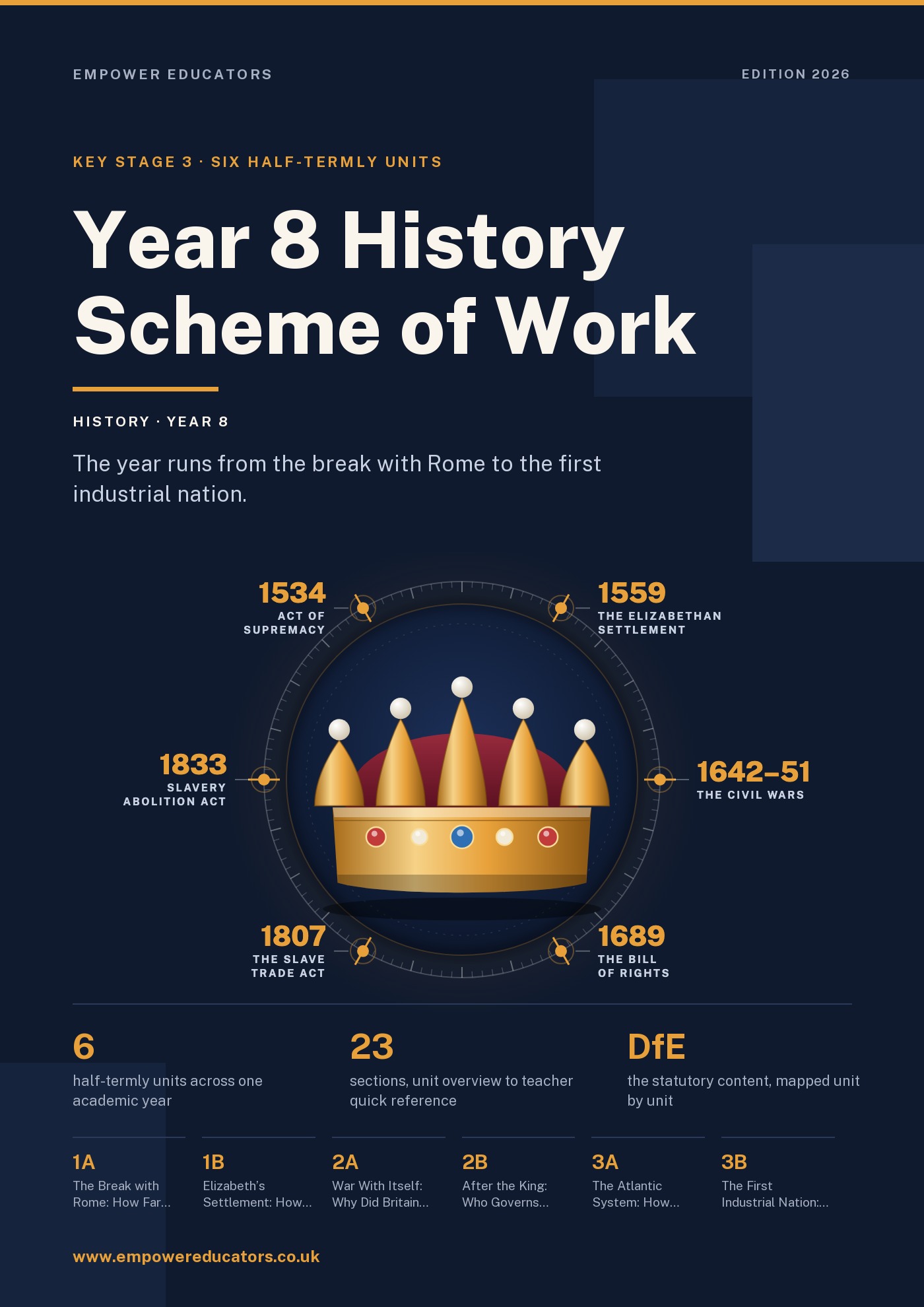
Six half-term units, in chronological order: the break with Rome; the Elizabethan settlement; the civil wars; who governed after the king, 1649 to 1707; the Atlantic system of slavery and empire; and the first industrial nation. Below is what each unit asks pupils to produce, the people and the events it names, taken from our Year 8 History scheme of work.
Six units, one academic year, in chronological order. The year completes the statutory period to 1745 and then opens the century after it, so that Year 9 begins with an industrial society already built.
Year 8, ages 12–13.
The year, unit by unit
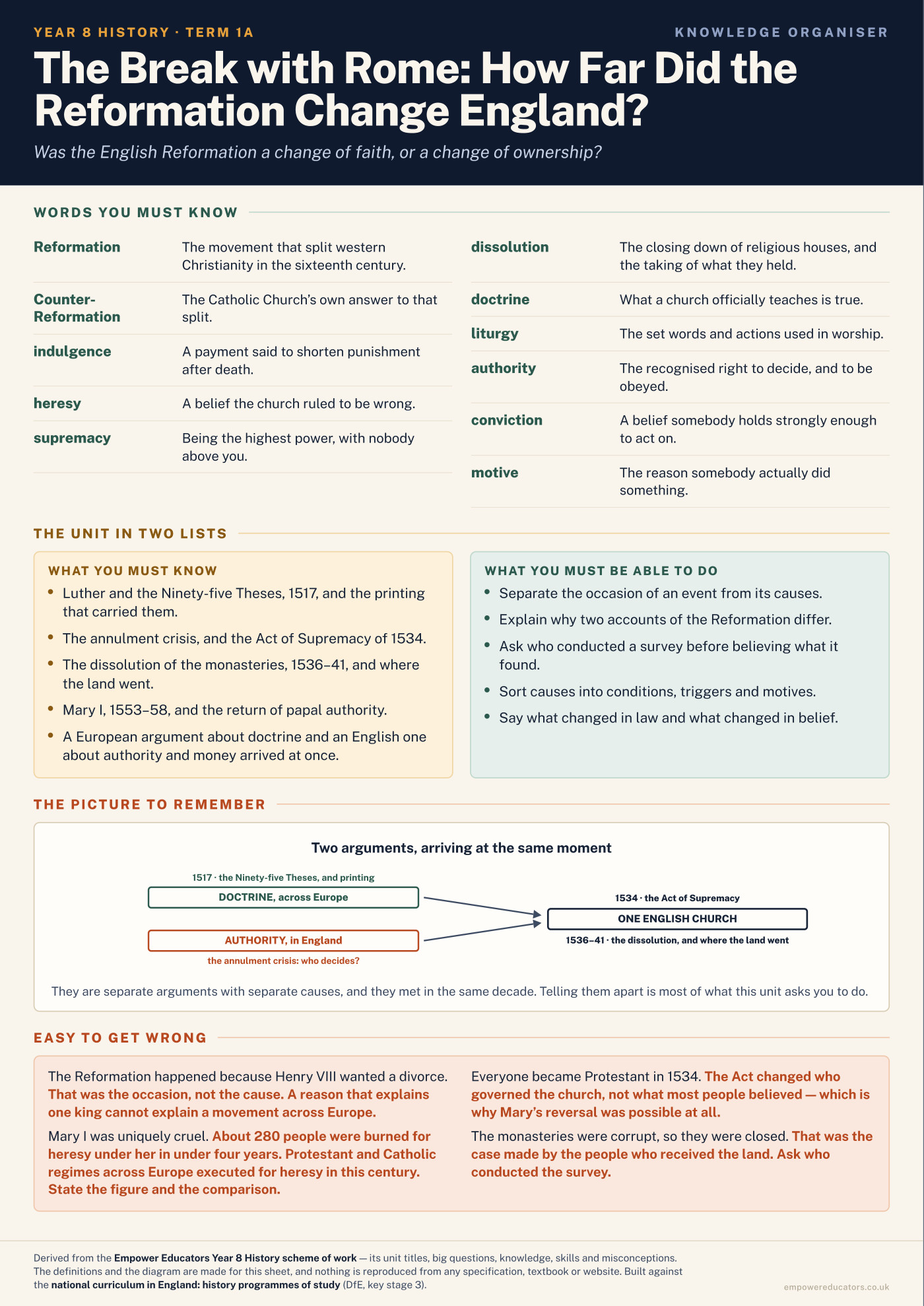
The Break with Rome: How Far Did the Reformation Change England?
Unit 1a · Autumn 1 · 6 lessons · September – October
Was the English Reformation a change of faith, or a change of ownership?
Pupils produce
An interpretation task: why do two accounts of the Reformation differ, and what does each rest on?
People
Martin Luther; Henry VIII; Mary I.
Events
The Ninety-five Theses; the Act of Supremacy; the dissolution; the restoration of papal authority under Mary.
Elizabeth's Settlement: How Do You Govern a Country That Has Changed Religion Three Times?
Unit 1b · Autumn 2 · 6 lessons · November – December
Was the Elizabethan settlement a solution, or a postponement?
Pupils produce
A source-utility task answered with contextual knowledge: how useful is this source for understanding the threat to Elizabeth?
People
Elizabeth I.
Events
The settlement; the Armada; the East India Company charter; Jamestown.
War With Itself: Why Did Britain Fight the Civil Wars?
Unit 2a · Spring 1 · 6 lessons · January – February
Why did a quarrel about money and religion end with a king on trial?
Pupils produce
An extended causal argument, three causes ranked and the ranking defended against a stated alternative.
People
Charles I; Oliver Cromwell.
Events
The breakdown with Parliament; the wars in England, Scotland and Ireland; the trial; the execution.
After the King: Who Governs, and With Whose Consent?
Unit 2b · Spring 2 · 6 lessons · February – March
Between 1649 and 1707, who ended up holding power — and how would you know?
Pupils produce
A change-and-continuity judgement across 1640–1707, with evidence on both sides.
People
Oliver Cromwell.
Events
The Protectorate; the Irish campaign; the Restoration; 1688; the Bill of Rights; the Union; the risings.
The Atlantic System: How Was Britain Changed by Slavery and Empire?
Unit 3a · Summer 1 · 6 lessons · April – May
Who built the Atlantic system, who paid for it, and who ended it?
Pupils produce
An enquiry with evidence the student selects, answering one part of the enquiry question.
People
Olaudah Equiano; William Wilberforce.
Events
The Atlantic trade; the Seven Years War; the American War of Independence; the Abolition Act, 1807; the Slavery Abolition Act, 1833.
The First Industrial Nation: Did Industrialisation Improve People's Lives?
Unit 3b · Summer 2 · 6 lessons · June – July
Whose lives improved, whose did not, and how long did it take to tell?
Pupils produce
A synoptic paragraph connecting industrialisation to the Atlantic system, plus a completed local enquiry.
People
None named. The unit is about a process and the people in it.
Events
The Poor Law Amendment Act of 1834 is the one dated event; otherwise the unit teaches a process and says so.
How it meets the key stage 3 programme of study
The scheme maps each requirement of the key stage 3 programme of study (National curriculum in England: history programmes of study, key stage 3, Department for Education, DFE-00194-2013, September 2013) to the unit that teaches it. Pupils should be taught to…
Chronological security: extend and deepen their chronologically secure knowledge and understanding of British, local and world history, so that it provides a well-informed context for wider learning
Every unit opens on the spine; 2b holds sixty years against it and 3b a century and a half.
Connections and trends: identify significant events, make connections, draw contrasts, and analyse trends within periods and over long arcs of time
2b — sixty years measured for change and continuity; 3b — a century and a half of industrialisation read as a trend rather than an event.
Historical terms and concepts: use historical terms and concepts in increasingly sophisticated ways
1a — Reformation, dissolution and supremacy taught as precise terms; 2a — the constitutional vocabulary of the civil wars, each word with its instance.
Enquiry and structured accounts: pursue historically valid enquiries including some they have framed themselves, and create relevant, structured and evidentially supported accounts in response
3a and 3b — the first enquiries in the key stage where students select their own evidence, and a local enquiry framed by the class.
Sources and interpretations: understand how different types of historical sources are used rigorously to make historical claims and discern how and why contrasting arguments and interpretations of the past have been constructed
1a — why two accounts of the Reformation differ; 1b — source utility answered with contextual knowledge; 3a — the silence of the record.
Overview and depth — the planning requirement teachers should combine overview and depth studies to help pupils understand both the long arc of development and the complexity of specific aspects of the content
Overview in 2b (1640–1700) and 3b (a century and a half); depth in 1a and 2a.
This year deliberately does not cover the extension of the franchise, empire in India, Ireland and Home Rule, or Darwin. All four are Year 9, and the reason is that each needs the industrial society this year builds in order to make sense: a class that has not met an urban working population cannot explain why the franchise became the question of the nineteenth century. Two of the programme's examples for 1745–1901 are not taken up at all — the Enlightenment, and the French Revolutionary wars. The spine places the wars; no unit teaches either, and this scheme says so rather than claiming them as context. A department that wants them adds a unit; the coverage matrix at the back marks both as not taken up.
The Year 8 History resources
Two PDFs sit behind this page, and they are meant to be used together: the scheme of work to plan the year, the knowledge organisers to put in front of pupils.
The statutory programme of study for key stage 3 history (DfE, 2013)·56 pages, 23 sections·For heads of history, subject leaders and every teacher who has to deliver it
Six half-term units, in the order they are taught: The Break with Rome: How Far Did the Reformation Change England?, Elizabeth's Settlement: How Do You Govern a Country That Has Changed Religion Three Times?, War With Itself: Why Did Britain Fight the Civil Wars?, After the King: Who Governs, and With Whose Consent?, The Atlantic System: How Was Britain Changed by Slavery and Empire? and The First Industrial Nation: Did Industrialisation Improve People's Lives?.
What do pupils produce in Year 8 History?
An interpretation task: why do two accounts of the Reformation differ, and what does each rest on?; A source-utility task answered with contextual knowledge: how useful is this source for understanding the threat to Elizabeth?; An extended causal argument, three causes ranked and the ranking defended against a stated alternative; A change-and-continuity judgement across 1640–1707, with evidence on both sides; An enquiry with evidence the student selects, answering one part of the enquiry question; A synoptic paragraph connecting industrialisation to the Atlantic system, plus a completed local enquiry.
Does Year 8 History meet the National Curriculum?
It maps each requirement of the key stage 3 programme of study (National curriculum in England: history programmes of study, key stage 3, Department for Education, DFE-00194-2013, September 2013) to the unit that teaches it, and on this year the scheme is plain: “This year deliberately does not cover the extension of the franchise, empire in India, Ireland and Home Rule, or Darwin.”
Cookies
This site works the same either way. Measurement — Google Analytics and Microsoft Clarity — only runs if you say yes, and it is used to see which resources people actually reach.Measurement only runs if you say yes.What is collected.