Science · GCSE Physics (Key Stage 4) · £5.99
Year 11 Physics
Scheme of Work
GCSE Physics Scheme of Work (SOW) — KS4 Year 11 PDF
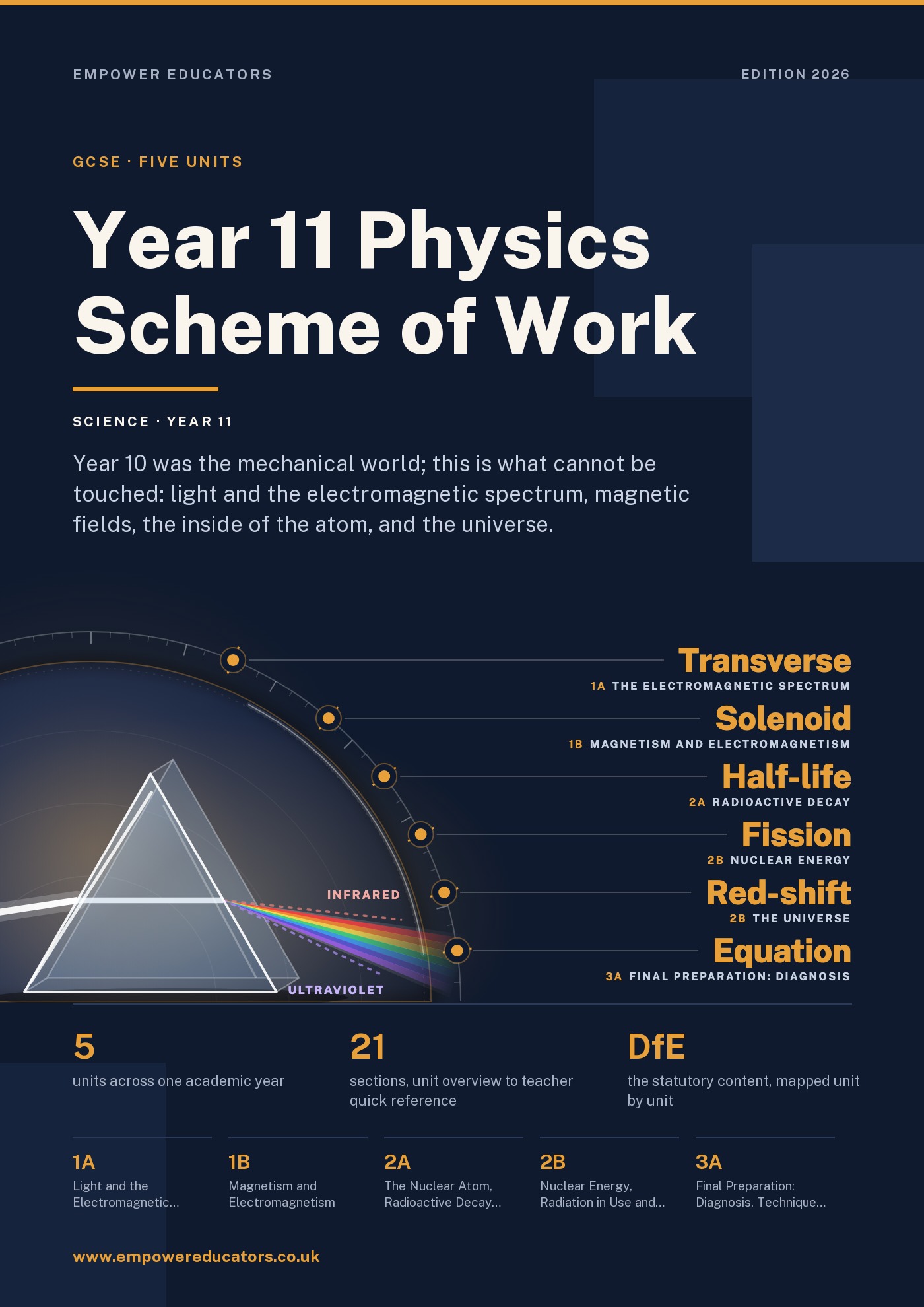
Seventy-one pages completing the two-year course. Year 10 was the mechanical world; this is what cannot be touched: light and the electromagnetic spectrum, magnetic fields, the inside of the atom, and the universe. The remaining forty-six of the subject content’s one hundred and twenty-three statements are taught here, each mapped to the phase that teaches it. Seven figures, an equations page dividing the nineteen relationships to recall from the nine supplied, and eight named joints back to Year 10.
£5.99The Year 11 scheme: 5 half-termly units, 71 pages
- A4 PDF
- first 8 pages free to read
- instant download
Teaching all of the GCSE course? Year 10 and Year 11 as one set: £9.99, saving £1.99.
One purchase covers the school that buys it. Print it, copy it, hand it round your department. Not for passing to other schools or uploading anywhere.
PDF download, ready straight after payment. Downloading it ends the 14-day right to cancel; a file that is faulty or not as described is always refunded. Refunds
Read before publication by the serving head of that department and by senior leaders, in school.
5.0 from 24+ reviews on Google
Schools that have bought from Empower Educators include Nottingham High School, Northampton High School GDST and Sutton Valence School.
Complete your Physics
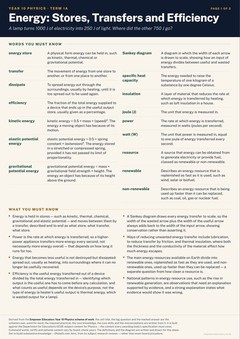

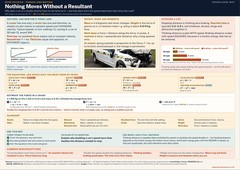
Board-neutral, written for AQA, OCR and Pearson Edexcel. All GCSE schemes of work
Both years: GCSE Physics scheme of work
Everything else this site has for Science: Science teaching resources
- 1aLight and the Electromagnetic Spectrum
- 1bMagnetism and Electromagnetism
- 2aThe Nuclear Atom, Radioactive Decay and Half-life
- 2bNuclear Energy, Radiation in Use and the Universe
- 3aFinal Preparation: Diagnosis, Technique and the Whole Course
Ten sections per unit, in the same order every time. Phases rather than single lessons, because science is timetabled at around three hours a week.
Five half-termly units, and the fifth teaches nothing new. Every statement is discharged by the end of Spring 2 so the final half-term can be spent on diagnosis and examination technique rather than on content a student would have no time to consolidate.
Light opens the year because the wave equation is the relationship the rest keeps returning to. It is the spectrum in the first unit and the red-shift in the fourth. The order then runs from the wave a student can see, through the field that carries it, to the nucleus that emits it, and finally to the sky.
One route fact shapes the whole plan and is stated rather than buried. The combined science subject content has no Space physics topic at all, and no fission, fusion or radiation-in-use content, so the fourth unit is separate physics from beginning to end. A combined class reaches the end of its physics course at the end of Spring 1, and the revision unit is written to start six weeks early in its place.
Physics is the only one of the three sciences whose subject content carries an equations appendix, so this book prints it: nineteen relationships to be recalled from memory and nine supplied in the examination, with the Higher-tier ones marked. Board-neutral throughout — the content, the tiering, the mathematics and the apparatus criteria are national; the named required practicals are set by each awarding organisation.
- Written to
- The GCSE subject content for physics (DfE, DFE-00352-2014) and for combined science (DFE-00351-2014)
- Intended for
- heads of science, physics leads and every teacher taking a class to the examinations
- Extent
- 71 pages · 21 sections
The sequence
What this scheme of work covers, unit by unit
The 5 units of the Year 11 Physics Scheme of Work, in teaching order, with the term each one runs in and the question it is built to answer.
1a
Light and the Electromagnetic Spectrum
Autumn 1 · approx. 7 weeks · September – October
harmless and the other dangerous?
1b
Magnetism and Electromagnetism
Autumn 2 · approx. 7 weeks · November – December
how do you know it is not the wire touching something?
2a
The Nuclear Atom, Radioactive Decay and Half-life
Spring 1 · approx. 6 weeks · January – February
A source has a half-life of six hours. Is it safe to handle after twelve?
2b
Nuclear Energy, Radiation in Use and the Universe
Spring 2 · approx. 6 weeks · February – March
blown itself apart?
3a
Final Preparation: Diagnosis, Technique and the Whole Course
Summer 1 · approx. 5 weeks · April – May, to the first paper
Which of the equations you must recall can you actually write down right now, without the sheet?
Look inside
Real pages, straight from the PDF
Click any page to see it full size.
Contents
All 21 sections
Taken from the book’s own contents page, so the page numbers are the real ones.