Science · A Level · £6.99
A Level Sciences
Scheme of Work
A Level Science Scheme of Work — All Three Sciences
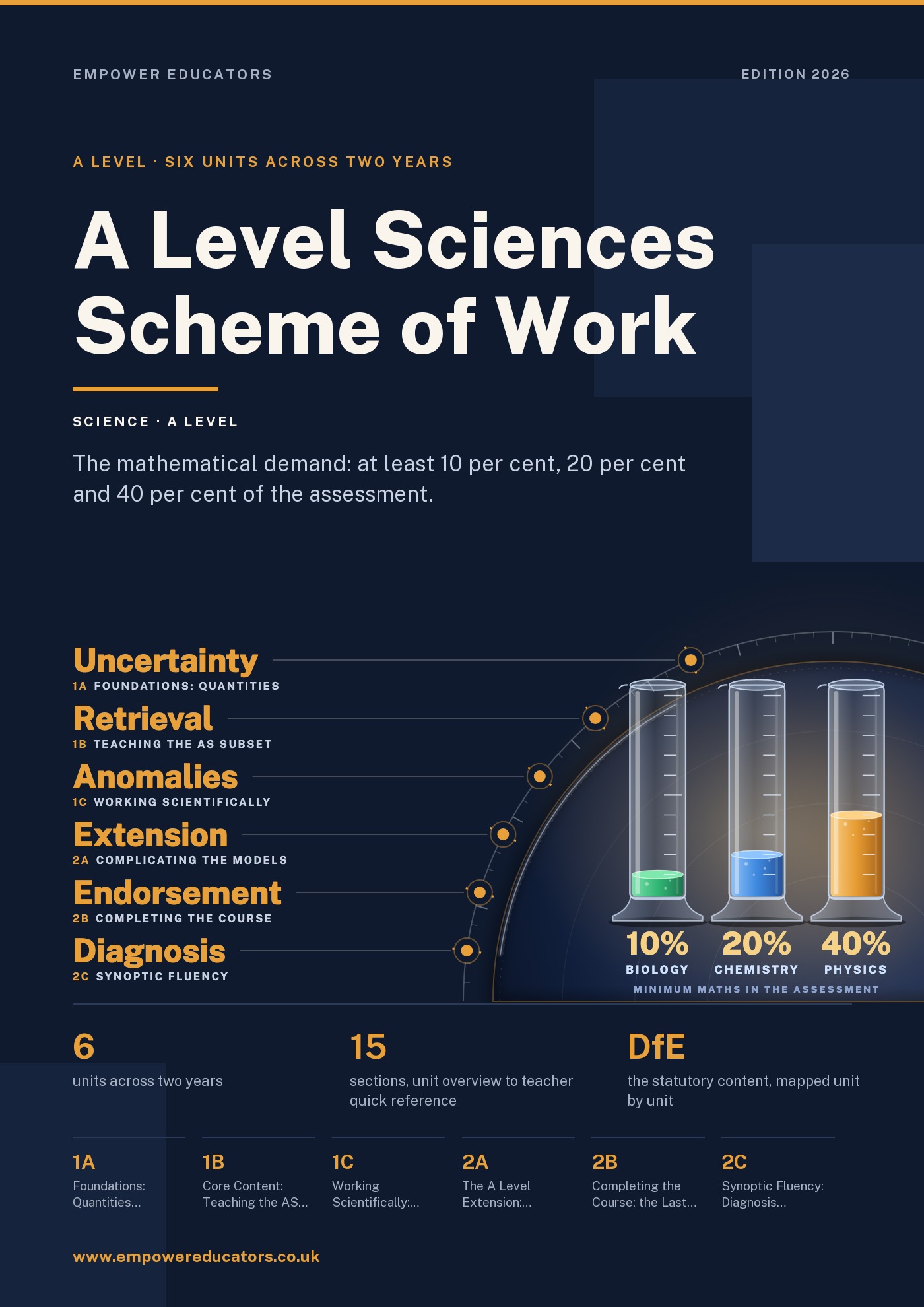
Forty-four pages covering biology, chemistry and physics together, because the DfE publishes one subject content document for all three. What they do not share is the mathematical demand: at least 10 per cent, 20 per cent and 40 per cent of the assessment. It is diagnosed by discipline in Week 1 rather than taught as one shared lesson. The twelve practical activities are scheduled across the two years with technician lead times, and practical skills are prepared for as written-paper marks as well as for the endorsement.
£6.99The A Level scheme: 6 units across Year 12 and Year 13, 44 pages
- A4 PDF
- first 8 pages free to read
- instant download
One purchase covers the school that buys it. Print it, copy it, hand it round your department. Not for passing to other schools or uploading anywhere.
PDF download, ready straight after payment. Downloading it ends the 14-day right to cancel; a file that is faulty or not as described is always refunded. Refunds
Read before publication by the serving head of that department and by senior leaders, in school.
5.0 from 24+ reviews on Google
Schools that have bought from Empower Educators include Nottingham High School, Northampton High School GDST and Sutton Valence School.
Complete your Science

Every key stage: Science scheme of work
Everything else this site has for Science: Science teaching resources
- 1aFoundations: Quantities, Uncertainty, and the Mathematics Inside Science
- 1bCore Content: Teaching the AS Subset So It Survives Year 13
- 1cWorking Scientifically: Data, Evidence and the Endorsement at Half Way
- 2aThe A Level Extension: Complicating the Models
- 2bCompleting the Course: the Last Content, the Last Practical, and the Endorsement Signed Off
- 2cSynoptic Fluency: Diagnosis, Application and the Examinations
Ten sections per unit, in the same order every time. Every unit carries the teaching the three disciplines share and then names what each one does with it, so a single-subject teacher reads their own row and a combined team can plan the year together.
The practical endorsement is treated as a two-year accumulation rather than a task: nine of the twelve activities fall in Year 12, the technique log is audited three times, and the folder is read by a stranger in January rather than assembled in May.
Nothing in this scheme is a risk assessment. Every activity must be checked against your own employer’s model — CLEAPSS, or SSERC in Scotland — in its current version before it runs.
- Written to
- The DfE subject content for AS and A level science (biology, chemistry, physics and psychology)
- Intended for
- heads of department, subject leaders and every teacher who has to deliver it
- Extent
- 44 pages · 15 sections
The sequence
What this scheme of work covers, unit by unit
The 6 units of the A Level Sciences Scheme of Work, in teaching order, with the term each one runs in and the question it is built to answer.
1a
Foundations: Quantities, Uncertainty, and the Mathematics Inside Science
Year 12 · Autumn · approx. 13 weeks · September – December
Your answer is 4.7. How do you know it is not 4.9?
1b
Core Content: Teaching the AS Subset So It Survives Year 13
Year 12 · Spring · approx. 11 weeks · January – March
Which of the things you learned this term will still be true in a year?
1c
Working Scientifically: Data, Evidence and the Endorsement at Half Way
Year 12 · Summer · approx. 12 weeks · April – July
The data disagrees with the theory. Which one is wrong?
2a
The A Level Extension: Complicating the Models
Year 13 · Autumn · approx. 13 weeks · September – December
What did last year's model have to leave out?
2b
Completing the Course: the Last Content, the Last Practical, and the Endorsement Signed Off
Year 13 · Spring · approx. 11 weeks · January – March
Is the endorsement evidence, or is it paperwork?
2c
Synoptic Fluency: Diagnosis, Application and the Examinations
Year 13 · Summer · approx. 6 weeks · April – May
You know the science. Why are you still losing marks?
Look inside
Real pages, straight from the PDF
Click any page to see it full size.
Contents
All 15 sections
Taken from the book’s own contents page, so the page numbers are the real ones.