All 4 sheets — Forces and motion, Waves and the electromagnetic spectrum, Electricity and Atomic structure and radioactivity — for £3.99. One landscape page per topic,
every claim sourced and every image licensed.
4 sheets · one A4 landscape PDF each · instant download
Bought once for the set, not per sheet. Photocopy them for your classes freely — keep
the running foot on the page, which carries the image credits the licences require.
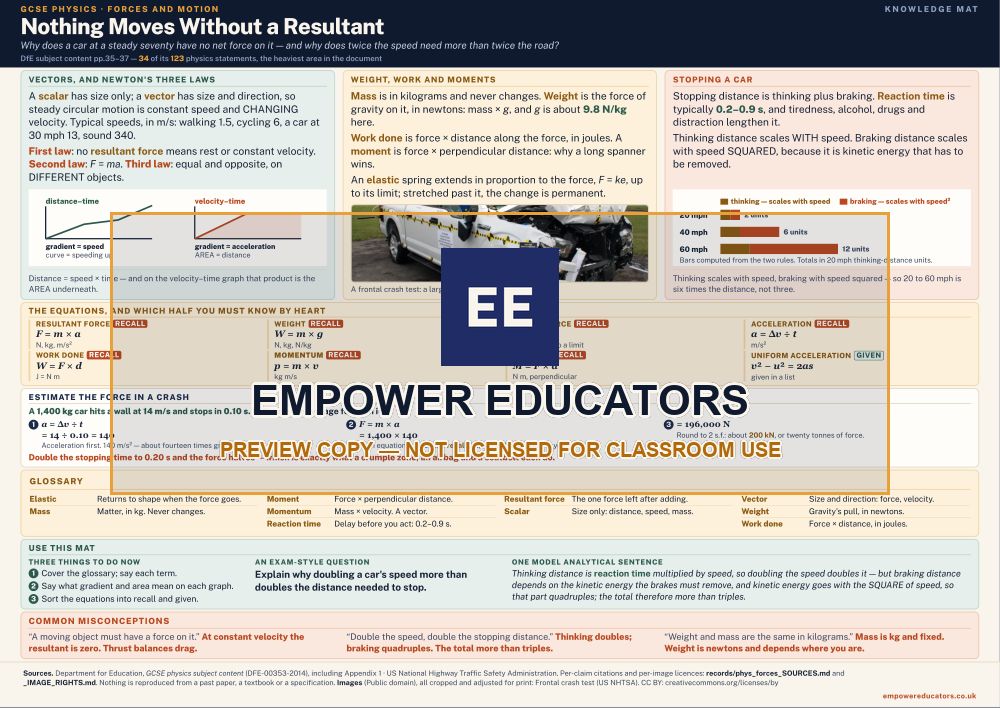
Why a car at a steady seventy has no net force on it — and why twice the speed needs more than twice the road. Scalars, vectors and Newton's three laws, with the two motion graphs; mass, weight, work, moments and Hooke's law; stopping distance drawn from its two rules; eight equations with a chip saying which you must recall and which you are given; a worked crash-force estimate. Ten terms to define, a model answer on doubling speed, and the misconceptions that cost marks.
If every electromagnetic wave travels at the same speed, what makes a gamma ray dangerous and a radio wave harmless? Amplitude, wavelength, frequency and period, with transverse and longitudinal waves drawn side by side; the seven bands of the spectrum in order, with what each is used for; reflection, refraction, absorption and colour, under Röntgen's first X-ray of 1895; the three relationships with the recall/given chip; a worked wavelength from a frequency. Eight terms to define, a model answer on why gamma rays ionise, and the misconceptions that cost marks.
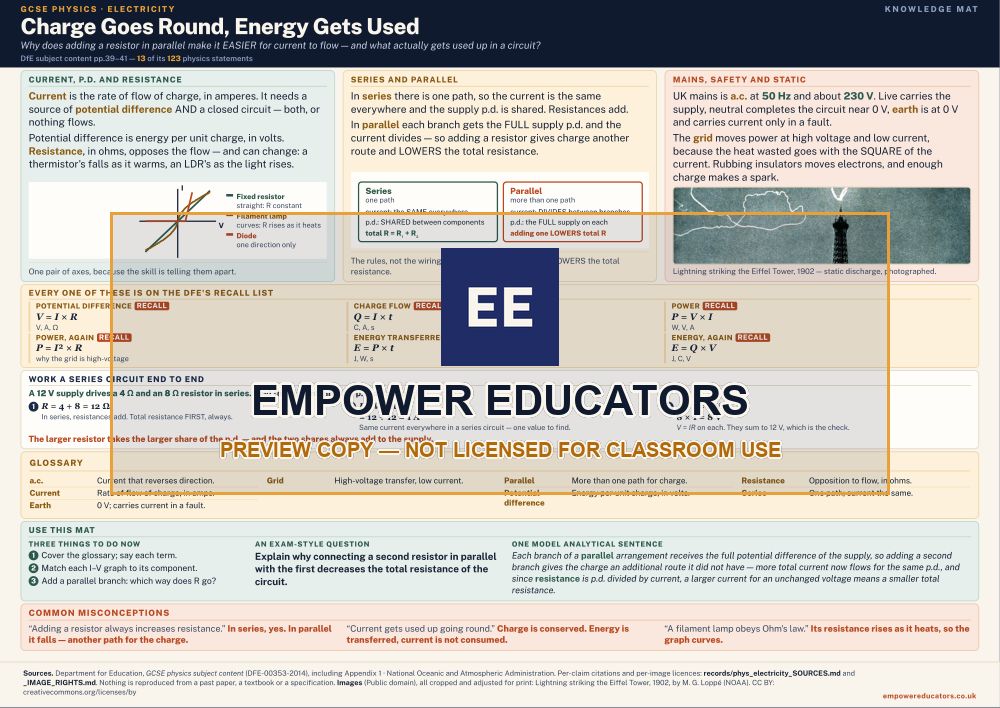
Why adding a resistor in parallel makes it easier for current to flow — and what actually gets used up in a circuit. Current, potential difference and resistance, with three I–V curves on one pair of axes; series and parallel rules; mains, safety, the grid and static, under lightning striking the Eiffel Tower in 1902; six equations, every one on the DfE's recall list; a series circuit worked end to end. Eight terms to define, a model answer on parallel resistance, and the misconceptions that cost marks.
If nobody can say which nucleus decays next, how can a half-life be known to the second? The nucleus and isotope notation; alpha, beta and gamma, with penetration and ionising power drawn running opposite ways; half-life, fission and fusion; six distinctions that decide an answer, from contamination to background radiation; a worked decline as a ratio. Ten terms to define, a model answer on why alpha is worst inside the body, and the misconceptions that cost marks.
The previews above are the full sheets, watermarked. Where a sheet carries photographs,
every one is public domain worldwide or licensed CC BY, verified per image against the
licence itself rather than a label, and the running foot names every creator, records that
the images have been cropped and adjusted for print, and links the licence; figures are
drawn in code for the sheet, and extracts are written for it or verified against a
public-domain text. Nothing on any sheet is reproduced
from a past paper, a mark scheme, an examiner report or a specification, and Empower
Educators is not affiliated with any awarding body.
Cookies
This site works the same either way. Measurement — Google Analytics and Microsoft
Clarity — only runs if you say yes, and it is used to see which resources people
actually reach. What is collected.