Chemistry · GCSE · £6.99
GCSE Chemistry
Questions
& Answers
A student who reaches 9.75 g instead of 10 g because they forgot the hydrogen keeps two of the three marks. One who writes 10 g with no working keeps none. That is error carried forward, and it is worth more marks in chemistry than in any other subject on the timetable. Every calculation here is marked step by step, each step saying what it still earns when the number coming into it is wrong; below six marks the schemes carry the allow and do not accept lines a real scheme has, and at six they become level descriptors.
£6.99100 questions, each answered three times (weak, middling, strong), 107 pages
- A4 PDF
- first 14 pages free to read
- instant download
One purchase covers the school that buys it. Print it, copy it, hand it round your department. Not for passing to other schools or uploading anywhere.
PDF download, ready straight after payment. Downloading it ends the 14-day right to cancel; a file that is faulty or not as described is always refunded. Refunds
Read before publication by the serving head of that department and by senior leaders, in school.
5.0 from 24+ reviews on Google
Schools that have bought from Empower Educators include Nottingham High School, Northampton High School GDST and Sutton Valence School.
Complete your Chemistry

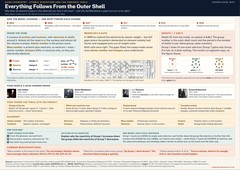
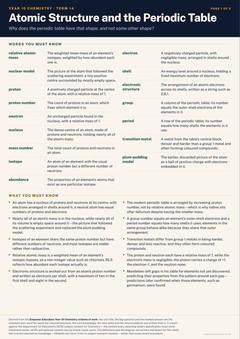
Everything else this site has for Chemistry: Chemistry teaching resources
Also teaching chemistry lower down the school, or the exam itself? Chemistry scheme of work · GCSE Chemistry assessment objectives
- 1Atomic structure and the Periodic Table
- 2Structure, bonding and the properties of matter
- 3Chemical changes
- 4Energy changes in chemistry
- 5Rates and equilibrium
- 6Quantitative chemistry
- 7Chemical analysis
- 8Industry, organic chemistry and the atmosphere
- 9Apparatus and working scientifically
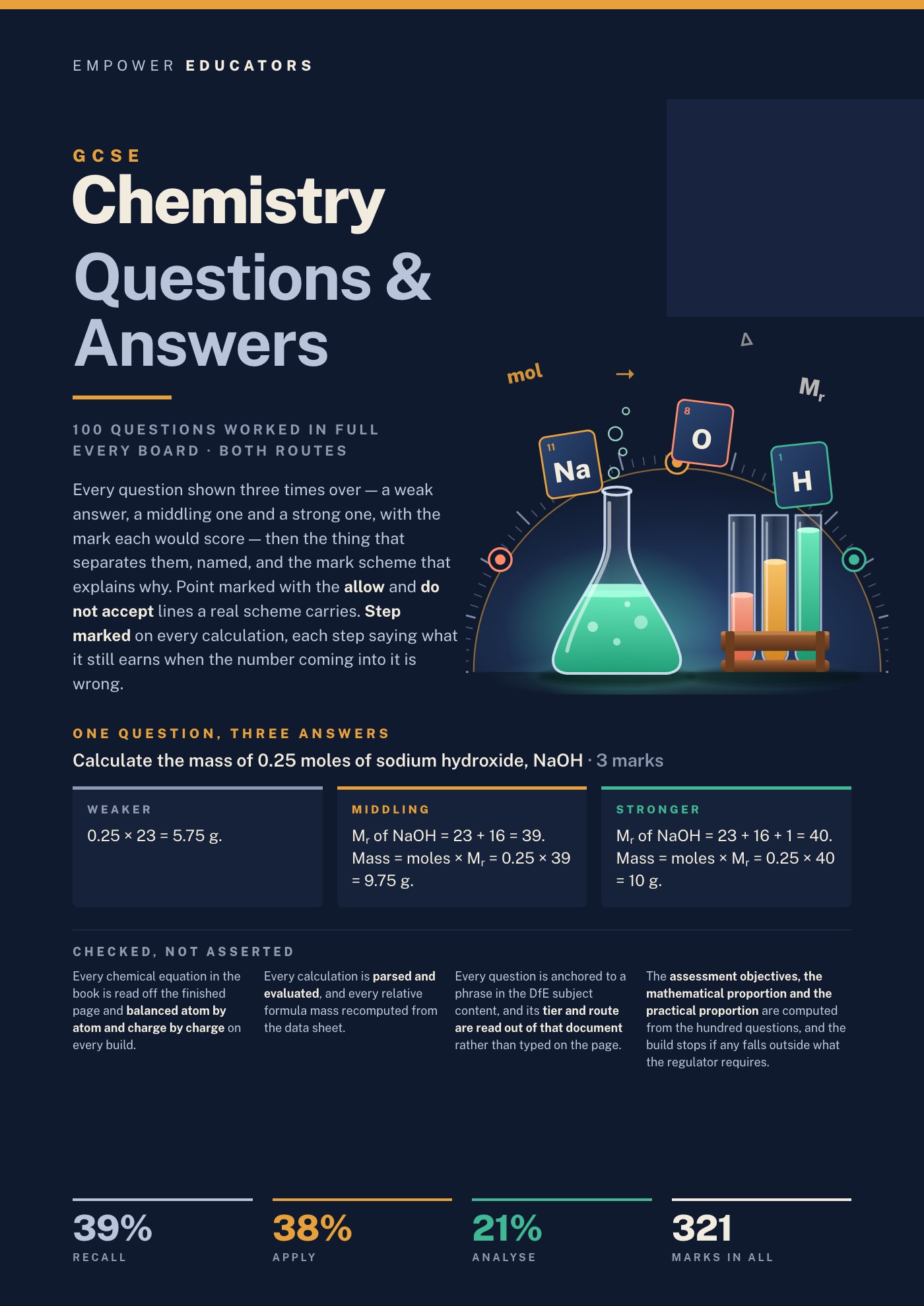
Not a bank of questions with the answers printed underneath. The three banded responses are the starting point, not the output: what follows each one is the discriminator, named out loud, then the questions you actually ask to move a student from the first answer to the last, then the mark scheme that shows what each line was worth. That combination is the part no mark scheme contains on its own.
Chemistry is the subject where working is worth marks, so this book carries a third kind of mark scheme the others do not. Every calculation is step marked, and each step says what it still earns when the value coming into it is wrong. A wrong relative formula mass, carried correctly through the relationship that follows it, keeps two marks out of three. A right answer with no working keeps none. That is how a chemistry paper is actually marked, and it is the strongest argument a teacher has for making a class write the method down.
Below six marks the schemes are point marked, with the two lines that decide most borderline answers: what is allowed (the wordings a marker still credits) and what is not accepted, which is where a mark goes for a word rather than for the chemistry. At six marks they become level descriptors, with one sentence on what actually lifts a response a band, which is never a further fact and always a further move.
Every question is written to a statement in the Department for Education’s subject content for GCSE chemistry, the document all four boards build their specifications on. That is checked on every build rather than asserted here, along with the tier and route each page is marked with. Every chemical equation is balanced atom by atom and charge by charge, every calculation is evaluated, and every relative formula mass is recomputed from the data sheet. No board is named anywhere in the book. Nothing is copied from a past paper, a mark scheme or an examiner report, and every figure is drawn in code, so there is no picture credit to clear before teaching from any page.
Tier and route are marked on the page rather than split into separate books. Thirteen questions are Higher tier and fifteen are required only by the separate chemistry GCSE; combined science is a subset of separate and Higher includes all of Foundation, so one book serves every class and each simply skips the pages its route does not need. The last chapter works through a single titration six ways: the method, the readings, the mean, the outliers, the errors, and whether the results are precise enough to support the conclusion at all.
- Written to
- The GCSE subject content for chemistry published by the Department for Education, which every board builds its specification on, and the assessment objectives and mathematical requirements set by Ofqual
- Intended for
- chemistry and science teachers and heads of department. Used with a class, not a student revision guide
- Extent
- 107 pages · 9 sections
Sample questions
Sample GCSE Chemistry questions and answers
Eight questions from the book, printed exactly as they appear in it: the question, the answers it works through, and the mark each one scores. All of them are in the free preview.
Question 1·Atomic structure and the Periodic Table·1 mark
Name the subatomic particle with a relative charge of +1.
Weaker0 marks
The electron.
Middling1 mark
The proton.
Stronger1 mark
The proton — it is the one with a positive charge, and the neutron is the one whose name says it has none.
What separates them
Three particles, three charges, and the whole of atomic structure rests on keeping them apart. The electron carries the charge of the same size and the opposite sign, which is why it is the answer a student reaches for when they have learned the pair as a pair rather than as two facts. The proton is positive, the electron negative, the neutron neither — and the neutron is the one whose name says so.
The full-mark answer1 mark
The proton.
Question 2·Atomic structure and the Periodic Table·3 marks
Give the relative mass and relative charge of a proton, a neutron and an electron.
Weaker1 mark
Protons are positive, neutrons are neutral and electrons are negative.
Middling2 marks
Proton: mass 1, charge +1. Neutron: mass 1, charge 0. Electron: charge −1.
Stronger3 marks
Proton: relative mass 1, relative charge +1. Neutron: relative mass 1, relative charge 0. Electron: relative mass 1/1836, which is effectively zero, relative charge −1.
What separates them
Two properties of three particles are wanted here — six pieces of information for three marks, so each mark covers a particle and needs both halves. The first answer gives one half three times and takes a single mark. The middling answer is complete for two particles and leaves the electron’s mass out, which is the one most often omitted because it is the one that is not a whole number. Its value matters: an electron weighs so little that the mass of an atom is effectively the mass of its nucleus, and that single consequence is why mass number counts protons and neutrons only.
The full-mark answer3 marks
Proton: relative mass 1, relative charge +1. Neutron: relative mass 1, relative charge 0. Electron: relative mass very small (1/1836), relative charge −1.
Question 4·Atomic structure and the Periodic Table·2 marks
Describe the difference between an atom and an ion of the same element.
Weaker1 mark
An ion is charged and an atom is not.
Middling2 marks
An atom has equal numbers of protons and electrons so it has no overall charge. An ion has lost or gained electrons, so the numbers are no longer equal and it has a charge.
Stronger2 marks
An atom has equal numbers of protons and electrons so it has no overall charge. An ion has lost or gained electrons, so the numbers are no longer equal and it has a charge. The number of protons does not change, so it is still the same element.
What separates them
True, and empty: the first answer names the difference without saying what causes it. Two marks want the charge and where it comes from, and the second half is a statement about electrons — an ion is an atom that has lost or gained them. The stronger answer adds the part that is not asked for but which shows the idea is secure: protons never change, which is why a sodium ion is still sodium. Change the protons and you have changed the element, which is a different thing entirely.
The full-mark answer2 marks
An atom has equal numbers of protons and electrons and no overall charge. An ion has lost or gained electrons, so protons and electrons are no longer equal and it carries a charge. The number of protons is unchanged, so it is still the same element.
Question 5·Atomic structure and the Periodic Table·3 marks
An atom of magnesium has atomic number 12 and mass number 24. Calculate the number of protons, neutrons and electrons it contains.
Weaker2 marks
12 protons, 24 neutrons, 12 electrons.
Middling3 marks
12 protons, 12 neutrons, 12 electrons.
Stronger3 marks
Protons = atomic number = 12. Electrons = protons = 12, because the atom is neutral. Neutrons = mass number − atomic number = 24 − 12 = 12.
What separates them
Reading the mass number straight off the page and calling it the neutron count is the whole of the first answer. The mass number counts protons and neutrons together, so the neutrons are what is left when the protons are taken out — a subtraction, which is the only arithmetic on the page and the only thing being tested. Magnesium is the awkward example for spotting the error, because 24 − 12 = 12 and every number on the page is either 12 or 24; the same mistake on sodium, 23 and 11, is visible at a glance.
The full-mark answer3 marks
Protons = atomic number = 12. Electrons = 12, because a neutral atom has equal numbers of protons and electrons. Neutrons = mass number − atomic number = 24 − 12 = 12.
Question 6·Atomic structure and the Periodic Table·2 marks
Calculate the number of electrons in an aluminium ion, Al3+ .
Weaker0 marks
Aluminium is 13, so 13 + 3 = 16 electrons.
Middling2 marks
Aluminium has 13 electrons. The ion is 3+ so it has lost 3. 13 − 3 = 10 electrons.
Stronger2 marks
An aluminium atom has 13 protons and 13 electrons. A 3+ charge means three more protons than electrons, so three electrons have been lost: 13 − 3 = 10.
What separates them
A positive charge means electrons have been lost, and the plus sign pulls students towards adding. The way to stop it going wrong is to say what the charge is made of: the protons have not moved, so a 3+ ion has three more protons than electrons, which can only happen if three electrons have gone. Read it as a subtraction that the plus sign is describing, not as an instruction to add.
The full-mark answer2 marks
An aluminium atom has 13 electrons. The 3+ charge means three electrons have been lost, so the ion has 13 − 3 = 10 electrons.
Question 7·Atomic structure and the Periodic Table·3 marks
Explain why all the elements in Group 1 react in a similar way.
Weaker0 marks
They are all in the same group so they are all similar.
Middling3 marks
They all have one electron in their outer shell. When they react they lose that electron to form a 1+ ion, so they all react in the same way.
Stronger3 marks
Every Group 1 element has one electron in its outer shell. Chemical reactions involve the outer electrons, so an atom with one outer electron loses it to reach a full outer shell, forming a 1+ ion in every case. The reactions are therefore of the same type, even though their vigour differs down the group.
What separates them
Using the group to explain itself explains nothing — the question is asking why the group behaves as a group. The chain has three links and each is a mark: one outer electron, that electron is lost, and a 1+ ion results. The stronger answer adds the qualification that keeps it honest, because caesium and lithium plainly do not react with the same vigour. Similar reactions, different rates — and the next question but three is about the difference.
The full-mark answer3 marks
All Group 1 elements have one electron in their outer shell. Reactions involve the outer electrons, so each atom loses that single electron to achieve a full outer shell. Each forms a 1+ ion, so their reactions are of the same type.
Question 57·Rates and equilibrium·6 marks
Evaluate the conditions chosen for the Haber process.
WeakerLevel 1 · 2 marks
The conditions are 450°C, 200 atmospheres and an iron catalyst. High pressure gives more ammonia and the catalyst speeds it up. The temperature is high to make it fast. These are the best conditions for making the most ammonia.
MiddlingLevel 2 · 4 marks
The reaction is exothermic and there are fewer gas molecules on the right, so a low temperature and a high pressure would both give the highest yield. In practice 450°C is used because at a low temperature the rate would be far too slow, and 200 atmospheres because higher pressures need very strong and expensive equipment. An iron catalyst speeds the reaction without affecting the yield.
What separates them
Treating every condition as chosen to maximise yield is why the first answer explains the temperature backwards. The second is correct and would satisfy most classroom marking. What Level 3 adds is the reason a compromise is acceptable: the unreacted nitrogen and hydrogen are recycled, so a modest yield per pass is not a modest yield overall. Once that is said, the conditions stop looking like a reluctant compromise and start looking like the right answer to the question industry is actually asking, which is not ‘what fraction converts’ but ‘how many tonnes a day, at what cost’.
The Level 3 answer6 marks · Level 3
The forward reaction is exothermic and has fewer moles of gas on the product side, so the highest yield would come from a low temperature and a very high pressure. Neither is used. At a low temperature the rate would be so slow that equilibrium would take far too long to reach, so about 450°C is chosen: it sacrifices yield to gain rate. At very high pressure the yield would be higher, but the plant would need to be far stronger and the compressors far more powerful, so about 200 atmospheres is chosen as the point where the extra ammonia stops paying for the extra equipment. The iron catalyst speeds the approach to equilibrium without altering the position, so it is the only condition with no cost to the yield. What makes the compromise acceptable is that the unreacted nitrogen and hydrogen are separated and passed through again, so a yield of around 15% per pass converts almost all the gas eventually. The conditions are therefore well chosen, because the quantity being maximised is not the yield per pass but the rate of production at an acceptable cost.
Question 63·Quantitative chemistry·3 marks
Calculate the mass of 0.25 moles of sodium hydroxide, NaOH.
Weaker0 marks
0.25 × 23 = 5.75 g
Middling2 marks
Mr of NaOH = 23 + 16 = 39. mass = moles × Mr = 0.25 × 39 = 9.75 g
Stronger3 marks
Mr of NaOH = 23 + 16 + 1 = 40. mass = moles × Mr = 0.25 × 40 = 10 g
What separates them
Both of the first two answers are wrong, and one of them scores nothing while the other keeps two marks out of three. Nothing separates them but what was written down. The middling answer forgot the hydrogen, so its Mr is wrong — but it states the relationship it is using and carries its own wrong number through correctly, and a chemistry mark scheme pays for both of those. The weaker answer reached a number and showed nothing, so there is no method to credit and no value that follows from anything. This is the whole argument for working on a calculation, and it is worth more marks in chemistry than in any other subject on the timetable.
The full-mark answer3 marks
Mr of NaOH = 23 + 16 + 1 = 40. mass = moles × Mr = 0.25 × 40 = 10 g
Look inside
Real pages, straight from the PDF
Click any page to see it full size.
Contents
All 9 sections
Taken from the book’s own contents page, so the page numbers are the real ones.