508·Computer Science · GCSE
Two Digits,
Every Decision
GCSE Computer Science Knowledge Mat — Logic & CPU
A processor only knows 0 and 1, so how does it decide anything? AND, OR and NOT drawn as real gate symbols with the truth table under each one — and each table is computed from the gate above it, so a table cannot drift from the gate it belongs to. Then the fetch–decode–execute cycle drawn as a cycle, with a return path that closes it, kept deliberately at the three stages every board examines. Then main memory against secondary storage, embedded systems, the operating system and utility software, and high-level against low-level language, beside a photograph of a processor die taken through a microscope. A band on what to check against your own specification — named registers, virtual memory, defragmentation — a worked truth table for a combination, eleven terms, and the misconceptions that cost marks.
Everything else this site has for Computer Science: Computer Science teaching resources
One purchase covers the school that buys it. Print it, copy it, hand it round your department. Not for passing to other schools or uploading anywhere.
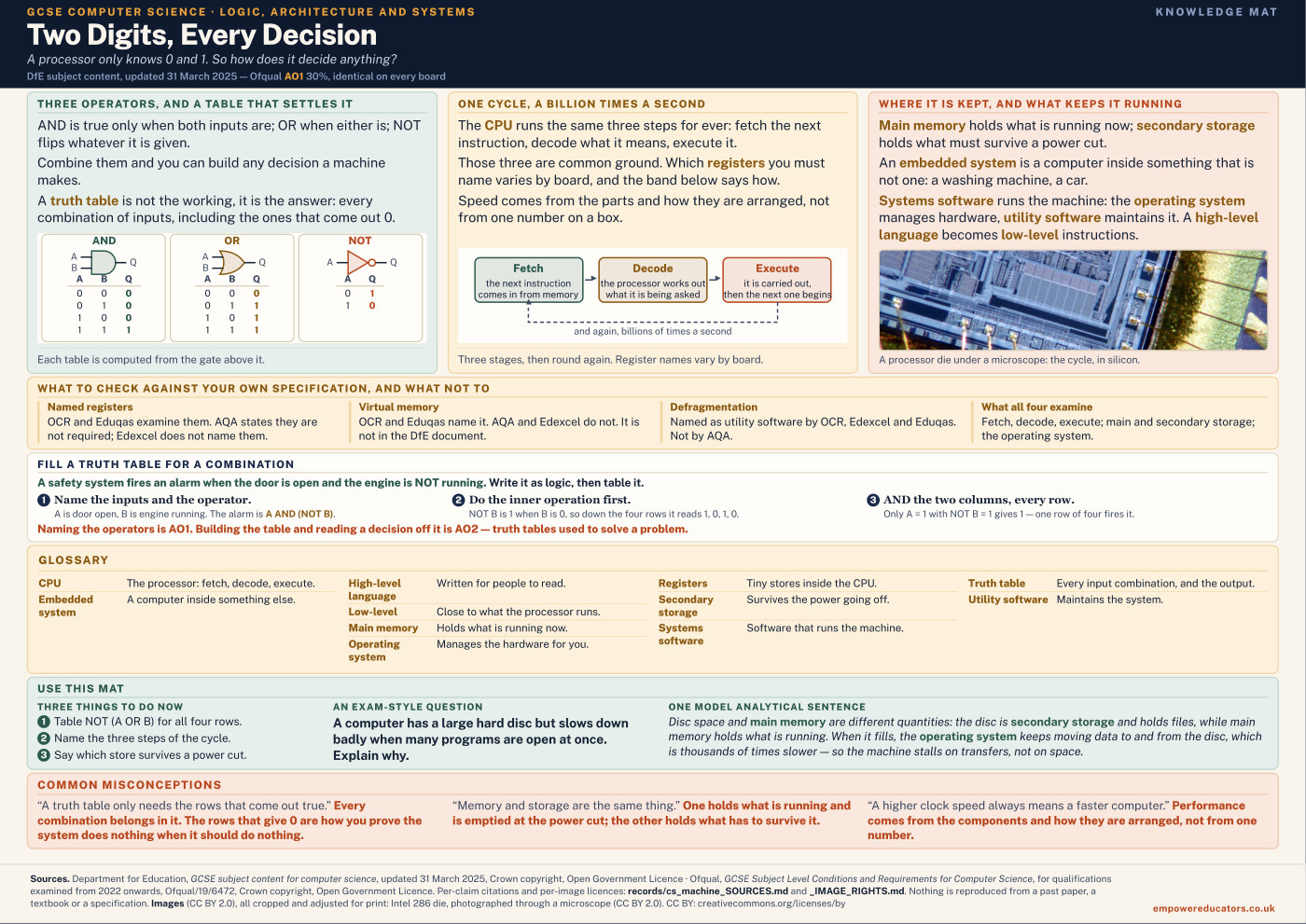
One landscape A4 page on one part of the GCSE Computer Science course, anchored to the DfE's own subject content and Ofqual's subject level conditions rather than a board's paraphrase — so it holds whichever specification a department follows. It carries Boolean logic and truth tables, CPU architecture and the fetch–execute cycle, main and secondary storage, hardware and embedded systems, systems software, and the levels of programming language — then the vocabulary, a worked truth table, and the misconceptions that cost marks.
The register question is the one this sheet is most careful about: one specification states in terms that knowledge of specific registers is not required, two name them, and one does not mention them. Nothing is reproduced from a past paper, a textbook or a specification.
Sold by subject: all four Computer Science sheets for one price. A knowledge organiser stores a unit and is revised from afterwards; this is meant to be on the table while the lesson is happening.
- Written to
- The DfE GCSE subject content for computer science (updated 31 March 2025) and Ofqual's subject level conditions for qualifications examined from 2022 onwards (Ofqual/19/6472), quoted; no board's specification, mark scheme or past paper. Named registers are examined by two of the four specifications read and explicitly not required by a third, so the cycle is taught at the level all four examine
- Intended for
- computer science teachers — on the desk during the lesson, not a student revision guide
- Extent
- 1 page · 8 sections
—·Look inside
Real pages, straight from the PDF
Click any page to see it full size.
—·Contents
All 8 sections
Taken from the booklet’s own contents page, so the page numbers are the real ones.