509·Computer Science · GCSE
Sent, Stolen,
and Who Pays
GCSE Computer Science Knowledge Mat — Networks
Your message crosses half a dozen networks to arrive — what can go wrong on the way, and who is answerable for it? Wired against wireless, LAN against WAN, and topologies drawn from their own definitions so the figure counts its own links: five devices, five links or ten, which is the whole trade. Then protocols and layers, drawn as a stack, because the reason layering exists is that each layer uses only the one below it. Then the DfE's own split of attacks into technical weaknesses and behaviour, finding vulnerabilities as a separate job from fixing them, and protection across design, creation, testing and use. A band on the ethical, legal, environmental and privacy impacts, a worked attack-and-defence, twelve terms, and the misconceptions that cost marks.
Everything else this site has for Computer Science: Computer Science teaching resources
One purchase covers the school that buys it. Print it, copy it, hand it round your department. Not for passing to other schools or uploading anywhere.
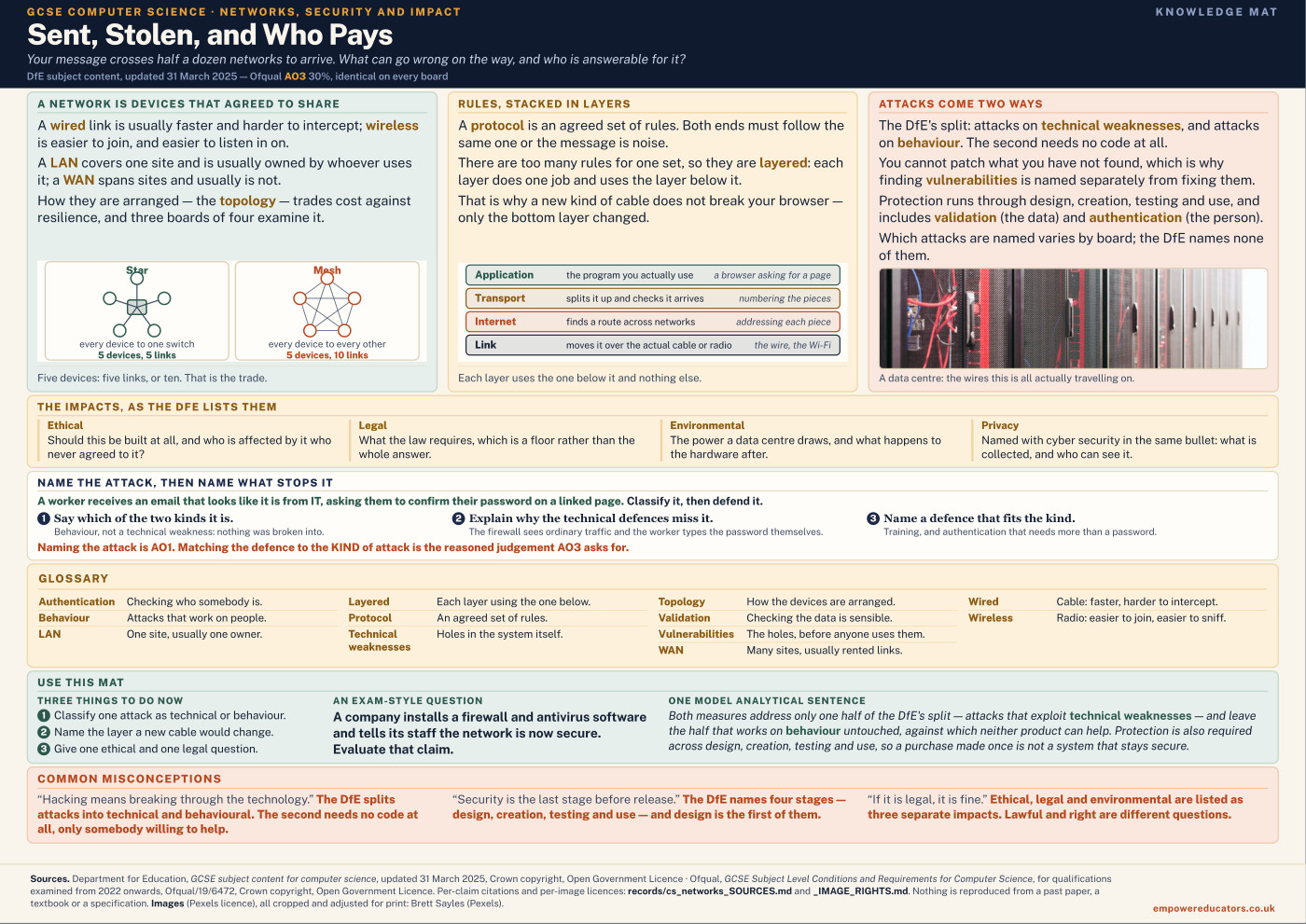
One landscape A4 page on one part of the GCSE Computer Science course, anchored to the DfE's own subject content and Ofqual's subject level conditions rather than a board's paraphrase — so it holds whichever specification a department follows. It carries wired and wireless connectivity, types of network and topology, protocols and layers, forms of attack, identifying vulnerabilities and protecting systems, and the ethical, legal and environmental impacts — then the vocabulary, a worked attack-and-defence, and the misconceptions that cost marks.
One specification does not examine topologies at all, and each board publishes its own list of named attacks while the DfE publishes none — so the sheet teaches the DfE's split into technical and behavioural attacks and says where the boards differ. Nothing is reproduced from a past paper, a textbook or a specification.
Sold by subject: all four Computer Science sheets for one price. A knowledge organiser stores a unit and is revised from afterwards; this is meant to be on the table while the lesson is happening.
- Written to
- The DfE GCSE subject content for computer science (updated 31 March 2025) and Ofqual's subject level conditions for qualifications examined from 2022 onwards (Ofqual/19/6472), quoted; no board's specification, mark scheme or past paper. The DfE names no attack and no topology, so neither is presented as common ground without saying which boards examine it
- Intended for
- computer science teachers — on the desk during the lesson, not a student revision guide
- Extent
- 1 page · 8 sections
—·Look inside
Real pages, straight from the PDF
Click any page to see it full size.
—·Contents
All 8 sections
Taken from the booklet’s own contents page, so the page numbers are the real ones.