Computer Science · GCSE · £6.99
GCSE Computer Science
Questions
& Answers
One hundred questions, each answered three times (weakly, securely and well), with the marks each earns and a paragraph naming the one thing that separates them. Trace tables, pseudocode, binary and hexadecimal working, file-size calculations, truth tables, logic diagrams and SQL, each with a real mark scheme. Written against the Department for Education subject content and read against all four current specifications, so where the boards genuinely differ the page says so rather than pretending they agree.
£6.99100 questions, each answered three times (weak, middling, strong), 106 pages
- A4 PDF
- first 14 pages free to read
- instant download
One purchase covers the school that buys it. Print it, copy it, hand it round your department. Not for passing to other schools or uploading anywhere.
PDF download, ready straight after payment. Downloading it ends the 14-day right to cancel; a file that is faulty or not as described is always refunded. Refunds
Read before publication by serving senior leaders, in school.
5.0 from 24+ reviews on Google
Schools that have bought from Empower Educators include Nottingham High School, Northampton High School GDST and Sutton Valence School.
Complete your Computer Science
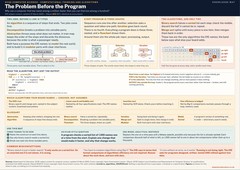
Everything else this site has for Computer Science: Computer Science teaching resources
- 1Computational thinking and algorithms
- 2Programming
- 3Data representation
- 4Computer systems
- 5Computer networks
- 6Cyber security
- 7Databases and SQL
- 8Boolean logic
- 9Impacts, and putting it together
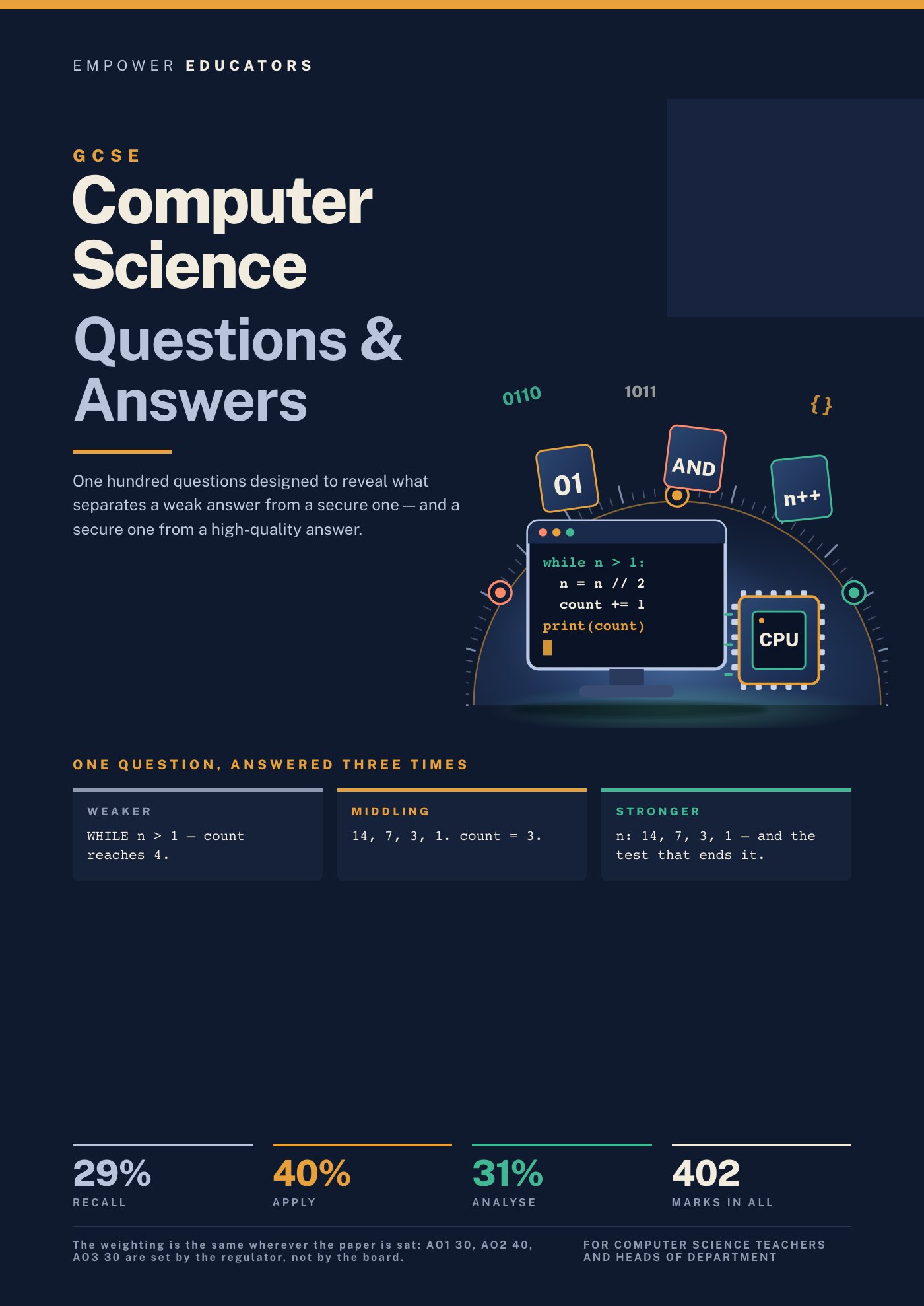
Not a bank of questions with the answers printed underneath. The three banded responses are the starting point, not the output: what follows each one is the discriminator, named out loud, then the questions you actually ask to move a student from the first answer to the last, then the mark scheme that shows what each line was worth.
Computer science needs more than written model answers, so it gets them. Completed trace tables where every pass has its own row. Pseudocode listings with the line numbers the question refers to. Binary and hexadecimal working set out column by column. File-size calculations marked step by step, each step saying what it still earns when the number coming into it is wrong. Truth tables, logic circuits drawn in code, database tables and SQL queries. Every calculation is recomputed from the built page on every build, every truth table is regenerated from the expression printed beside it, and every SQL query is executed against the table it sits next to.
The assessment objectives are the one thing the boards do not choose. Ofqual sets AO1 at 30%, AO2 at 40% and AO3 at 30%, and all four specifications carry exactly that. This book is weighted to it by marks — not by question count, which is the easy way to look balanced and be wrong — and the build stops if any objective drifts more than three points. The first draft came out at 18/36/46, because evaluation is the interesting part to write and nothing on a page would ever have shown it.
Where the four boards differ, the book says so on the page. That is not a disclaimer, it is a page: every divergence listed against the questions it affects. AQA states in terms that “knowledge of specific registers is not required”, and examines no network topologies at all. Its binary arithmetic will not carry beyond the eighth bit, so overflow sits outside what it assesses. Its cyber-security threat list does not include brute-force or denial-of-service attacks. SQL is not in the Department for Education document at all, and the four boards do four different things with it: a full topic for one, three keywords for another, nothing whatever for the third.
A book that spent nine questions on SQL would be spending nine questions on content half the market never sits. This one spends five, and prints the reason.
Everything else is common ground, and that is checked rather than claimed. Every question is anchored to a phrase in the Department for Education subject content, resolved against the published document on every build, and the build fails if a phrase is not there or if a board is named on a page that carries no note. Nine questions carry one. The rest name nobody.
- Written to
- The GCSE subject content for computer science published by the Department for Education, updated 31 March 2025 for teaching from September 2025, with all four current specifications read against it — AQA 8525 version 1.3, OCR J277 version 3.1, Pearson Edexcel 1CP2 and WJEC Eduqas
- Intended for
- computer science teachers and heads of department. Used with a class, not a student revision guide
- Extent
- 106 pages · 9 sections
Sample questions
Sample GCSE Computer Science questions and answers
Five questions from the book, printed exactly as they appear in it: the question, the answers it works through, and the mark each one scores. All of them are in the free preview.
Question 1·Computational thinking and algorithms·2 marks
State what is meant by decomposition.
Weaker0 marks
Breaking a problem down.
Middling1 mark
Breaking a problem down into smaller problems.
Stronger2 marks
Breaking a large problem into smaller sub-problems, each small enough to be solved on its own, so that the whole problem becomes manageable.
What separates them
The first answer is not wrong, it is unfinished: it names the action and stops before the thing that makes decomposition worth doing. Two marks want the breaking down and what the smaller parts are for — that each can be solved separately. A one-word gap, and it is the same gap that costs marks on abstraction two pages later.
The full-mark answer2 marks
Decomposition is breaking a large problem down into smaller sub-problems, each of which is simple enough to be understood and solved on its own.
Question 2·Computational thinking and algorithms·3 marks
A self-checkout weighs an item, looks up its price and adds it to a running total. Identify the input, the process and the output at this stage.
Weaker0 marks
Input is the item. Process is the till. Output is the receipt.
Middling2 marks
Input is the weight. Process is looking up the price. Output is the total.
Stronger3 marks
Input: the weight read from the scale. Process: look the weight up against the item’s price per kilogram and add the result to the running total. Output: the updated total shown on screen.
What separates them
The first answer names objects; the question asks for data. A till is a device, not a process, and a receipt comes later. What lifts the third answer is that every one of the three is a piece of data at this stage — the weight going in, the lookup and addition happening to it, the total coming out. Naming the stage you are in is half of input-process-output and the half students skip.
The full-mark answer3 marks
Input: the weight of the item from the scale. Process: looking up the price per kilogram and multiplying it by the weight, then adding that to the running total. Output: the updated running total displayed to the customer.
Question 3·Computational thinking and algorithms·2 marks
Describe what is meant by abstraction.
Weaker0 marks
Making something simpler.
Middling1 mark
Removing unnecessary detail from a problem.
Stronger2 marks
Removing the detail that does not matter for the problem being solved, so that what is left is a model you can actually work with.
What separates them
‘Making something simpler’ is what abstraction looks like from outside; it is not what it is. The second mark is for the words for the problem being solved, because the same detail can be essential in one program and noise in another. A route-planner throws away shop names; a delivery app for those shops cannot.
The full-mark answer2 marks
Abstraction is removing or hiding detail that is not relevant to the problem being solved, leaving a simplified model of the situation that a program can work with.
Question 4·Computational thinking and algorithms·3 marks
A route-planning app stores road junctions and the distances between them, but not the names of the shops on each road. Explain how this is an example of abstraction.
Weaker0 marks
It is abstraction because it is simpler.
Middling2 marks
The shop names are not needed to find a route, so they are left out.
Stronger3 marks
Finding a shortest route only needs the points and the distances between them, so the app keeps those and discards everything else. The shop names are real, but they cannot change which route is shortest, so storing them would add data without changing any answer.
What separates them
The middling answer is correct and would be marked as such; what it does not do is say why the shop names cannot matter. The stronger answer ties the omission to the calculation: the route is decided by distances, and no shop name can alter a distance. That is the difference between naming an abstraction and explaining one, and it is worth a mark on every abstraction question in the subject.
The full-mark answer3 marks
The app models the road network as points (junctions) joined by distances, because a shortest route is calculated from distances alone. The names of shops are detail that cannot affect that calculation, so they are left out. The result is a smaller model that gives exactly the same answer and can be searched far faster.
Question 6·Computational thinking and algorithms·2 marks
State the difference between a count-controlled and a condition-controlled loop.
Weaker0 marks
One counts and one uses a condition.
Middling2 marks
A count-controlled loop runs a set number of times; a condition-controlled loop runs until something is true.
Stronger2 marks
A count-controlled loop repeats a known, fixed number of times, set before the loop starts. A condition-controlled loop repeats while (or until) a condition holds, so the number of repetitions is not known in advance.
What separates them
The first answer restates the names of the two loops and adds nothing; a definition that uses the word being defined has not defined it. Both other answers earn the two marks, and the third is worth reading anyway for the phrase not known in advance. That is the real distinction: it is not that one counts, it is that one of them knows how many times before it starts.
The full-mark answer2 marks
A count-controlled loop repeats a fixed number of times, known before the loop begins. A condition-controlled loop repeats while a condition is met, so how many times it runs is not known until it stops.
Twelve more GCSE Computer Science questions, with answers, free
Look inside
Real pages, straight from the PDF
Click any page to see it full size.
Contents
All 9 sections
Taken from the book’s own contents page, so the page numbers are the real ones.