506·Computer Science · GCSE
The Problem
Before the Program
GCSE Computer Science Knowledge Mat — Algorithms
Why can a computer find one name among a million faster than you can find one among a hundred? Decomposition and abstraction as jobs rather than words, with a figure that splits one problem into three parts you can test separately; sequence, selection and iteration drawn as three real flowcharts, because what separates them is the shape of the path; and the only two algorithms the DfE names — binary search and merge sort — with a figure that actually runs the search, pass by pass, greying out the half it discards and printing the verdict each comparison produces. The centrepiece is annotated pseudocode: eight lines, with the line that breaks the algorithm while still running perfectly pointed at and explained. A band on which extra algorithms each board names and how each one wants efficiency judged — not by Big O, which the DfE excludes — ten terms, and the misconceptions that cost marks.
Everything else this site has for Computer Science: Computer Science teaching resources
One purchase covers the school that buys it. Print it, copy it, hand it round your department. Not for passing to other schools or uploading anywhere.
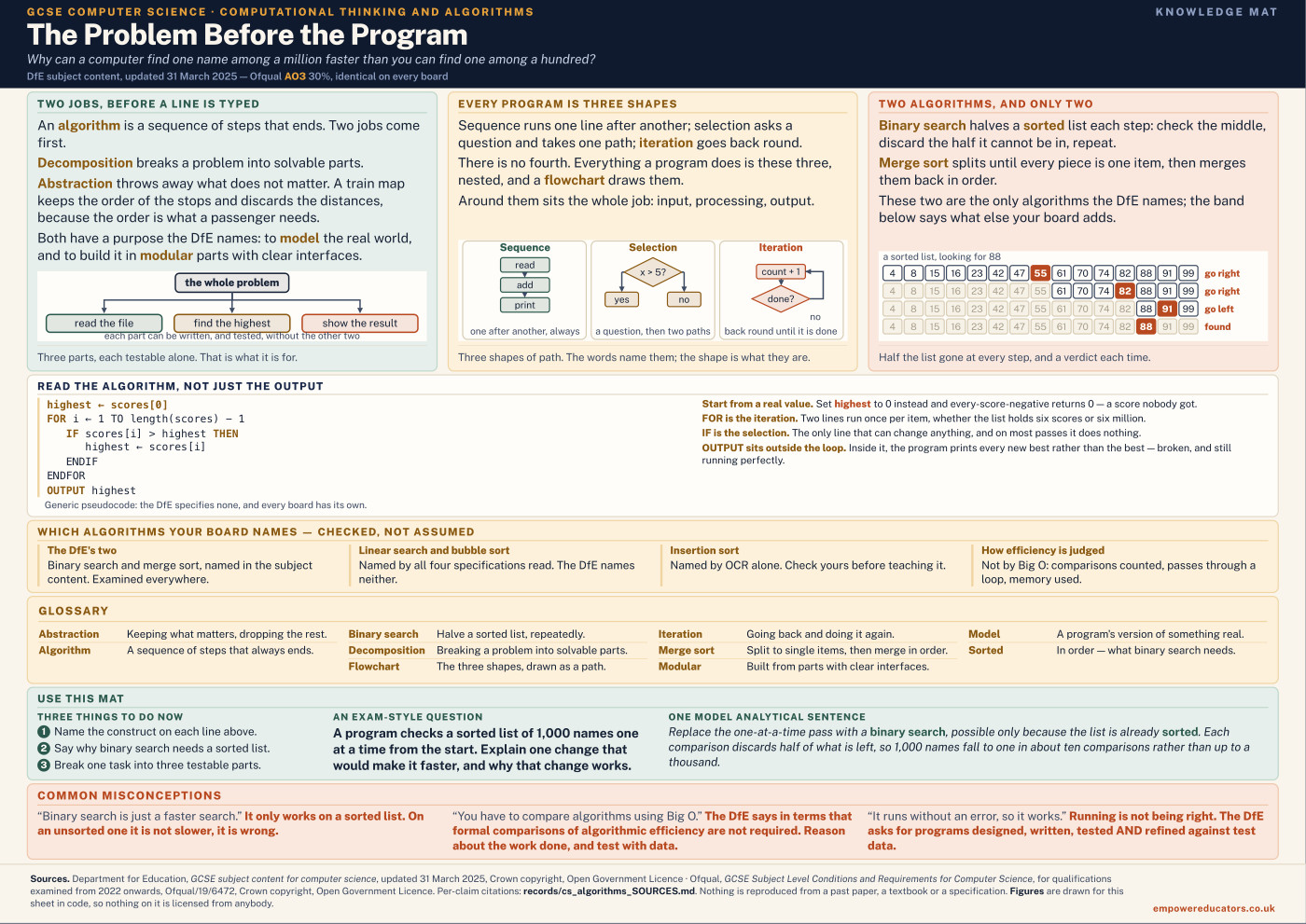
One landscape A4 page on one part of the GCSE Computer Science course, anchored to the DfE's own subject content and Ofqual's subject level conditions rather than a board's paraphrase — so it holds whichever specification a department follows. It carries decomposition and abstraction, sequence, selection and iteration, input, processing and output, binary search and merge sort, and what the DfE says about judging an algorithm — then the vocabulary, an annotated algorithm, and the misconceptions that cost marks.
Computer science is the one subject where the thing a student has to read is itself a text, so this sheet borrows the format the English mats use for extracts and points at the lines that decide whether an algorithm is right. Nothing is reproduced from a past paper, a textbook or a specification, and every figure is drawn in code, so nothing on the sheet is licensed from anybody.
Sold by subject: all four Computer Science sheets for one price. A knowledge organiser stores a unit and is revised from afterwards; this is meant to be on the table while the lesson is happening.
- Written to
- The DfE GCSE subject content for computer science (updated 31 March 2025) and Ofqual's subject level conditions for qualifications examined from 2022 onwards (Ofqual/19/6472), quoted; no board's specification, mark scheme or past paper. The pseudocode is written in no board's reference language, because the DfE specifies none
- Intended for
- computer science teachers — on the desk during the lesson, not a student revision guide
- Extent
- 1 page · 8 sections
—·Look inside
Real pages, straight from the PDF
Click any page to see it full size.
—·Contents
All 8 sections
Taken from the booklet’s own contents page, so the page numbers are the real ones.