Empower
Educators
All knowledge mats

GCSE Computer Science·Knowledge mats

GCSE Computer Science Knowledge Mats

All 4 sheets — Algorithms, Data representation, Logic and systems and Networks and security — for £3.99. One landscape page per topic, every claim sourced and every image licensed.

4 sheets · one A4 landscape PDF each · instant download

Bought once for the set, not per sheet. Photocopy them for your classes freely — keep the running foot on the page, which carries the image credits the licences require.

£3.99 for all 4

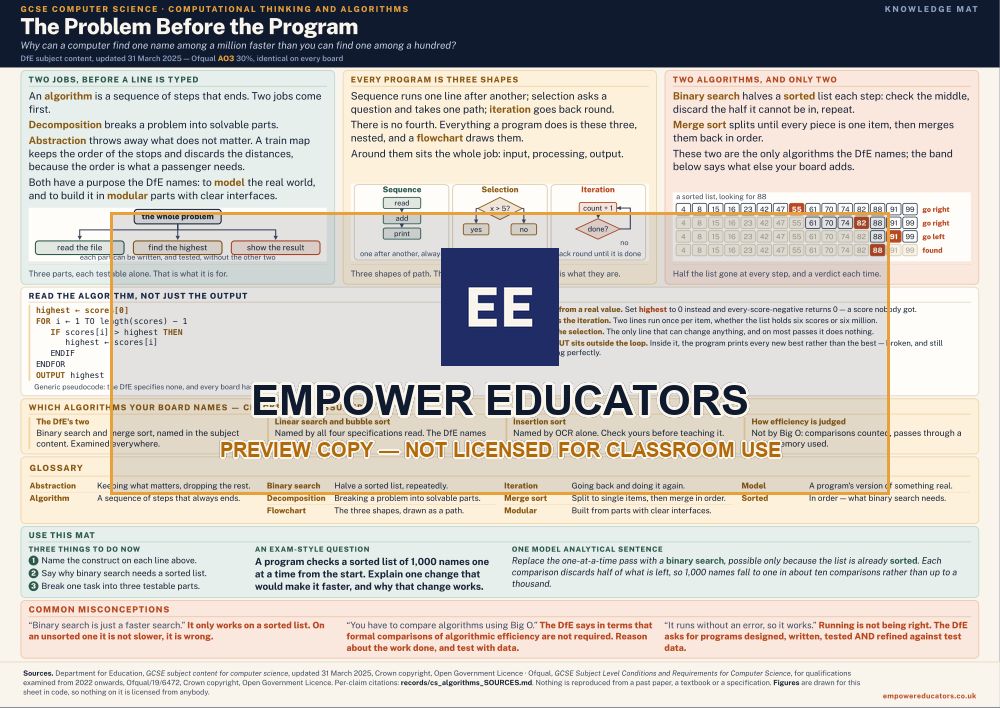
Algorithms knowledge mat — watermarked preview

Algorithms

The Problem Before the Program

Why can a computer find one name among a million faster than you can find one among a hundred? Decomposition and abstraction as jobs rather than words, with a figure that splits one problem into three parts you can test separately; sequence, selection and iteration drawn as three real flowcharts, because what separates them is the shape of the path; and the only two algorithms the DfE names — binary search and merge sort — with a figure that actually runs the search, pass by pass, greying out the half it discards and printing the verdict each comparison produces. The centrepiece is annotated pseudocode: eight lines, with the line that breaks the algorithm while still running perfectly pointed at and explained. A band on which extra algorithms each board names and how each one wants efficiency judged — not by Big O, which the DfE excludes — ten terms, and the misconceptions that cost marks.
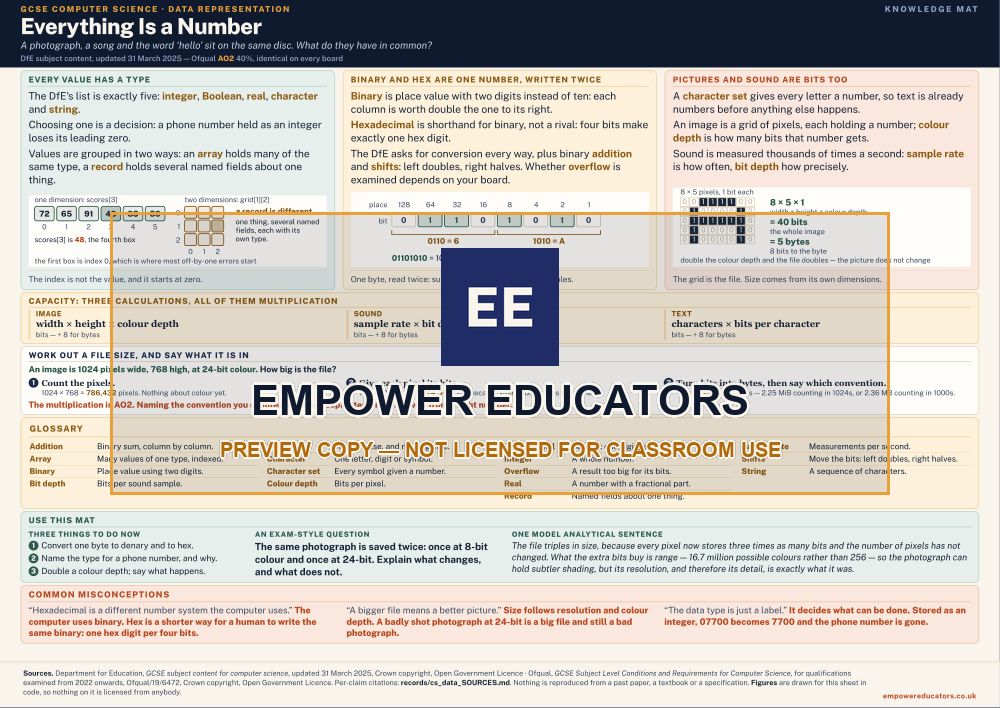
Data representation knowledge mat — watermarked preview

Data representation

Everything Is a Number

A photograph, a song and the word 'hello' sit on the same disc — what do they have in common? The five data types the DfE names and why choosing one is a decision, with a figure that draws a one-dimensional array beside a two-dimensional one and puts the index under the box, never in it. Then binary and hexadecimal as one number written twice, with a place-value strip that sums its own bits to 106 and splits itself into the nibbles 6 and A. Then text, sound and graphics, with a bitmap small enough to count: the grid is the file, and the file size is multiplied out of the grid's own dimensions. Three capacity formulae, a worked file-size calculation that ends by naming which convention it counted in, sixteen terms, and the misconceptions that cost marks.
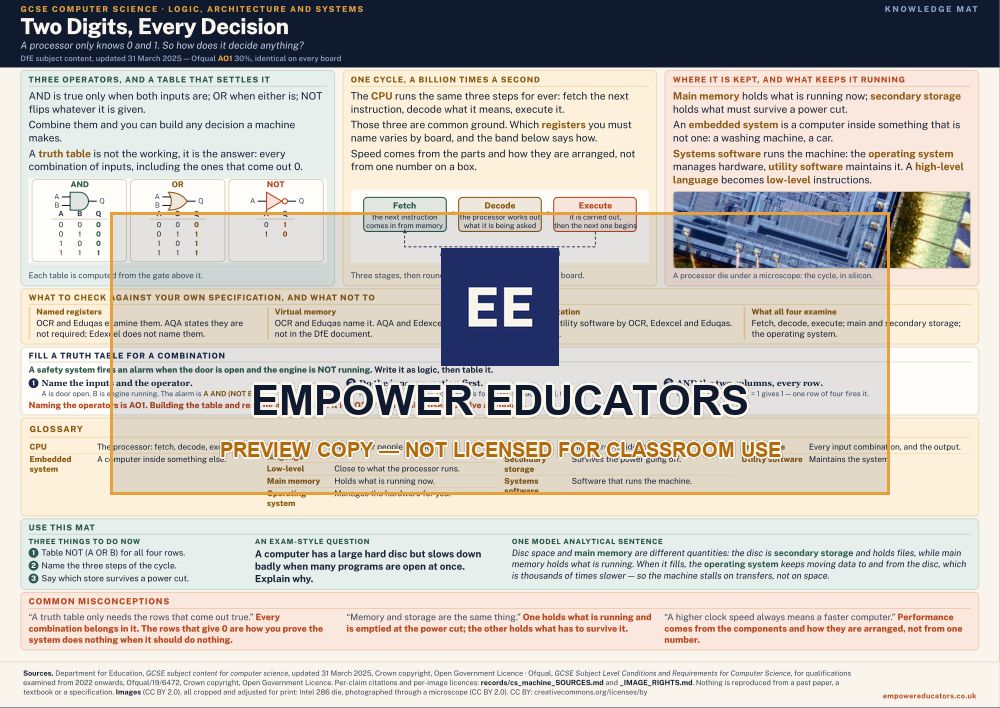
Logic and systems knowledge mat — watermarked preview

Logic and systems

Two Digits, Every Decision

A processor only knows 0 and 1, so how does it decide anything? AND, OR and NOT drawn as real gate symbols with the truth table under each one — and each table is computed from the gate above it, so a table cannot drift from the gate it belongs to. Then the fetch–decode–execute cycle drawn as a cycle, with a return path that closes it, kept deliberately at the three stages every board examines. Then main memory against secondary storage, embedded systems, the operating system and utility software, and high-level against low-level language, beside a photograph of a processor die taken through a microscope. A band on what to check against your own specification — named registers, virtual memory, defragmentation — a worked truth table for a combination, eleven terms, and the misconceptions that cost marks.

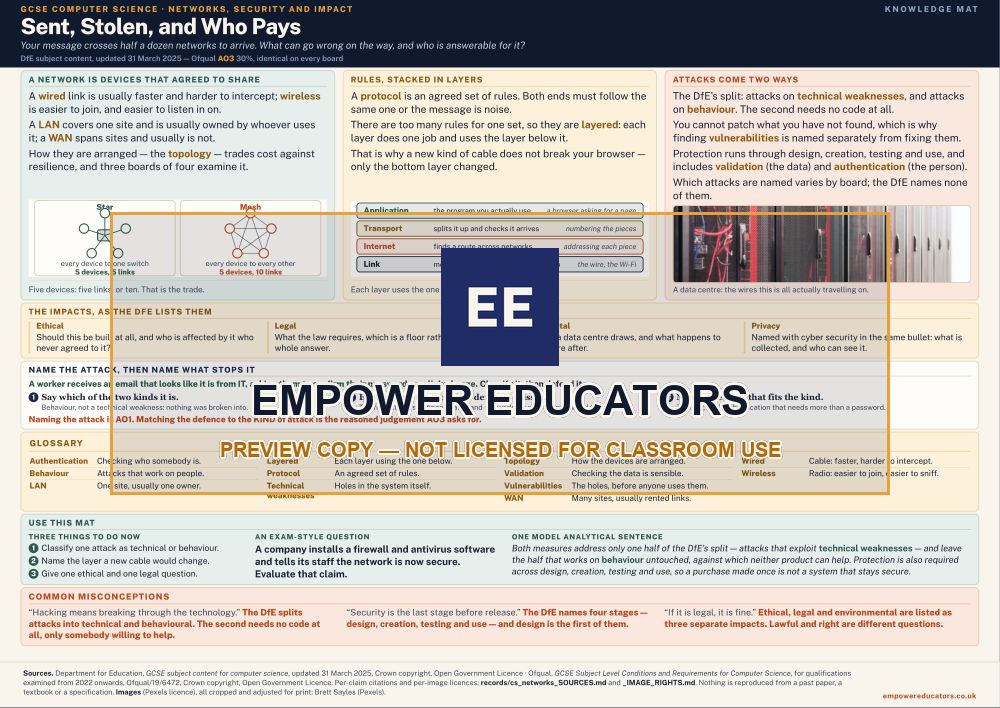
Networks and security knowledge mat — watermarked preview

Networks and security

Sent, Stolen, and Who Pays

Your message crosses half a dozen networks to arrive — what can go wrong on the way, and who is answerable for it? Wired against wireless, LAN against WAN, and topologies drawn from their own definitions so the figure counts its own links: five devices, five links or ten, which is the whole trade. Then protocols and layers, drawn as a stack, because the reason layering exists is that each layer uses only the one below it. Then the DfE's own split of attacks into technical weaknesses and behaviour, finding vulnerabilities as a separate job from fixing them, and protection across design, creation, testing and use. A band on the ethical, legal, environmental and privacy impacts, a worked attack-and-defence, twelve terms, and the misconceptions that cost marks.

The previews above are the full sheets, watermarked. Where a sheet carries photographs, every one is public domain worldwide or licensed CC BY, verified per image against the licence itself rather than a label, and the running foot names every creator, records that the images have been cropped and adjusted for print, and links the licence; figures are drawn in code for the sheet, and extracts are written for it or verified against a public-domain text. Nothing on any sheet is reproduced from a past paper, a mark scheme, an examiner report or a specification, and Empower Educators is not affiliated with any awarding body.

Your basket

Nothing in it yet.

Total £0.00

Checkout