—·Computer Science · GCSE
The Problem Before the Program
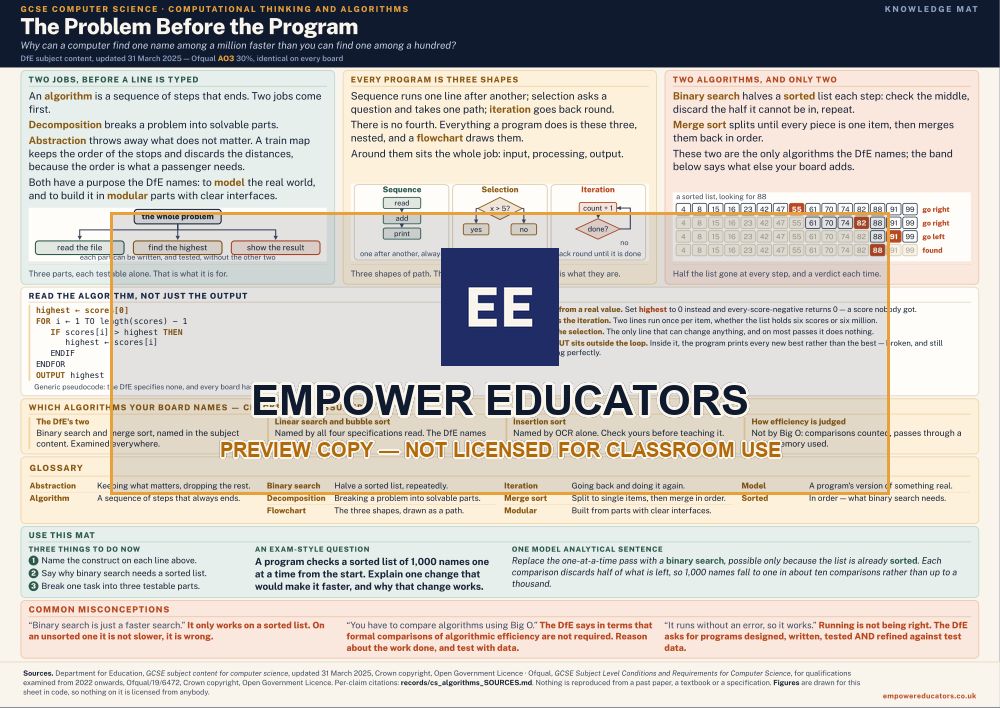
Why can a computer find one name among a million faster than you can find one among a hundred? Decomposition and abstraction as jobs rather than words, with a figure that splits one problem into three parts you can test separately; sequence, selection and iteration drawn as three real flowcharts, because what separates them is the shape of the path; and the only two algorithms the DfE names — binary search and merge sort — with a figure that actually runs the search, pass by pass, greying out the half it discards and printing the verdict each comparison produces. The centrepiece is annotated pseudocode: eight lines, with the line that breaks the algorithm while still running perfectly pointed at and explained. A band on which extra algorithms each board names and how each one wants efficiency judged — not by Big O, which the DfE excludes — ten terms, and the misconceptions that cost marks.
Ready for the classroom
Get the clean copy
You have seen the whole sheet — nothing is held back. What you buy is the clean copy without the watermark, at full print resolution, ready to run off for every class in the department.
- Every sheet with no watermark, at print resolution
- 1 print-and-use template
- Referenced to the DfE GCSE subject content for computer science (updated 31 March 2025) and Ofqual's subject level conditions for qualifications examined from 2022 onwards (Ofqual/19/6472), quoted; no board's specification, mark scheme or past paper. The pseudocode is written in no board's reference language, because the DfE specifies none
- Instant PDF download, yours to keep and reproduce across the school that buys it — not for other schools