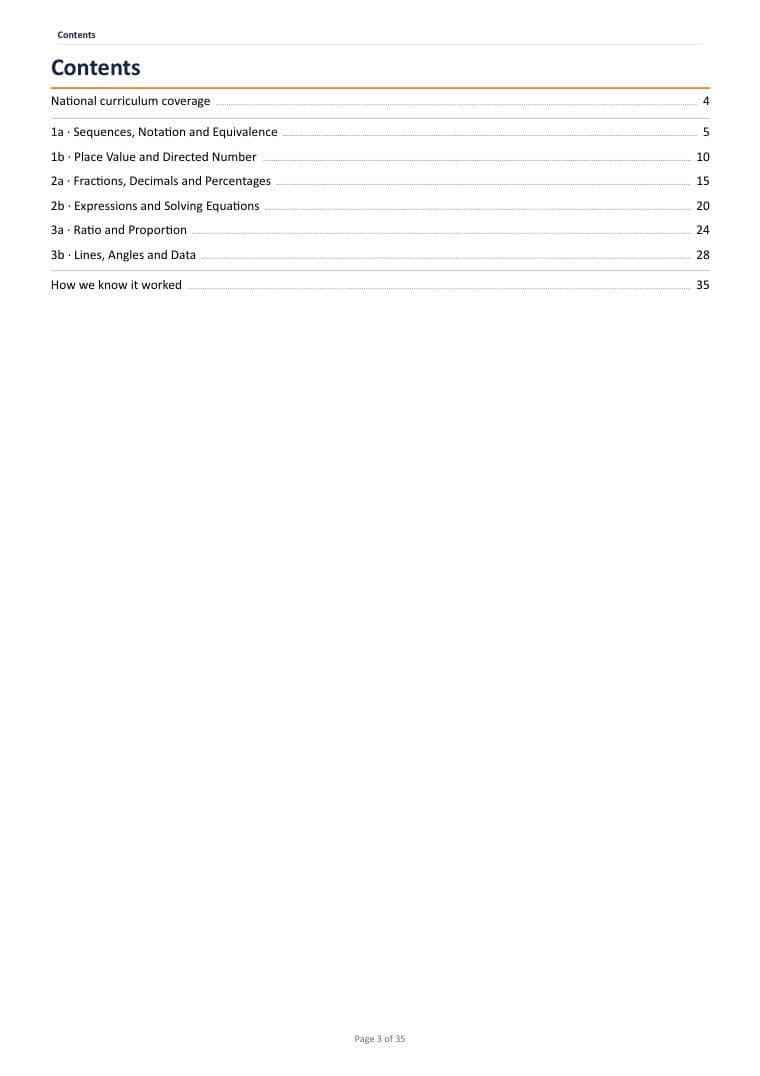
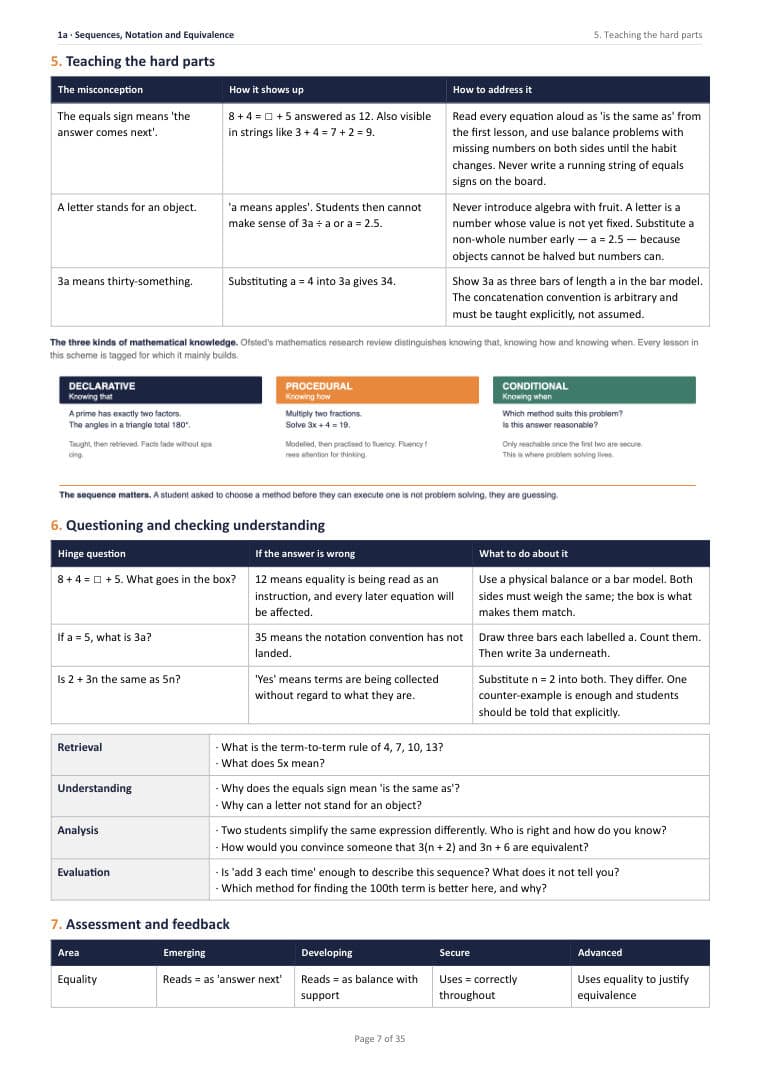
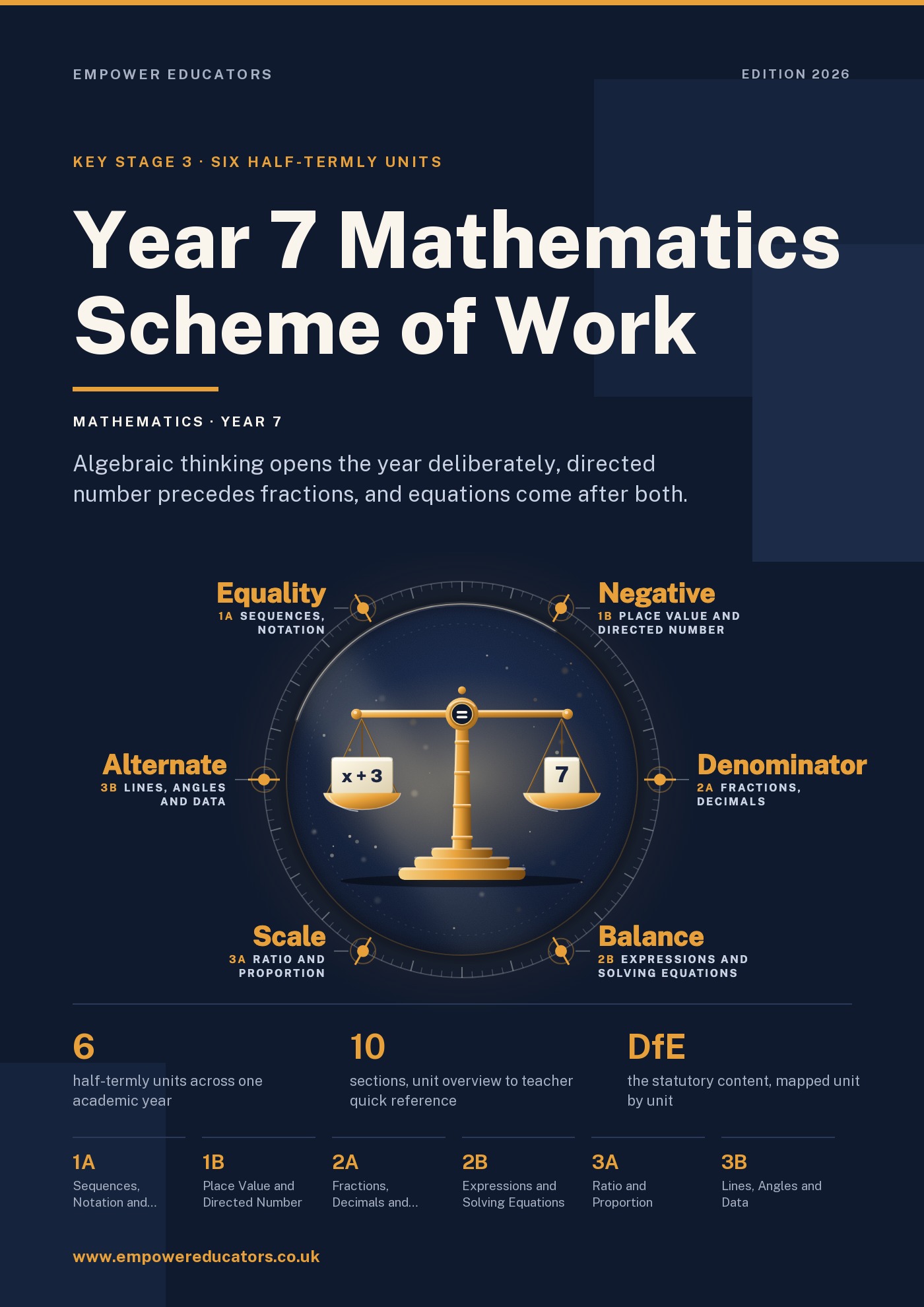
Six half-term units, in the order we teach them: sequences, notation and equivalence; place value and directed number; fractions, decimals and percentages; expressions and solving equations; ratio and proportion; and lines, angles and data. Below is what each unit starts from, what pupils produce and the representation it teaches with, taken from our Year 7 Mathematics scheme of work.
Six half-termly units. Algebraic thinking opens the year deliberately, directed number precedes fractions, and equations come after both. Each unit states the prerequisite it cannot run without.
Year 7 means ages 11–12, or P7–S1 in Scotland.
The year, unit by unit
Sequences, Notation and Equivalence
Unit 1a · Autumn 1 · approx. 7 weeks · September – October
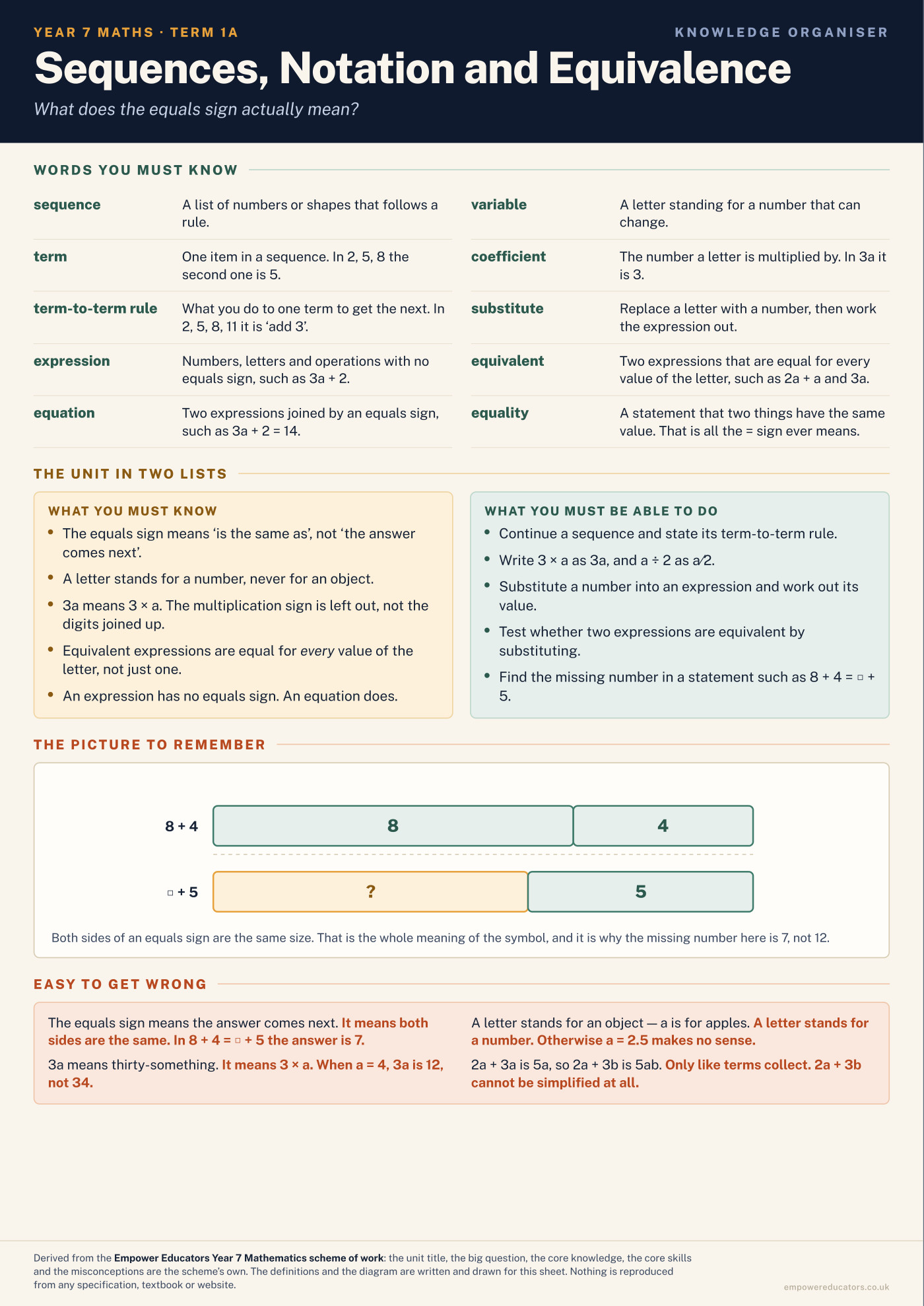
What does the equals sign actually mean?
Starts from
Secure recall of times tables to 12 × 12, and confident addition and subtraction of whole numbers. Test this in week one; do not assume it from key stage 2 data.
Pupils produce
A written explanation of a sequence's rule using correct algebraic notation, and a set of equivalent expressions justified.
Key representation
Bar model for equivalence; sequences shown as growing patterns before they are shown as numbers.
Place Value and Directed Number
Unit 1b · Autumn 2 · approx. 7 weeks · November – December
What is actually happening when you subtract a negative?
Starts from
Secure column addition and subtraction, and confident reading of a number line. Both are checked in Phase 1 and taught if absent — this unit cannot proceed without them.
Pupils produce
A set of directed-number calculations solved and explained using a number line, with reasoning written out.
Key representation
The number line for direction; place value counters for structure.
Fractions, Decimals and Percentages
Unit 2a · Spring 1 · approx. 6 weeks · January – February
Why are a half, 0.5 and 50% the same thing?
Starts from
Place value including decimals, from Unit 1b. A student who thinks 0.35 > 0.5 cannot convert reliably and will not benefit from this unit until that is fixed.
Pupils produce
A worked set of problems moving between the three forms, with the choice of form justified.
Key representation
Bar model throughout; the same bar shaded and labelled three ways.
Expressions and Solving Equations
Unit 2b · Spring 2 · approx. 6 weeks · February – April
If you do the same thing to both sides, why does the answer stay true?
Starts from
Unit 1a notation and the equals sign as balance, and Unit 1b directed number. A student who cannot handle −4 will not solve 3x + 7 = −5.
Pupils produce
A set of linear equations solved with reasoning shown at each step, and one equation formed from a worded problem.
Key representation
Balance and bar model for equations; algebra tiles for simplifying.
Ratio and Proportion
Unit 3a · Summer 1 · approx. 6 weeks · April – May
When two things grow together, what stays the same?
Starts from
Unit 2a fractions and multiplicative reasoning. A student still adding numerators cannot reason proportionally and should be taught 2a again first.
Pupils produce
A set of proportional problems solved with a stated method, including one where proportion does not apply.
Key representation
Double number line and bar model, used side by side.
Lines, Angles and Data
Unit 3b · Summer 2 · approx. 6 weeks · June – July
How do you know a mathematical statement is true, rather than just likely?
Starts from
Accurate use of a protractor and ruler, and Unit 2b's habit of justifying each step. Measurement accuracy is checked in Phase 1.
Pupils produce
A geometric reasoning task with each step justified by a named rule, and a short data investigation.
Key representation
Annotated diagrams where every known angle is marked and named.
How it meets the key stage 3 programme of study
The scheme maps each requirement of the statutory programme of study for key stage 3 (Department for Education, 2013) to the unit that teaches it. Pupils should be taught to…
consolidate their numerical and mathematical capability from key stage 2 and extend their understanding of the number system and place value to include decimals, fractions, powers and roots
1b place value, decimals and rounding · 2a fractions, decimals and percentages · 1b directed number
extend their understanding of the number system; make connections between number relationships, and their algebraic and graphical representations
1a notation, sequences and equivalence · 2b expressions and linear equations · 3a ratio as a multiplicative relationship
develop their mathematical knowledge, in part through solving problems and evaluating the outcomes, including multi-step problems
Multi-step problems in 2b (forming equations), 3a (proportional judgement) and 3b (geometric reasoning and data investigation)
Content: number · algebra · ratio, proportion and rates of change · geometry and measures · probability · statistics
Number 1b, 2a · Algebra 1a, 2b · Ratio and proportion 3a · Geometry and measures 3b · Statistics 3b · Probability not taught this year — see the coverage note
Probability is not taught in Year 7. That is a deliberate choice, not an oversight: probability depends on fractions, which are not secure until Unit 2a, and teaching it in the same year produces two shaky topics instead of one solid one. It is taught in Year 8 Unit 3a, with fractions a year old. If your department prefers it in Year 7, it must come after 2a and something else must go.
The Year 7 Maths resources
Two PDFs sit behind this page, and they are meant to be used together: the scheme of work to plan the year, the knowledge organisers to put in front of pupils.
The statutory programme of study for key stage 3 mathematics (DfE, 2013)·35 pages, 10 sections·For heads of mathematics, subject leaders and every teacher who has to deliver it
Six half-term units, in the order they are taught: Sequences, Notation and Equivalence, Place Value and Directed Number, Fractions, Decimals and Percentages, Expressions and Solving Equations, Ratio and Proportion and Lines, Angles and Data.
What do pupils produce in Year 7 Maths?
A written explanation of a sequence's rule using correct algebraic notation, and a set of equivalent expressions justified; A set of directed-number calculations solved and explained using a number line, with reasoning written out; A worked set of problems moving between the three forms, with the choice of form justified; A set of linear equations solved with reasoning shown at each step, and one equation formed from a worded problem; A set of proportional problems solved with a stated method, including one where proportion does not apply; A geometric reasoning task with each step justified by a named rule, and a short data investigation.
Does Year 7 Maths meet the National Curriculum?
Yes, across the three years of key stage 3. It maps each requirement of the statutory programme of study for key stage 3 (Department for Education, 2013) to the unit that teaches it, and on this year the scheme is plain: “Probability is not taught in Year 7.”
Cookies
This site works the same either way. Measurement — Google Analytics and Microsoft Clarity — only runs if you say yes, and it is used to see which resources people actually reach.Measurement only runs if you say yes.What is collected.