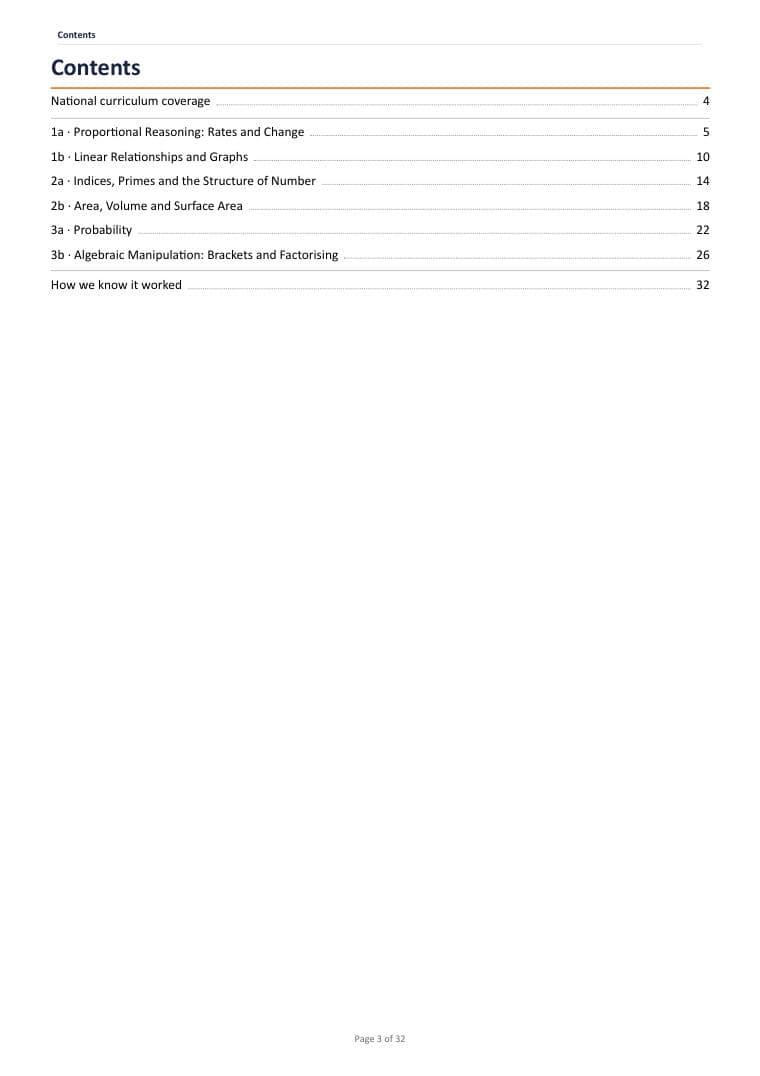
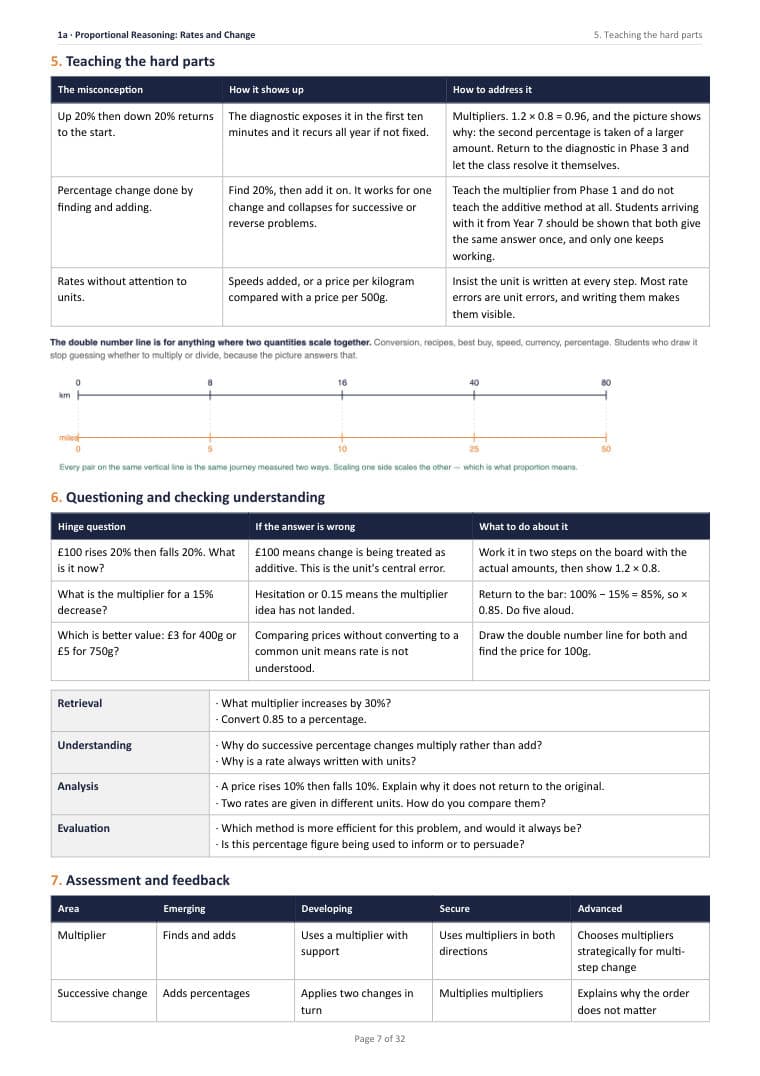
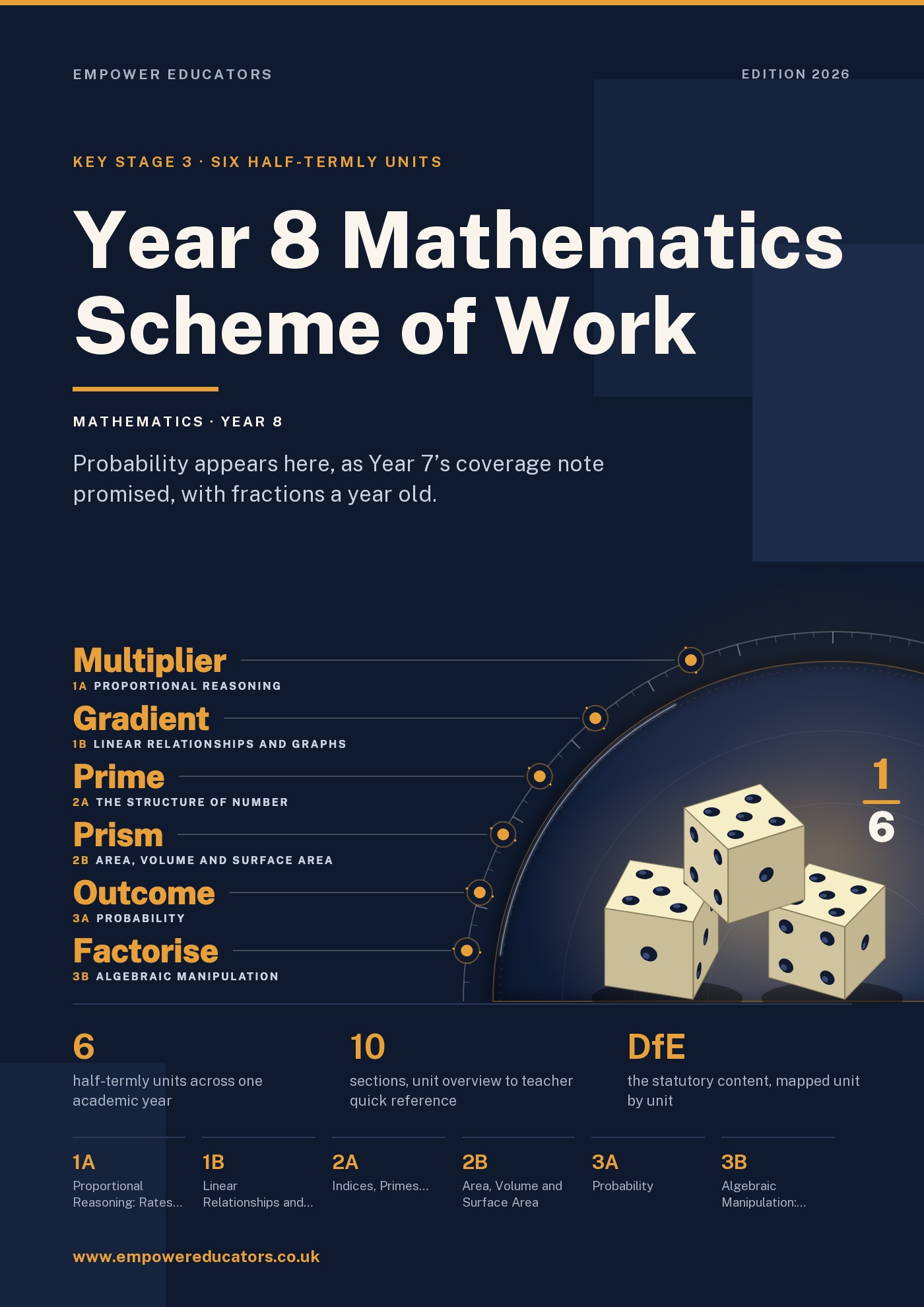
Six half-term units, in the order we teach them: proportional reasoning, rates and change; linear relationships and graphs; indices, primes and the structure of number; area, volume and surface area; probability; and brackets and factorising. Below is what each unit starts from, what pupils produce and the representation it teaches with, taken from our Year 8 Mathematics scheme of work.
Six half-termly units written backwards from Year 9 and forwards from Year 7. Probability appears here, as Year 7's coverage note promised, with fractions a year old.
Year 8 means ages 12–13, or S1–S2 in Scotland.
The year, unit by unit
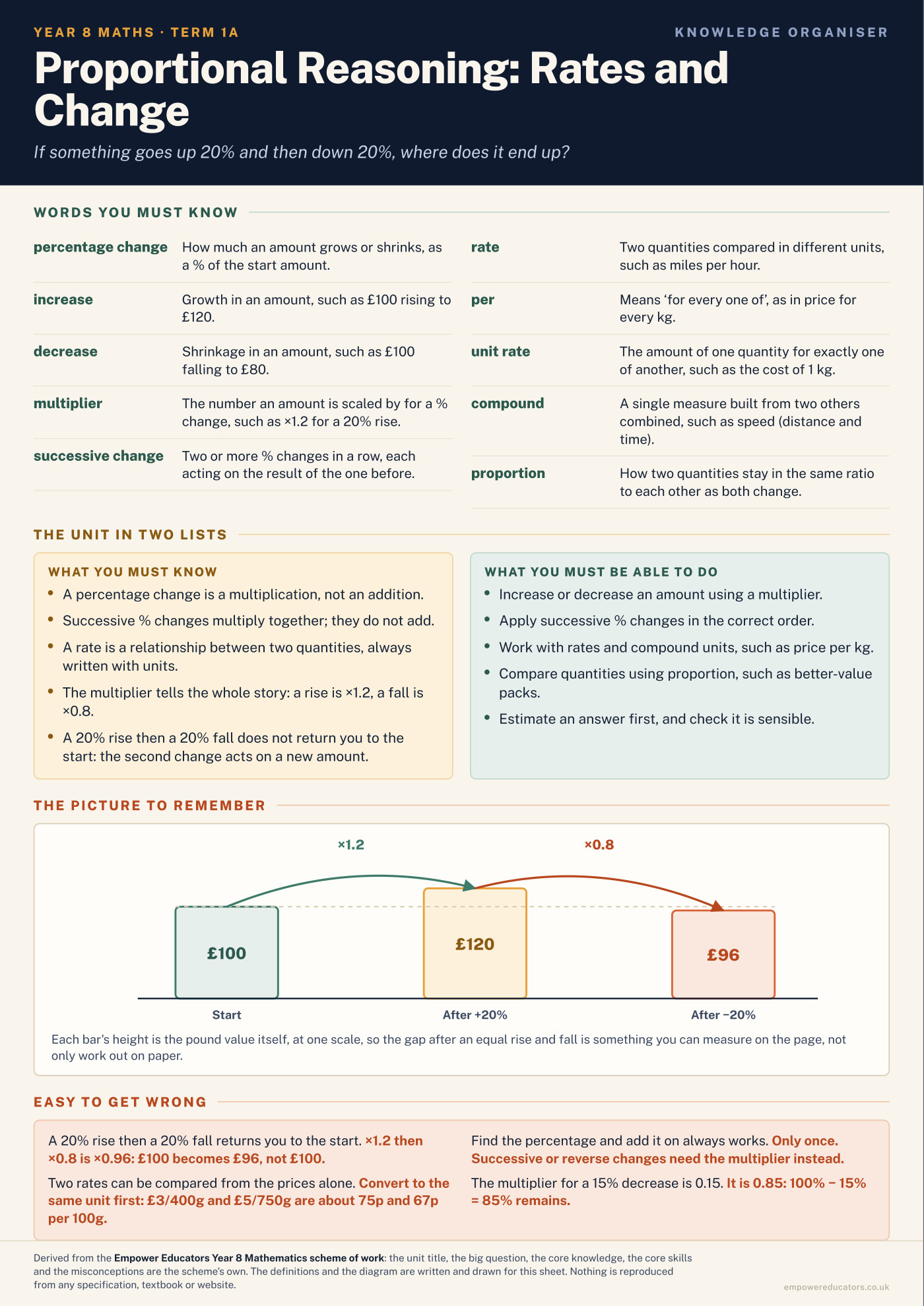
Proportional Reasoning: Rates and Change
Unit 1a · Autumn 1 · approx. 7 weeks · September – October
If something goes up 20% and then down 20%, where does it end up?
Starts from
Year 7 Unit 3a unitary method and Unit 2a fraction–decimal–percentage conversion. Check both in Phase 1; this unit compounds them and cannot carry a gap.
Pupils produce
A set of multi-step proportional problems including percentage change, with the method justified.
Key representation
Double number line for rates; bar model for change; the multiplier written above an arrow.
Linear Relationships and Graphs
Unit 1b · Autumn 2 · approx. 7 weeks · November – December
What does a straight line on a graph actually tell you?
Starts from
Year 7 Unit 2b substitution and linear equations, and Year 7 Unit 1b directed number. Plotting negative coordinates is impossible without the latter.
Pupils produce
A set of linear graphs drawn and interpreted, with the meaning of gradient and intercept explained in context.
Key representation
The triple — table, graph and equation shown together for every relationship.
Indices, Primes and the Structure of Number
Unit 2a · Spring 1 · approx. 6 weeks · January – February
Why is every whole number built from primes in exactly one way?
Starts from
Secure times tables and Year 7 Unit 1a notation. Prime factorisation is impossible without fluent recall of factors.
Pupils produce
A set of index and prime factorisation problems with the laws justified rather than recited.
Key representation
Factor trees; index laws written out as repeated multiplication before being generalised.
Area, Volume and Surface Area
Unit 2b · Spring 2 · approx. 6 weeks · February – April
Why does doubling the sides of a shape not double its area?
Starts from
Year 7 Unit 3b measurement accuracy, and Year 8 Unit 1a proportional reasoning for the scaling phase.
Pupils produce
A set of area, volume and surface area problems including compound shapes, with formulae justified.
Key representation
Physical dissection — a parallelogram cut and rearranged into a rectangle; nets for surface area.
Probability
Unit 3a · Summer 1 · approx. 6 weeks · April – May
If a coin lands heads five times in a row, what is it more likely to do next?
Starts from
Year 7 Unit 2a fractions, decimals and percentages, secure. Probability is written in all three and a student shaky on conversion cannot access it — this is why Year 7 does not teach probability.
Pupils produce
A set of probability problems using tables and tree diagrams, with one common fallacy explained.
Key representation
Sample space diagram and tree diagram; the probability scale as a number line from 0 to 1.
Algebraic Manipulation: Brackets and Factorising
Unit 3b · Summer 2 · approx. 6 weeks · June – July
Why is 3(x + 2) the same as 3x + 6, and how would you convince someone?
Starts from
Year 7 Unit 2b simplifying and solving, and Year 7 Unit 1b directed number. Expanding −3(x − 4) is unteachable without secure negatives.
Pupils produce
A set of expansion and factorisation problems with the equivalence justified by area or substitution.
Key representation
Algebra tiles and the area model, used for both directions.
How it meets the key stage 3 programme of study
The scheme maps each requirement of the statutory programme of study for key stage 3 (Department for Education, 2013) to the unit that teaches it. Pupils should be taught to…
consolidate their numerical and mathematical capability from key stage 2 and extend their understanding of the number system and place value to include decimals, fractions, powers and roots
2a indices, primes and factorisation · 1a percentage change and rates · Year 7 place value revisited through retrieval
extend their understanding of the number system; make connections between number relationships, and their algebraic and graphical representations
1b linear graphs and y = mx + c · 3b expanding and factorising · 1a proportional relationships
develop their mathematical knowledge, in part through solving problems and evaluating the outcomes, including multi-step problems
Multi-step problems in 1a (successive change), 2b (compound shapes and scaling) and 3a (tree diagrams)
Content: number · algebra · ratio, proportion and rates of change · geometry and measures · probability · statistics
Number 2a · Algebra 1b, 3b · Ratio and proportion 1a · Geometry and measures 2b · Probability 3a · Statistics revisited in Year 9 Unit 2b
Statistics is light this year and returns in force in Year 9 Unit 2b. Year 7 covered averages and representation; Year 8 spends its data time on probability instead, because probability needs the fraction fluency that is now a year old and because splitting both across three years produces two thin treatments. If your department prefers statistics in Year 8, swap it with Year 9 Unit 2b rather than adding it.
The Year 8 Maths resources
Two PDFs sit behind this page, and they are meant to be used together: the scheme of work to plan the year, the knowledge organisers to put in front of pupils.
The statutory programme of study for key stage 3 mathematics (DfE, 2013)·32 pages, 10 sections·For heads of mathematics, subject leaders and every teacher who has to deliver it
Six half-term units, in the order they are taught: Proportional Reasoning: Rates and Change, Linear Relationships and Graphs, Indices, Primes and the Structure of Number, Area, Volume and Surface Area, Probability and Algebraic Manipulation: Brackets and Factorising.
What do pupils produce in Year 8 Maths?
A set of multi-step proportional problems including percentage change, with the method justified; A set of linear graphs drawn and interpreted, with the meaning of gradient and intercept explained in context; A set of index and prime factorisation problems with the laws justified rather than recited; A set of area, volume and surface area problems including compound shapes, with formulae justified; A set of probability problems using tables and tree diagrams, with one common fallacy explained; A set of expansion and factorisation problems with the equivalence justified by area or substitution.
Does Year 8 Maths meet the National Curriculum?
Yes, across the three years of key stage 3. It maps each requirement of the statutory programme of study for key stage 3 (Department for Education, 2013) to the unit that teaches it, and on this year the scheme is plain: “Statistics is light this year and returns in force in Year 9 Unit 2b.”
Cookies
This site works the same either way. Measurement — Google Analytics and Microsoft Clarity — only runs if you say yes, and it is used to see which resources people actually reach.Measurement only runs if you say yes.What is collected.