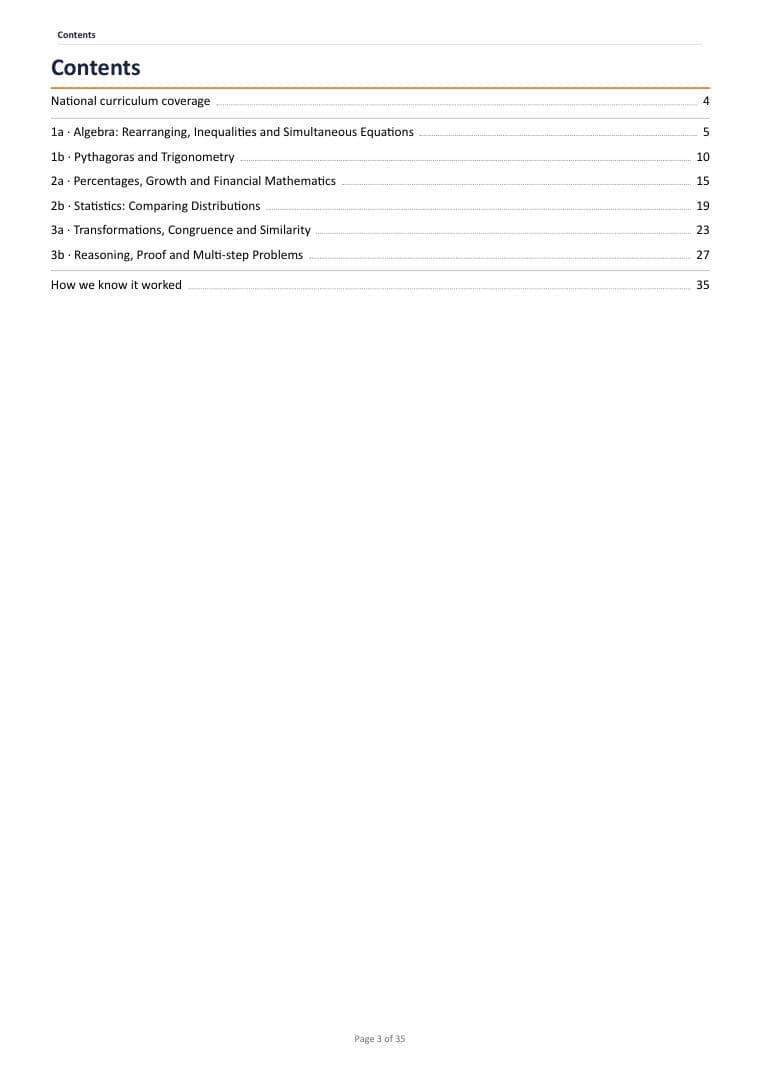
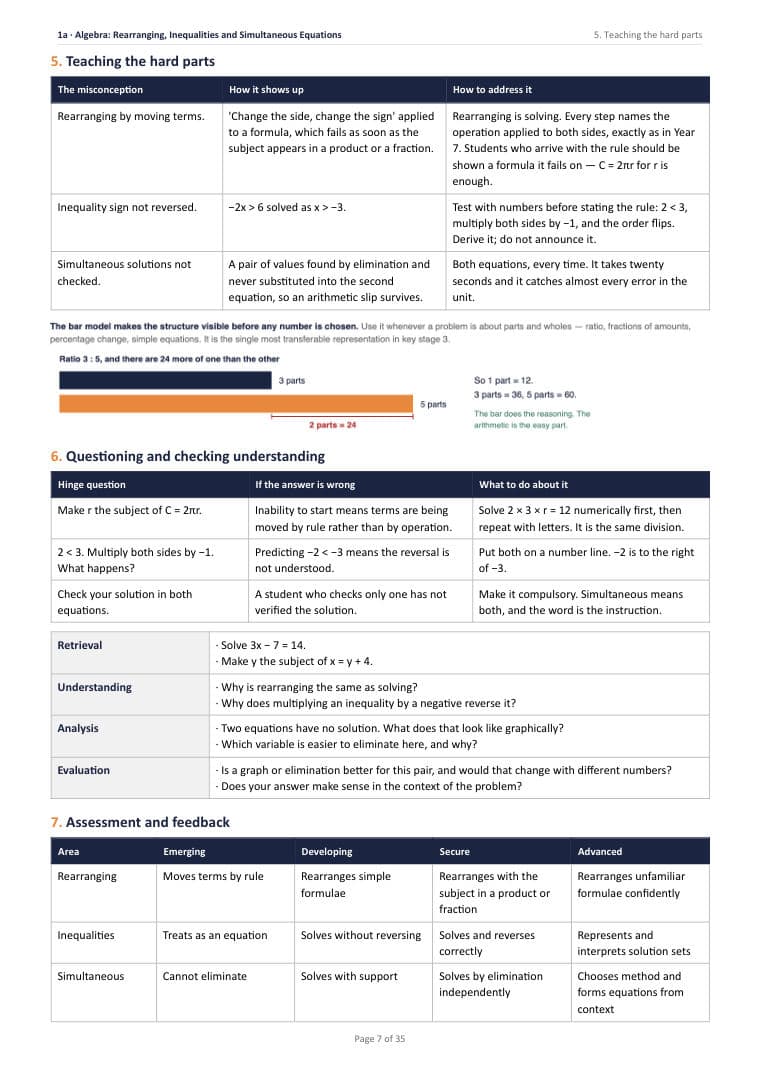
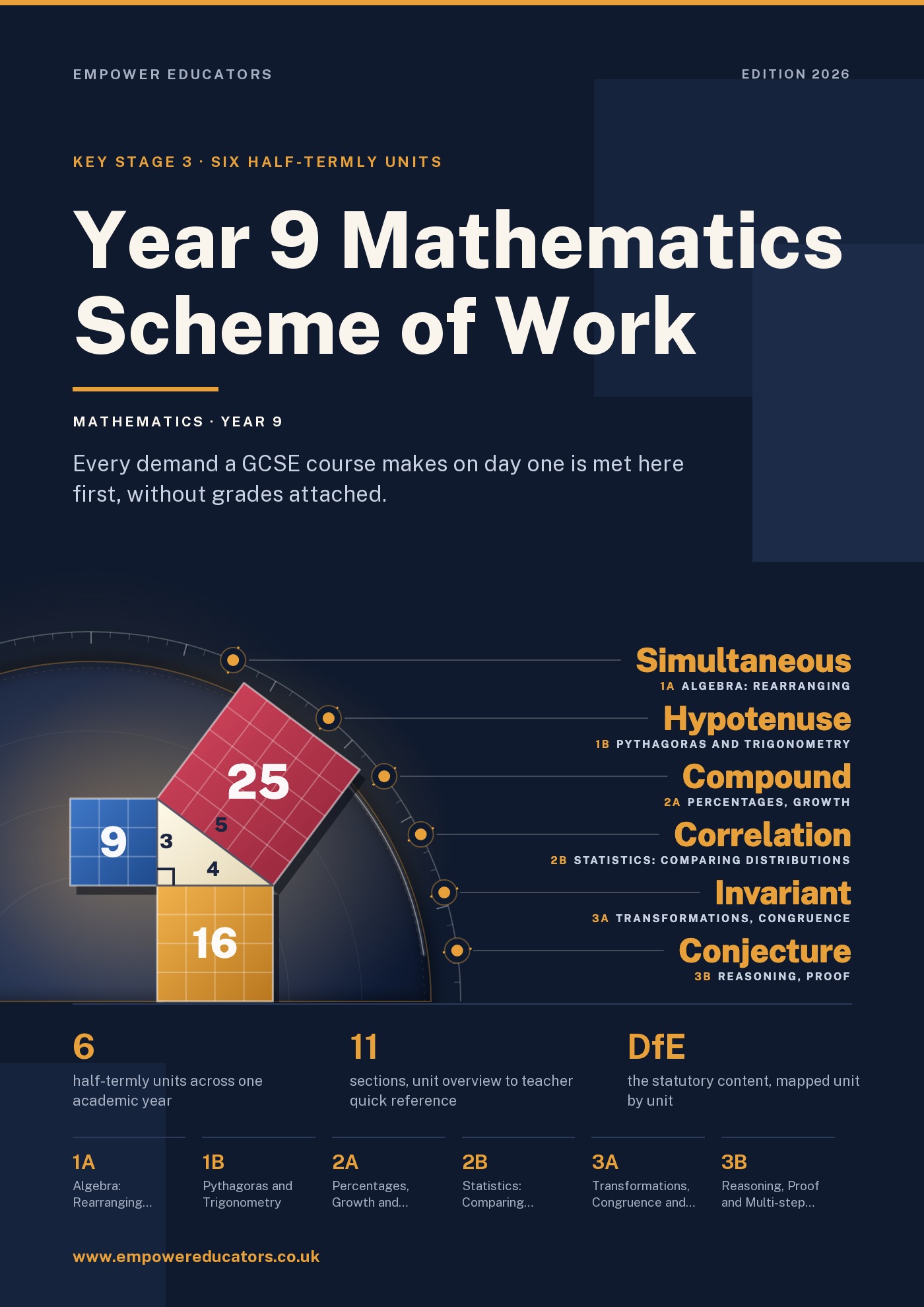
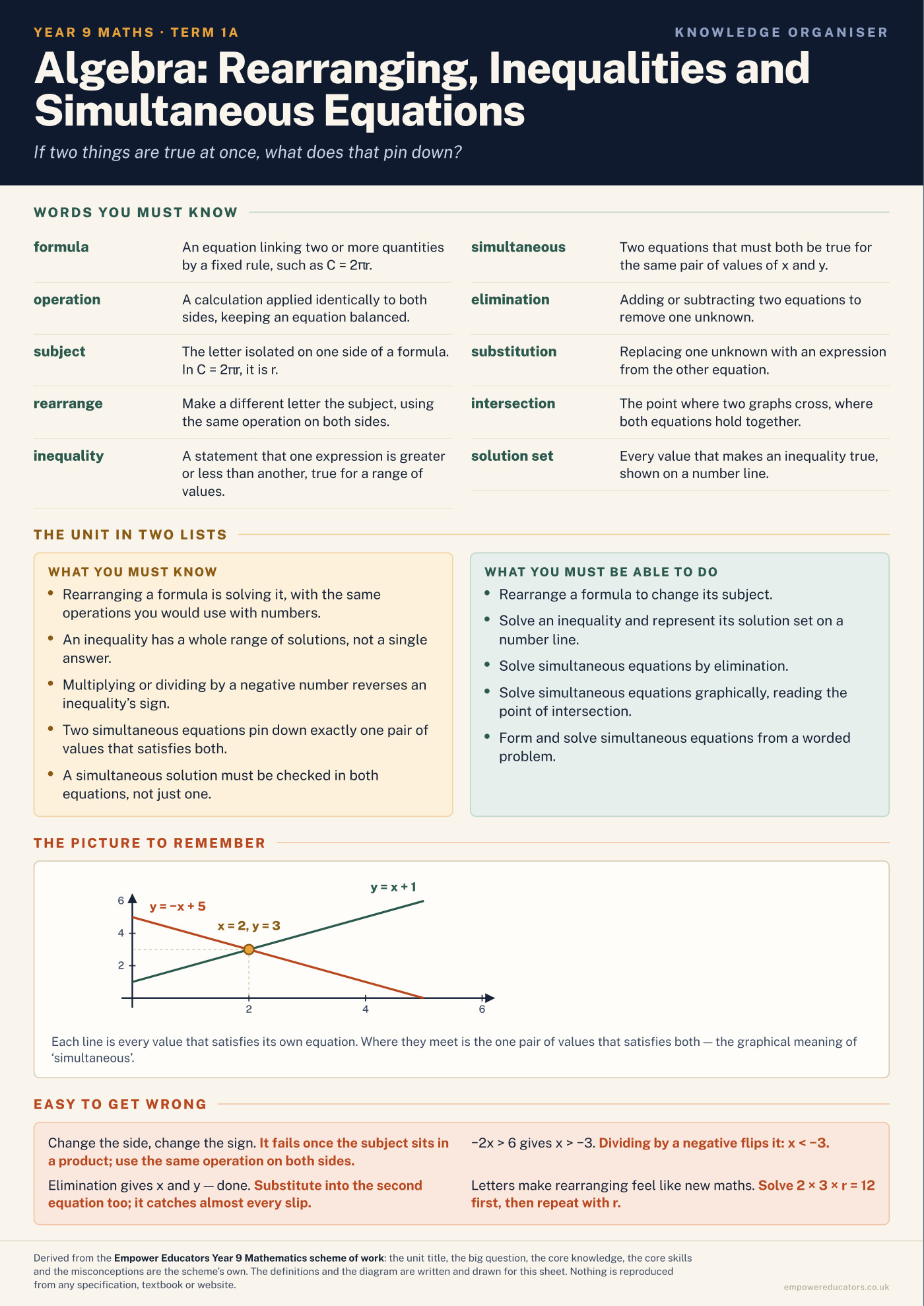
Six half-term units, in the order we teach them: rearranging, inequalities and simultaneous equations; Pythagoras and trigonometry; percentages, growth and financial mathematics; comparing distributions; transformations, congruence and similarity; and reasoning, proof and multi-step problems. Below is what each unit starts from, what pupils produce and the representation it teaches with, taken from our Year 9 Mathematics scheme of work.
Six half-termly units forming the bridge to GCSE. Every demand a GCSE course makes on day one — algebraic fluency, trigonometry, financial mathematics, comparing distributions, similarity and sustained reasoning — is met here first, without grades attached.
Year 9 means ages 13–14, or S2–S3 in Scotland.
The year, unit by unit
Algebra: Rearranging, Inequalities and Simultaneous Equations
Unit 1a · Autumn 1 · approx. 7 weeks · September – October
If two things are true at once, what does that pin down?
Starts from
Year 8 Unit 3b expanding and factorising, and Year 7 Unit 2b balance. A student who moves terms by rule rather than by operation cannot rearrange a formula and will not recover here.
Pupils produce
A set of rearranged formulae, solved inequalities and simultaneous equations, each with reasoning shown.
Key representation
Balance for rearranging; number line for inequalities; the crossing point of two lines.
Pythagoras and Trigonometry
Unit 1b · Autumn 2 · approx. 7 weeks · November – December
How do you measure something you cannot reach?
Starts from
Unit 1a rearranging, and Year 8 Unit 2a square roots. A student who cannot rearrange cannot use a trigonometric ratio in more than one direction.
Pupils produce
A set of right-angled triangle problems solved and justified, including one in a real context.
Key representation
The area proof of Pythagoras; a set of similar triangles showing the ratio is constant.
Percentages, Growth and Financial Mathematics
Unit 2a · Spring 1 · approx. 6 weeks · January – February
Why does a debt grow faster than you expect?
Starts from
Year 8 Unit 1a percentage change as a multiplier. A student still finding a percentage and adding it cannot handle compound growth and should revisit Year 8 first.
Pupils produce
A financial investigation using repeated percentage change, with the conclusion justified.
Key representation
The multiplier chain; a graph of compound against simple growth.
Statistics: Comparing Distributions
Unit 2b · Spring 2 · approx. 6 weeks · February – April
Two groups have the same average. How can they be completely different?
Starts from
Year 7 Unit 3b averages and range, and Year 8 Unit 1b graph interpretation. Both are checked in Phase 1.
Pupils produce
A statistical comparison of two real data sets using an average and a measure of spread, with limitations stated.
Key representation
Two distributions drawn on the same axes; the scatter graph.
Transformations, Congruence and Similarity
Unit 3a · Summer 1 · approx. 6 weeks · April – May
What stays the same when a shape moves, and what changes?
Starts from
Year 8 Unit 2b scaling by dimension, and Year 8 Unit 1b coordinates. A student who thinks doubling the sides doubles the area will produce wrong answers throughout the similarity phases.
Pupils produce
A set of transformation and similarity problems, including one where scale factor is used to find a missing length.
Key representation
Tracing paper for rotation; the ray diagram for enlargement.
Reasoning, Proof and Multi-step Problems
Unit 3b · Summer 2 · approx. 6 weeks · June – July
What is the difference between something that always works and something that has always worked so far?
Starts from
Unit 1a algebraic manipulation, and the habit of justifying steps established from Year 7 Unit 2b onward. This unit consolidates rather than introduces.
Pupils produce
A proof of a general statement, and a multi-step problem solved with the strategy explained.
Key representation
The general form — 2n for any even number, 2n + 1 for any odd — written before any manipulation.
How it meets the key stage 3 programme of study
The scheme maps each requirement of the statutory programme of study for key stage 3 (Department for Education, 2013) to the unit that teaches it. Pupils should be taught to…
consolidate their numerical and mathematical capability from key stage 2 and extend their understanding of the number system and place value to include decimals, fractions, powers and roots
2a compound growth, decay and reverse percentage · Year 7 and 8 number revisited through weekly retrieval
extend their understanding of the number system; make connections between number relationships, and their algebraic and graphical representations
1a rearranging, inequalities and simultaneous equations · 3b algebraic proof · 1b trigonometric ratios as proportional relationships
develop their mathematical knowledge, in part through solving problems and evaluating the outcomes, including multi-step problems
3b is entirely multi-step problem solving and proof. Multi-step problems also close units 1a, 2a and 2b
Content: number · algebra · ratio, proportion and rates of change · geometry and measures · probability · statistics
Number 2a · Algebra 1a, 3b · Ratio and proportion 2a, 3a · Geometry and measures 1b, 3a · Statistics 2b · Probability Year 8 Unit 3a
Across the three years the programme of study is fully covered, but the coverage is deliberately uneven within each year: probability sits only in Year 8, statistics mostly in Year 7 and Year 9, and proof only here. That is a sequencing choice, not an omission — each topic waits until its prerequisite is a year old. The prerequisite map at the back of this book shows the whole dependency chain. Reorder units and check it still holds.
The Year 9 Maths resources
Two PDFs sit behind this page, and they are meant to be used together: the scheme of work to plan the year, the knowledge organisers to put in front of pupils.
The statutory programme of study for key stage 3 mathematics (DfE, 2013)·35 pages, 11 sections·For heads of mathematics, subject leaders and every teacher who has to deliver it
Six half-term units, in the order they are taught: Algebra: Rearranging, Inequalities and Simultaneous Equations, Pythagoras and Trigonometry, Percentages, Growth and Financial Mathematics, Statistics: Comparing Distributions, Transformations, Congruence and Similarity and Reasoning, Proof and Multi-step Problems.
What do pupils produce in Year 9 Maths?
A set of rearranged formulae, solved inequalities and simultaneous equations, each with reasoning shown; A set of right-angled triangle problems solved and justified, including one in a real context; A financial investigation using repeated percentage change, with the conclusion justified; A statistical comparison of two real data sets using an average and a measure of spread, with limitations stated; A set of transformation and similarity problems, including one where scale factor is used to find a missing length; A proof of a general statement, and a multi-step problem solved with the strategy explained.
Does Year 9 Maths meet the National Curriculum?
Yes, across the three years of key stage 3. It maps each requirement of the statutory programme of study for key stage 3 (Department for Education, 2013) to the unit that teaches it, and on this year the scheme is plain: “Across the three years the programme of study is fully covered, but the coverage is deliberately uneven within each year: probability sits only in Year 8, statistics mostly in Year 7 and Year 9, and proof only here.”
Cookies
This site works the same either way. Measurement — Google Analytics and Microsoft Clarity — only runs if you say yes, and it is used to see which resources people actually reach.Measurement only runs if you say yes.What is collected.