Mathematics · Key Stage 3 · £4.99
Year 7 Mathematics
Scheme of Work
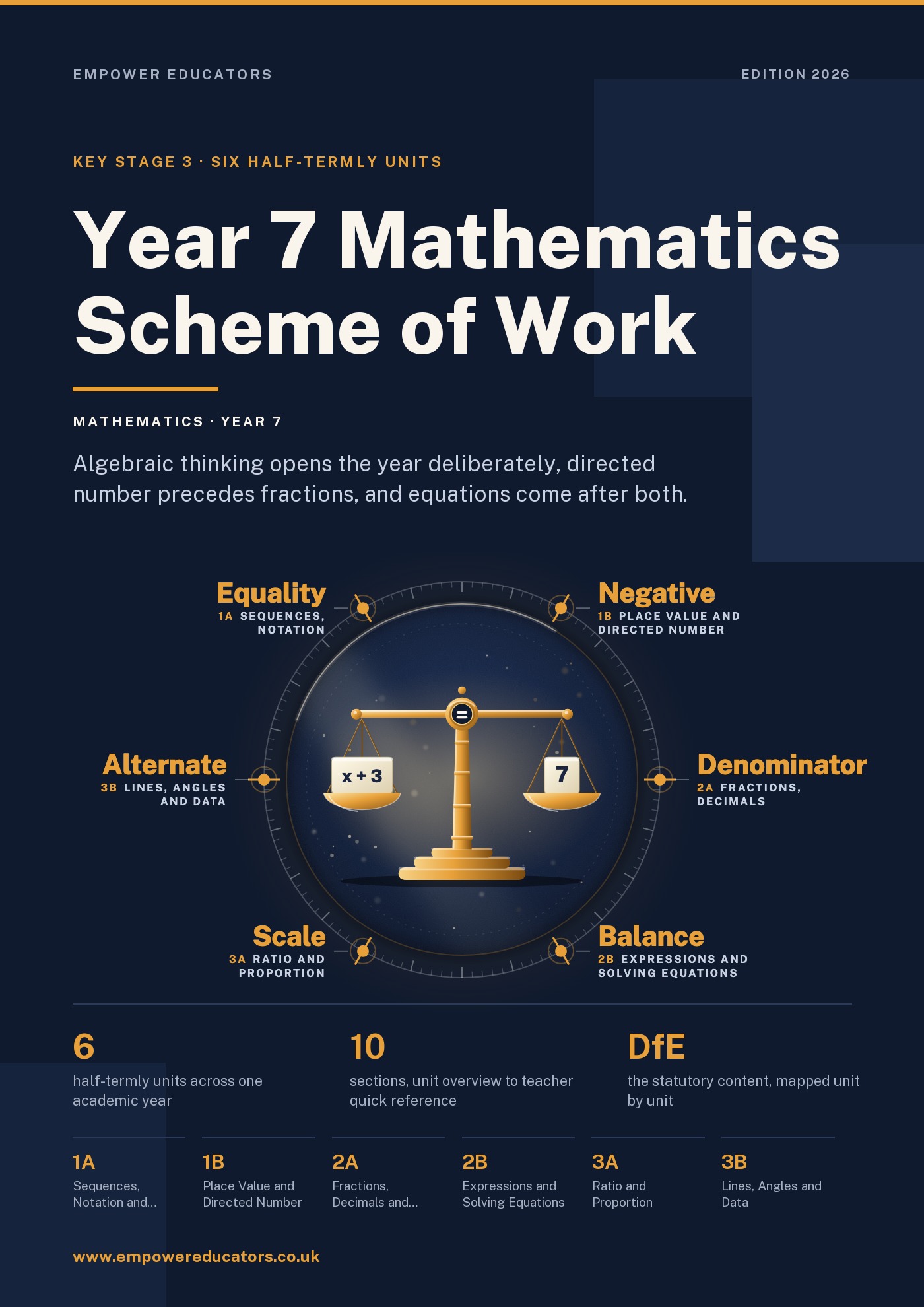
Six half-termly units across one academic year. Algebraic thinking opens the year deliberately, directed number precedes fractions, and equations come after both. Each unit states the prerequisite it cannot run without.
£4.99The Year 7 scheme: 6 half-termly units, 35 pages
- A4 PDF
- first 8 pages free to read
- instant download
Teaching all of Key Stage 3? Year 7, Year 8 and Year 9 as one set: £11.99, saving £2.98.
One purchase covers the school that buys it. Print it, copy it, hand it round your department. Not for passing to other schools or uploading anywhere.
PDF download, ready straight after payment. Downloading it ends the 14-day right to cancel; a file that is faulty or not as described is always refunded. Refunds
Read before publication by the serving head of that department and by senior leaders, in school.
5.0 from 24+ reviews on Google
Schools that have bought from Empower Educators include Nottingham High School, Northampton High School GDST and Sutton Valence School.
Complete your Mathematics
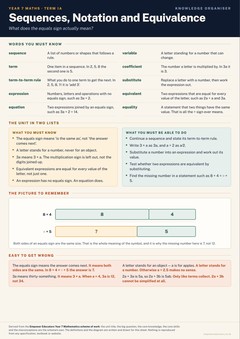
The whole key stage: KS3 Maths scheme of work
Everything else this site has for Mathematics: Mathematics teaching resources
- 1aSequences, Notation and Equivalence
- 1bPlace Value and Directed Number
- 2aFractions, Decimals and Percentages
- 2bExpressions and Solving Equations
- 3aRatio and Proportion
- 3bLines, Angles and Data
Ten sections per unit, in the same order every time. Phases rather than single lessons, because mathematics is timetabled at three to four hours a week.
One principle applies to every unit and is stated once at the front: a method a student cannot explain is a method they will lose. Reasoning is required at every step, from the first week of Year 7.
Every duration, context and assessment word is a strong default rather than a fixed rule. Year 7 means ages 11–12, or P7–S1 in Scotland.
- Written to
- The statutory programme of study for key stage 3 mathematics (DfE, 2013)
- Intended for
- heads of mathematics, subject leaders and every teacher who has to deliver it
- Extent
- 35 pages · 10 sections
The sequence
What this scheme of work covers, unit by unit
The 6 units of the Year 7 Mathematics Scheme of Work, in teaching order, with the term each one runs in and the question it is built to answer.
1a
Sequences, Notation and Equivalence
Autumn 1 · approx. 7 weeks · September – October
What does the equals sign actually mean?
1b
Place Value and Directed Number
Autumn 2 · approx. 7 weeks · November – December
What is actually happening when you subtract a negative?
2a
Fractions, Decimals and Percentages
Spring 1 · approx. 6 weeks · January – February
Why are a half, 0.5 and 50% the same thing?
2b
Expressions and Solving Equations
Spring 2 · approx. 6 weeks · February – April
If you do the same thing to both sides, why does the answer stay true?
3a
Ratio and Proportion
Summer 1 · approx. 6 weeks · April – May
When two things grow together, what stays the same?
3b
Lines, Angles and Data
Summer 2 · approx. 6 weeks · June – July
How do you know a mathematical statement is true, rather than just likely?
Look inside
Real pages, straight from the PDF
Click any page to see it full size.
Contents
All 10 sections
Taken from the book’s own contents page, so the page numbers are the real ones.