Mathematics · GCSE · £6.99
GCSE Mathematics
Questions
& Answers
GCSE Maths Questions and Answers (PDF)
A wrong answer with the method written above it keeps two marks in three. The same wrong answer standing alone keeps none, and the difference is not ability — it is what ended up on the page. Every one of these hundred questions carries its own mark scheme, method, accuracy and independent marks set out separately, so a class can see which line earned what. Higher-tier content is marked on the page rather than split into a second book.
£6.99100 questions, each answered three times (weak, middling, strong), 107 pages
- A4 PDF
- first 14 pages free to read
- instant download
One purchase covers the school that buys it. Print it, copy it, hand it round your department. Not for passing to other schools or uploading anywhere.
PDF download, ready straight after payment. Downloading it ends the 14-day right to cancel; a file that is faulty or not as described is always refunded. Refunds
Read before publication by the serving head of that department and by senior leaders, in school.
5.0 from 24+ reviews on Google
Schools that have bought from Empower Educators include Nottingham High School, Northampton High School GDST and Sutton Valence School.
Complete your Mathematics


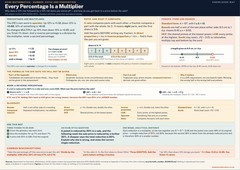
Everything else this site has for Mathematics: Mathematics teaching resources
Also teaching mathematics lower down the school, or the exam itself? Mathematics scheme of work · GCSE Mathematics assessment objectives
- 1Number
- 2Algebra: expressions and manipulation
- 3Equations, inequalities and graphs
- 4Ratio, proportion and rates of change
- 5Geometry: angles, shape and properties
- 6Mensuration, Pythagoras and trigonometry
- 7Probability
- 8Statistics
- 9Method, working and communication
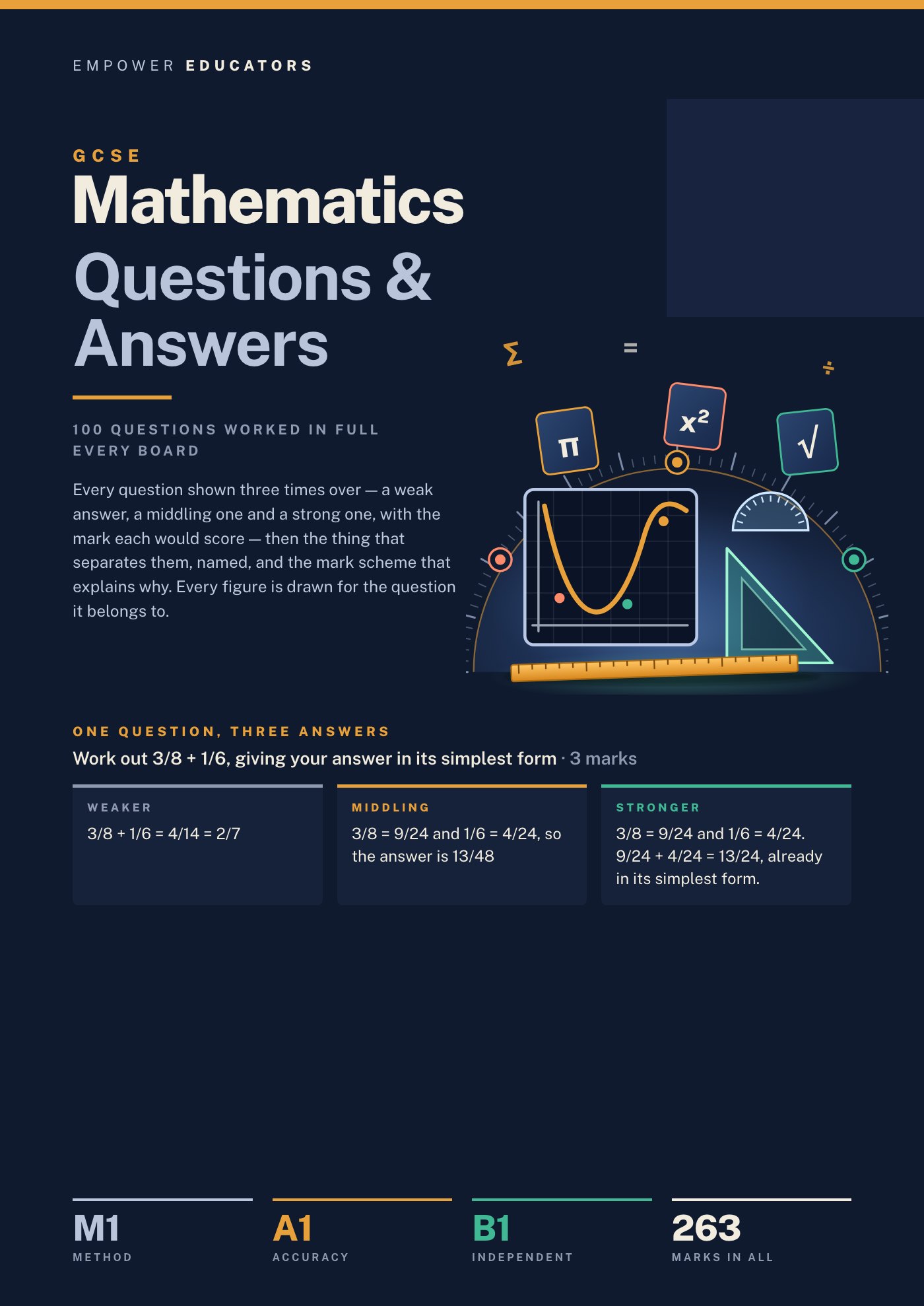
Not a bank of questions with the answers printed underneath. The three banded responses are the starting point, not the output: what follows each one is the discriminator, named out loud, then the questions you actually ask to move a student from the first answer to the last, then the mark scheme that shows what each line was worth. That combination is the part no mark scheme contains on its own.
Every question, every answer and every figure in this book is written and drawn for it. Nothing is copied from a past paper, a mark scheme or an examiner report, and no candidate’s script appears anywhere in it. The mark schemes follow the same conventions the boards use (method, accuracy and independent marks) rather than being reproduced from any of them.
Twenty-nine of the hundred are Higher tier and say so in the top corner. Higher includes all of Foundation, so a Higher class needs every page and a Foundation class skips those twenty-nine, which is why the book is not split in two. The last eight questions are about working and communication rather than content: why a correct answer with no working can score less than a wrong one, what “show that” requires that “work out” does not, and why a rounded value should never be carried into the next line.
- Written to
- The GCSE subject content for mathematics (DfE) and the three assessment objectives set by Ofqual, which are worded identically across AQA, Edexcel, OCR and Eduqas
- Intended for
- mathematics teachers and heads of department. Used with a class, not a student revision guide
- Extent
- 107 pages · 9 sections
Sample questions
Sample GCSE Maths questions and answers
Seven questions from the book, printed exactly as they appear in it: the question, the answers it works through, and the mark each one scores. All of them are in the free preview.
Question 1·Number·1 mark
Write down the value of the 7 in 3.078.
WeakerWould score 0 of 1
The 7 is worth 7, because that is the digit that is written there.
MiddlingWould score 1 of 1
The 7 is in the hundredths column.
StrongerWould score 1 of 1
0.07, or seven hundredths.
What separates them
One mark, and the command is write down, so no working is wanted and none is credited. Naming the column is usually accepted, but it answers a question about position rather than value — and the question asked for a value. Giving the number itself cannot be marked wrong on either reading, which is the reason to give it.
The full-mark answer1 mark
0.07, or seven hundredths.
Question 2·Number·1 mark
Write 0.000048 in standard form.
WeakerWould score 0 of 1
0.000048 = 48 × 10−6
MiddlingWould score 0 of 1
4.8 × 10⁻⁶
StrongerWould score 1 of 1
4.8 × 10⁻⁵
What separates them
Standard form has two conditions and the weaker answers each break one. The first number must be at least 1 and less than 10, so 48 is not allowed however correct the power is. The middling answer fixes that and then miscounts: moving the point from 0.000048 to 4.8 is five places, not six. Counting the zeros gives six and is the reason the error is so common — the count is of places moved, not zeros written.
The full-mark answer1 mark
4.8 × 10⁻⁵
Question 3·Number·2 marks
Write 84 as a product of its prime factors.
WeakerWould score 0 of 2
84 = 4 × 21
MiddlingWould score 2 of 2
84 = 2 × 2 × 3 × 7
StrongerWould score 2 of 2
84 = 22 × 3 × 7
What separates them
Stopping at a pair of factors leaves 4 in the answer, and 4 is not prime, so nothing the question asked for has been done. The middling answer is completely correct and would take both marks: a product of primes is what was requested, and index form is a convention rather than a requirement. Writing it in index form is still worth doing, because every later use of this — highest common factor, lowest common multiple, square numbers — reads off the indices and not off a list.
The full-mark answer2 marks
84 = 22 × 3 × 7
Question 4·Number·3 marks
Find the highest common factor and the lowest common multiple of 84 and 120.
WeakerWould score 0 of 3
The HCF is 4 and the LCM is 840, found by listing the factors and multiples of each number.
MiddlingWould score 2 of 3
84 = 22 × 3 × 7 and 120 = 23 × 3 × 5. HCF = 2 × 3 = 6. LCM = 840.
StrongerWould score 3 of 3
84 = 22 × 3 × 7 and 120 = 23 × 3 × 5. HCF takes the lower index of each shared prime: 22 × 3 = 12. LCM takes the higher index of every prime present: 23 × 3 × 5 × 7 = 840.
What separates them
Listing factors works for small numbers, which is why it survives as far as a question where it does not — and this is that question. The weak answer lists, which works for small numbers and is why it survives to a question where it does not — the factor list is long enough that 12 gets missed. The middling answer has the right method and the right prime factorisations, then takes one 2 for the HCF instead of the lower index, which is two: it loses a mark on the last step of a correct method. Lower index for the HCF, higher index for the LCM, is the whole rule.
The full-mark answer3 marks
84 = 22 × 3 × 7 and 120 = 23 × 3 × 5. The HCF takes the lower index of each prime in both: 22 × 3 = 12. The LCM takes the higher index of every prime in either: 23 × 3 × 5 × 7 = 840.
Question 5·Number·3 marks
Work out 3⁄8 + 1⁄6, giving your answer in its simplest form.
WeakerWould score 0 of 3
3⁄8 + 1⁄6 = 4⁄14 = 2⁄7
MiddlingWould score 2 of 3
3⁄8 = 9⁄24 and 1⁄6 = 4⁄24, so the answer is 13⁄48
StrongerWould score 3 of 3
3⁄8 = 9⁄24 and 1⁄6 = 4⁄24. 9⁄24 + 4⁄24 = 13⁄24, which is already in its simplest form.
What separates them
This is the page that makes the argument for writing method down, so it is worth being exact about the marks. The middling answer is wrong — it adds the numerators and then writes the wrong denominator — and still scores two of the three, because both method marks were earned before the slip. The weak answer is also wrong and scores nothing, because adding across leaves no method on the page to credit. The gap between them is two marks and it is not a gap in ability.
The full-mark answer3 marks
3⁄8 = 9⁄24 and 1⁄6 = 4⁄24. Adding the numerators over the common denominator gives 13⁄24. 13 is prime and is not a factor of 24, so the fraction is already in its simplest form.
Question 6·Number·3 marks
Work out 23⁄5 × 11⁄4, giving your answer as a mixed number.
WeakerWould score 0 of 3
2 × 1 = 2 and 3⁄5 × 1⁄4 = 3⁄20, so the answer is 23⁄20
MiddlingWould score 2 of 3
13⁄5 × 5⁄4 = 65⁄20
StrongerWould score 3 of 3
13⁄5 × 5⁄4 = 65⁄20 = 13⁄4 = 31⁄4
What separates them
Multiplying the whole numbers and the fractions separately is the weak answer, and it is which is not how multiplication distributes and gives an answer smaller than either factor pair suggests. The middling answer converts correctly and multiplies correctly, then stops: the question asked for a mixed number and sixty-five twentieths is not one. That is the accuracy mark, and it is lost to not re-reading the question rather than to any error in the maths.
The full-mark answer3 marks
23⁄5 = 13⁄5 and 11⁄4 = 5⁄4. 13⁄5 × 5⁄4 = 65⁄20, which cancels to 13⁄4 and converts to 31⁄4.
Question 7·Number·3 marks
Estimate the value of (4.9 × 19.6) ÷ 0.51.
WeakerWould score 0 of 3
(4.9 × 19.6) ÷ 0.51 = 188.2, worked out on a calculator and then rounded.
MiddlingWould score 2 of 3
5 × 20 ÷ 0.5 = 100 ÷ 0.5 = 50
StrongerWould score 3 of 3
5 × 20 ÷ 0.5 = 100 ÷ 0.5 = 200
What separates them
Here the accurate answer is the one that scores nothing. Estimate asks for each number rounded to one significant figure and the calculation done with those — an exact answer proves the estimate was never made. The middling answer estimates correctly and then halves instead of doubling: dividing by a number smaller than 1 makes the result larger, which is the one fact this question is really testing.
The full-mark answer3 marks
Rounding each number to one significant figure gives 5 × 20 ÷ 0.5. The numerator is 5 × 20 = 100, and dividing by 0.5 doubles it, so the estimate is 200. The true value is 188.2, so the estimate is close and, as it should be, easier to obtain.
Look inside
Real pages, straight from the PDF
Click any page to see it full size.
Contents
All 9 sections
Taken from the book’s own contents page, so the page numbers are the real ones.