Mathematics · GCSE (Key Stage 4) · £5.99
Year 10 Mathematics
Scheme of Work
GCSE Maths Scheme of Work (SOW) — Y10 Higher & Foundation
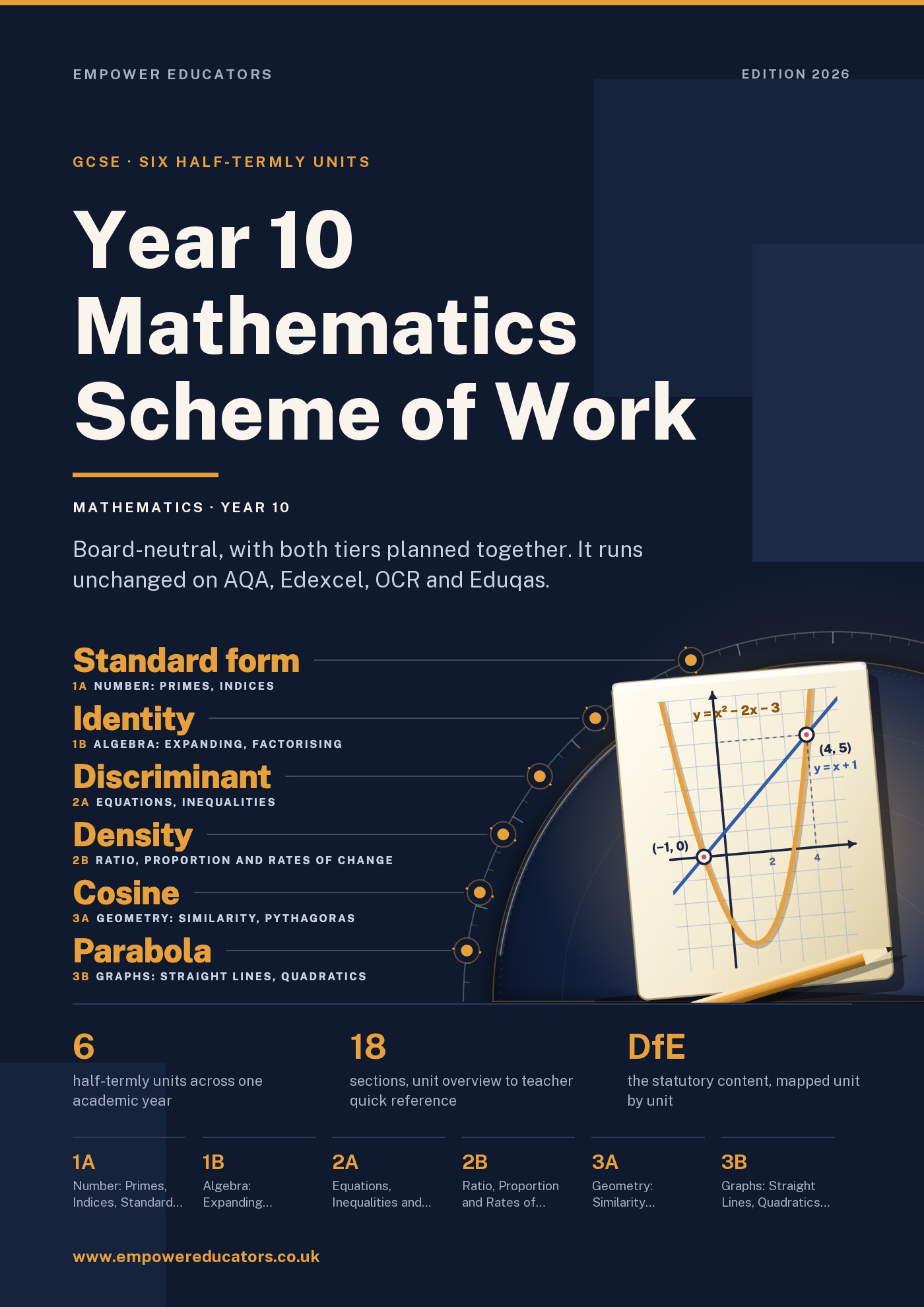
Sixty-one pages, board-neutral, with both tiers planned together. The Foundation and Higher split is taken from the bold type in the DfE subject content rather than from any one specification, so it runs unchanged on AQA, Edexcel, OCR and Eduqas. Every unit shows a piece of student work with the error in it beside the repair, and six printable diagnostics sit at the back.
£5.99The Year 10 scheme: 6 half-termly units, 61 pages
- A4 PDF
- first 8 pages free to read
- instant download
Teaching all of the GCSE course? Year 10 and Year 11 as one set: £9.99, saving £1.99.
One purchase covers the school that buys it. Print it, copy it, hand it round your department. Not for passing to other schools or uploading anywhere.
PDF download, ready straight after payment. Downloading it ends the 14-day right to cancel; a file that is faulty or not as described is always refunded. Refunds
Read before publication by the serving head of that department and by senior leaders, in school.
5.0 from 24+ reviews on Google
Schools that have bought from Empower Educators include Nottingham High School, Northampton High School GDST and Sutton Valence School.
Complete your Mathematics


Board-neutral, written for AQA, Pearson Edexcel, OCR and Eduqas. All GCSE schemes of work
Both years: GCSE Mathematics scheme of work
Everything else this site has for Mathematics: Mathematics teaching resources
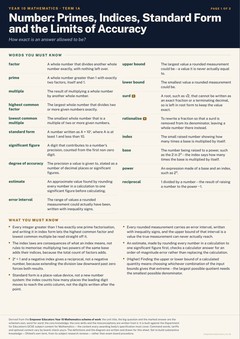
- 1aNumber: Primes, Indices, Standard Form and the Limits of Accuracy
- 1bAlgebra: Expanding, Factorising and Changing the Subject
- 2aEquations, Inequalities and Simultaneous Equations
- 2bRatio, Proportion and Rates of Change
- 3aGeometry: Similarity, Pythagoras and Trigonometry
- 3bGraphs: Straight Lines, Quadratics and Real-Life Relationships
Ten sections per unit, in the same order every time. Phases rather than single lessons, because mathematics is timetabled at three to four hours a week.
Both tiers are planned together, because a class is not two classes and an entry decision made in Year 10 is made a year too early. Every unit names the statutory content it discharges, so coverage across the two years can be audited rather than assumed.
Number and algebra come first because the assessment objectives make fluency load-bearing for everything else.
- Written to
- The GCSE subject content and assessment objectives for mathematics (DfE, 2013)
- Intended for
- heads of department, subject leaders and every teacher who has to deliver it
- Extent
- 61 pages · 18 sections
- Rearranging formulae, inequalities and simultaneous equations (Year 9, Unit 1a) — Unit 1b and Unit 2a here extend that to GCSE demand.
- Pythagoras' theorem and right-angled trigonometry (Year 9, Unit 1b) — Unit 3a extends it to similarity and non-right-angled cases.
- Percentages, growth and financial mathematics (Year 9, Unit 2a) — Unit 2b builds ratio and proportion on the same footing.
- Comparing distributions (Year 9, Unit 2b).
- Transformations, congruence and similarity (Year 9, Unit 3a) — Unit 3a here extends similarity into GCSE-level ratio and scale problems.
- Multi-step reasoning and proof (Year 9, Unit 3b) — the sustained reasoning every unit this year assumes.
The sequence
What this scheme of work covers, unit by unit
The 6 units of the Year 10 Mathematics Scheme of Work, in teaching order, with the term each one runs in and the question it is built to answer.
1a
Number: Primes, Indices, Standard Form and the Limits of Accuracy
Autumn 1 · approx. 7 weeks · September – October
How exact is an answer allowed to be?
1b
Algebra: Expanding, Factorising and Changing the Subject
Autumn 2 · approx. 7 weeks · November – December
When are two expressions that look completely different actually the same?
2a
Equations, Inequalities and Simultaneous Equations
Spring 1 · approx. 6 weeks · January – February
What does it take to pin a value down — and when is one answer not enough?
2b
Ratio, Proportion and Rates of Change
Spring 2 · approx. 6 weeks · February – April
When one quantity changes, what exactly happens to the other?
3a
Geometry: Similarity, Pythagoras and Trigonometry
Summer 1 · approx. 6 weeks · April – May
If you know some of a triangle, what else is already decided?
3b
Graphs: Straight Lines, Quadratics and Real-Life Relationships
Summer 2 · approx. 7 weeks · June – July
What can you read off a picture that you could not see in the equation?
Look inside
Real pages, straight from the PDF
Click any page to see it full size.
Contents
All 18 sections
Taken from the book’s own contents page, so the page numbers are the real ones.