Geography · GCSE · £6.99
GCSE Geography
Questions
& Answers
In geography the middling answer is rarely the one that knows less. It is the one whose chain of reasoning stops a link short, and naming that is what each of these hundred pages does. Ten figures are drawn in code rather than sourced, so the hydrograph, the choropleth and the map extract carry no licensing question; and where a misconception is spatial it is drawn twice, the version most students produce beside the version that is correct.
£6.99100 questions, each answered three times (weak, middling, strong), 106 pages
- A4 PDF
- first 14 pages free to read
- instant download
One purchase covers the school that buys it. Print it, copy it, hand it round your department. Not for passing to other schools or uploading anywhere.
PDF download, ready straight after payment. Downloading it ends the 14-day right to cancel; a file that is faulty or not as described is always refunded. Refunds
Read before publication by serving senior leaders, in school.
5.0 from 24+ reviews on Google
Schools that have bought from Empower Educators include Nottingham High School, Northampton High School GDST and Sutton Valence School.
Complete your Geography


Everything else this site has for Geography: Geography teaching resources
Also teaching geography lower down the school, or the exam itself? Geography scheme of work · GCSE Geography assessment objectives
- 1Tectonic hazards
- 2Weather hazards and climate change
- 3Ecosystems and the living world
- 4Coastal landscapes
- 5River landscapes
- 6Glacial landscapes
- 7Urban issues and challenges
- 8The changing economic world
- 9Resource management
- 10Fieldwork
- 11Geographical skills
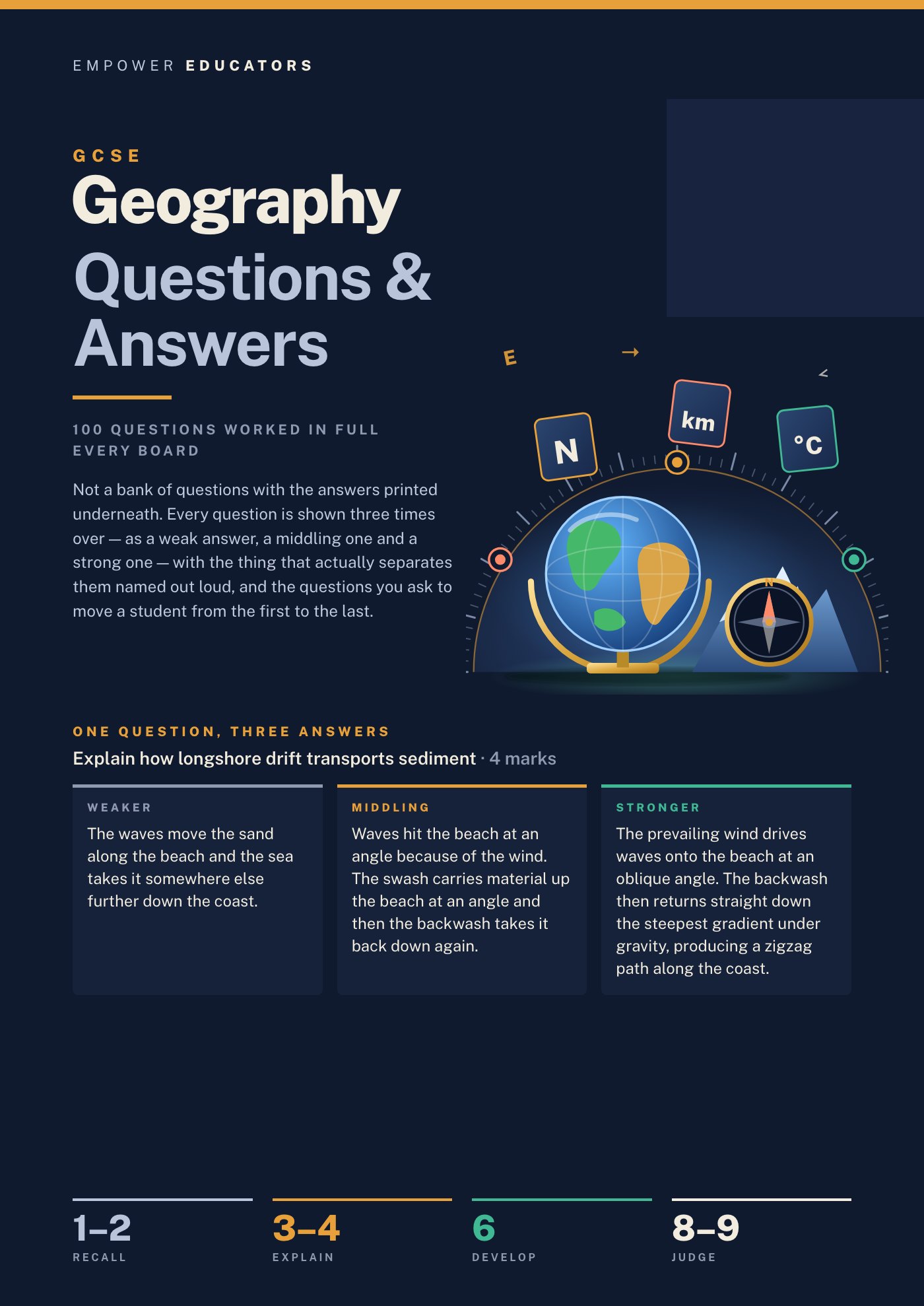
Not a bank of questions with the answers printed underneath. The three banded responses are the starting point, not the output: what follows each one is the discriminator, named out loud, and then the questions you actually ask to move a student from the first answer to the last. That prompt sequence is the part no mark scheme contains.
Every question and every answer here is written for this book. None is copied from a past paper, a mark scheme or an examiner report, and no candidate’s script appears anywhere in it. What the questions do carry is the wording, the command word, the mark tariff and the structure the assessment objectives require — which is why they work whichever board a department has chosen.
Ten diagrams and data resources are drawn in code rather than sourced, so the hydrograph, the map extract, the choropleth and the rest carry no licensing question. Where a misconception is spatial, it is drawn twice: the version most students produce beside the version that is correct, because a class that only ever sees the right diagram cannot recognise its own error.
- Written to
- The GCSE subject content for geography (DfE) and the four assessment objectives set by Ofqual, which are worded identically across AQA, Edexcel, OCR and Eduqas
- Intended for
- geography teachers and heads of department. Used with a class, not a student revision guide
- Extent
- 106 pages · 11 sections
Sample questions
Sample GCSE Geography questions and answers
Seven questions from the book, printed exactly as they appear in it: the question, the answers it works through, and the mark each one scores. All of them are in the free preview.
Question 1·Tectonic hazards·4 marks
Describe the global distribution of earthquakes and volcanoes.
WeakerWould score 0 of 4
Earthquakes happen all over the world, but mostly in hot countries like Japan and America.
MiddlingWould score 2 of 4
Earthquakes and volcanoes are found at plate boundaries. There are a lot of them around the Pacific Ocean, and some in the Mediterranean too.
StrongerWould score 4 of 4
Both are concentrated in narrow belts along plate margins rather than spread evenly. The largest belt rings the Pacific Ocean; a second runs west to east through the Mediterranean and into Asia. A third line of earthquakes, with almost no volcanoes, follows the mid-Atlantic. Continental interiors such as central Australia have virtually none.
What separates them
A describe answer is marked on pattern, named places and the exception — and on none of the reasons. The middling answer has the pattern and one region, then stops. The strongest one explains nothing at all: it says narrow belts, not evenly spread, names three of them, and finishes on where there are none. Students lose marks here by reaching for a cause, and a cause is a sentence that cannot score on this command word however accurate it is.
The full-mark answer4 marks
Earthquakes and volcanoes are concentrated in narrow belts along plate margins rather than spread evenly across the globe. The largest belt rings the Pacific Ocean, and a second runs west to east through the Mediterranean and into southern Asia. A third belt of earthquakes with almost no volcanoes follows the mid-Atlantic. Continental interiors, such as central Australia and northern Canada, have virtually none.
Question 3·Tectonic hazards·6 marks
Explain why the effects of an earthquake are often greater in a lower-income country.
WeakerWould score 1 of 6
Because they are poor and they do not have good buildings, so more people die.
MiddlingWould score 3 of 6
In a lower-income country the buildings are not built to withstand earthquakes, so they collapse and kill people. There is also less money for the emergency services.
StrongerWould score 6 of 6
One reason is building quality. Aseismic regulations are less likely to be enforced, so unreinforced concrete and masonry collapse rather than flex — and it is buildings falling, not the ground moving, that causes most earthquake deaths. A second is the speed of the response. With fewer trained search teams, helicopters and hospital beds, the gap between the shaking and the first medical treatment is longer, so injuries that would have been survivable become fatal.
What separates them
Both the middling and the strongest answer name building quality and emergency response, so the two reasons are not what separates them. The middling one stops at the first consequence — buildings collapse, people die — and never reaches the second step, which is where the development marks live. And note what the weaker answer does: “they are poor” is not a reason. Poverty is the context. The marks are for saying what poverty does.
The full-mark answer6 marks · 3 + 3
One reason is building quality. Aseismic building regulations are less likely to be enforced, so unreinforced concrete and masonry collapse rather than flex, and it is falling buildings rather than ground movement that causes the majority of earthquake deaths. A second reason is the speed of the response. With fewer trained search teams, helicopters and hospital beds available, the interval between the shaking and the first medical treatment is longer, so injuries that would have been survivable elsewhere become fatal.
Question 4·Tectonic hazards·6 marks
Suggest why people continue to live in areas at risk from volcanic eruptions.
WeakerWould score 1 of 6
Because it is their home and they do not want to move away from their family.
MiddlingWould score 2 of 6
The soil near volcanoes is very fertile, so farmers get good crops there. Volcanoes also attract tourists, which brings money into the area.
StrongerWould score 6 of 6
One reason is agricultural. Weathered volcanic ash releases minerals into the soil, so yields are high enough to support a farming population denser than the land nearby could carry — leaving means losing the livelihood, not just the house. A second is that the risk is not continuous. Eruptions may be decades apart and monitoring now gives days of warning, so residents are weighing a distant, manageable risk against a certain and immediate loss.
What separates them
Suggest asks you to apply what you know to a situation you were not taught directly, so the marks are for the reasoning and not for the recall. The middling answer offers two entirely correct facts — fertile soil, tourism — and does nothing with either. Neither is carried to the point where it explains a decision. The strongest answer does what the command word actually asks: it turns each fact into a reason a person standing there would give you.
The full-mark answer6 marks · 3 + 3
One reason is agricultural. Weathered volcanic ash releases minerals into the soil, so yields are high enough to support a farming population denser than the surrounding land could carry, which means leaving costs a household its livelihood and not simply its house. A second reason is that the risk is intermittent rather than continuous. Eruptions may be decades apart, and monitoring now provides days of warning, so residents are weighing a distant and manageable risk against a certain and immediate loss.
Question 5·Tectonic hazards·6 marks
Compare the effects of two tectonic hazards you have studied.
WeakerWould score 1 of 6
In the poorer country a lot of people died. In the richer one there was a tsunami and lots of buildings got destroyed.
MiddlingWould score 3 of 6
In the lower-income event over a hundred thousand people were killed. In the higher-income event far fewer died, even though the earthquake was stronger. They had better buildings and warning systems there.
StrongerWould score 6 of 6
Both events killed and displaced people, but the balance was reversed. The lower-income event was the weaker of the two in magnitude and yet killed far more, because unreinforced buildings collapsed onto a dense urban population. The higher-income event was stronger and cost far more in damage to property, yet killed a fraction as many, because aseismic construction held and warnings moved people out of the tsunami zone. So the more powerful hazard produced the smaller death toll.
What separates them
A comparison has to hold both events inside the same sentence. The middling answer describes each in turn and only connects them at the very end, which is why it reads as two descriptions with a comment attached — and it compares deaths in one place with buildings in the other, which is not comparing at all. Look for the linking words: whereas, by contrast, the same but. And compare like with like — deaths against deaths, cost against cost.
The full-mark answer6 marks · 3 + 3
Both events caused death and large-scale displacement, but the balance between human and economic loss was reversed. The lower-income event was the weaker of the two in magnitude and yet killed far more, because unreinforced buildings collapsed onto a densely populated urban area. By contrast the higher-income event was the stronger and cost far more in damage to property, yet killed a fraction as many, because aseismic construction held and warning systems moved people out of the tsunami zone. The more powerful hazard therefore produced the smaller death toll.
Question 6·Tectonic hazards·4 marks
Outline one immediate and one long-term response to a tectonic hazard.
WeakerWould score 0 of 4
They send help to the people and then afterwards they build everything again.
MiddlingWould score 2 of 4
An immediate response is search and rescue to find survivors. A long-term response is rebuilding houses so that people have somewhere to live again.
StrongerWould score 4 of 4
An immediate response is search and rescue, carried out in the first hours and days while trapped survivors can still be reached alive. A long-term response is rebuilding to a higher aseismic standard, which takes years and reduces the death toll in the next event rather than in this one.
What separates them
Outline asks for a short summary and gives no marks for development — and the middling answer still loses two. What it never establishes is the timescale, which is the only thing that makes a response immediate or long-term at all. Rebuilding is a long-term response because it takes years; say so and the mark is secure. Notice too that the strongest answer here is barely longer than the middling one. Outline is one of the few commands where writing more actively costs marks, because the time comes out of the nine-marker.
The full-mark answer4 marks · 2 + 2
An immediate response is search and rescue, carried out in the first hours and days after the event while trapped survivors can still be reached alive. A long-term response is rebuilding to a higher aseismic standard, which takes place over several years and reduces the death toll in the next event rather than in this one.
Question 7·Tectonic hazards·9 marks
Assess the extent to which monitoring and prediction reduce the effects of tectonic hazards.
WeakerCaps the answer at 2–3
Monitoring helps a lot, because scientists can watch the volcano and tell people to leave before anything happens to them.
MiddlingCaps it at 4–5
Monitoring is useful for volcanoes because there are warning signs beforehand. However, earthquakes cannot be predicted at all. So it depends on which hazard you are talking about.
StrongerLeaves 8–9 open
Monitoring works for volcanoes and does not work for earthquakes, so the extent has to be judged separately for each. Where warning signs exist — gas emissions, ground swelling, small tremors — monitoring buys days and cuts deaths sharply. Where no reliable short-term precursor exists, it changes almost nothing, and the work falls to planning instead.
What separates them
The middling answer reaches the right conclusion — it depends on the hazard — and still sits in the middle band, because it arrives at it instead of starting from it. On an assess question the structure is the argument, and an answer that discovers its thesis in the last paragraph has spent eight marks describing.
How it opens, and how it closes9 marks · opening and close
The opening. Monitoring works for volcanoes and does not work for earthquakes, so the extent has to be judged separately for each rather than for tectonic hazards as a category. Where warning signs exist it reduces deaths substantially; where none do, it reduces almost nothing. Three paragraphs run here: what volcanic monitoring actually detects and how much warning it buys, the absence of any reliable short-term earthquake precursor, and what planning achieves in its place. The close. So monitoring reduces the effects of volcanic hazards a great deal and of seismic ones very little. The statement holds for one half of the topic and fails for the other, which is why an answer that treats tectonic hazards as one category cannot reach the top band.
Question 8·Tectonic hazards·9 marks
‘The primary effects of a tectonic hazard are always more serious than the secondary effects.’ To what extent do you agree?
WeakerCaps the answer at 2–3
I disagree, because the secondary effects can be really bad as well, like tsunamis and people having nowhere to live.
MiddlingCaps it at 4–5
The primary effects, like buildings collapsing, kill people straight away. However, secondary effects such as tsunamis and disease can end up killing more. So both of them are serious.
StrongerLeaves 8–9 open
‘More serious’ has to be defined before it can be judged, and the obvious measures pull in opposite directions: primary effects dominate the first minutes, secondary effects dominate the months that follow. Measured by immediate deaths the statement holds; measured by total harm it does not. This answer judges by total harm.
What separates them
This is the same trap as every evaluate question, and it is worth naming out loud: the middling answer has both sides and no criterion, so “both are serious” is the only place it can finish. But notice something specific here. It also treats serious as though the word had one meaning, when deaths, cost and duration give three different answers to this question. A student who picks one measure and says so can reach the top band on half the content of a student trying to cover everything.
How it opens, and how it closes9 marks · opening and close
The opening. ‘More serious’ has to be defined before the statement can be judged, and the two obvious measures pull in opposite directions: primary effects dominate the first minutes, secondary effects dominate the months that follow. This answer judges by total harm across the whole event, and on that measure the statement does not hold. Three paragraphs run here: what the primary effects do and how quickly, what the secondary effects add and over what timescale, and the events in which that ordering reverses. The close. So the statement holds only if serious means immediate. Judged across the whole event, secondary effects usually cause the greater total harm — and the reason the statement feels true is that the primary effects are the ones reported first.
Look inside
Real pages, straight from the PDF
Click any page to see it full size.
Contents
All 11 sections
Taken from the book’s own contents page, so the page numbers are the real ones.