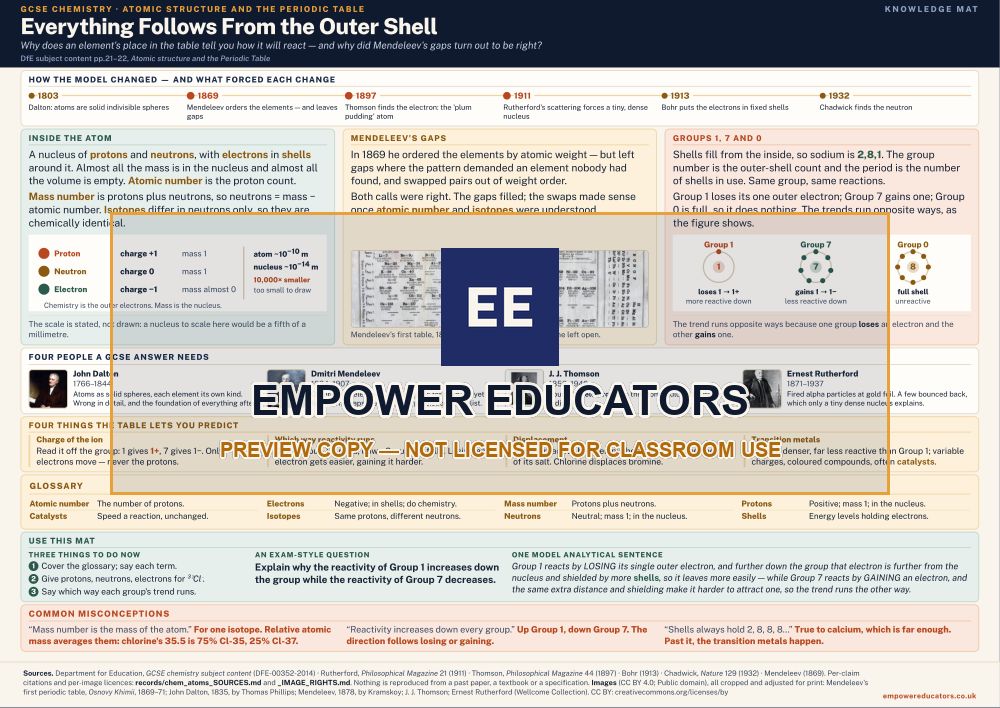
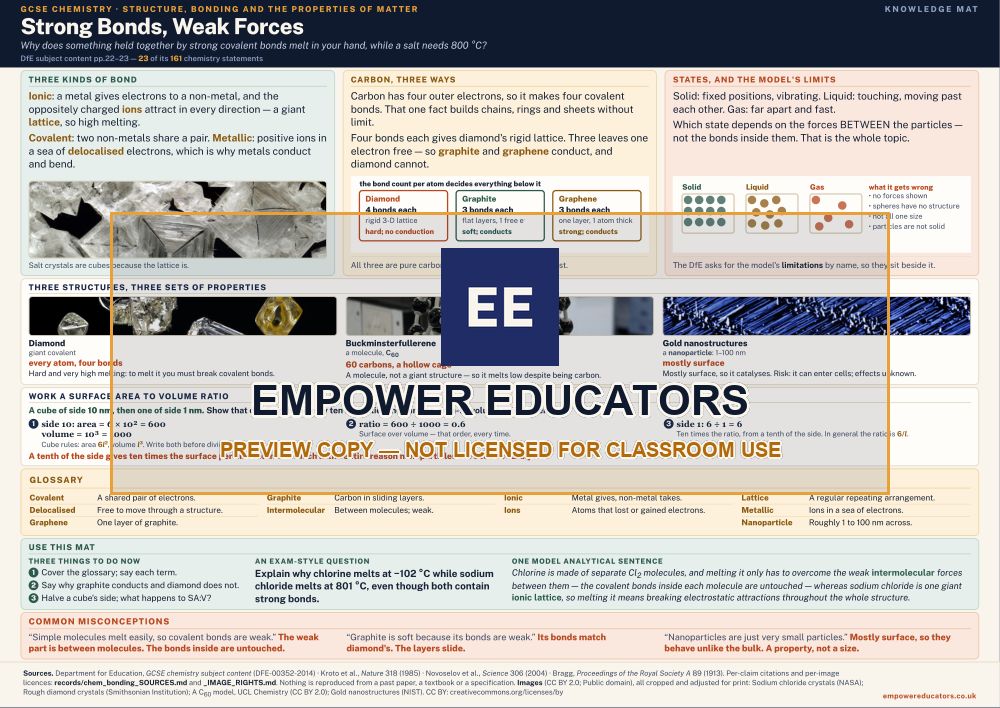
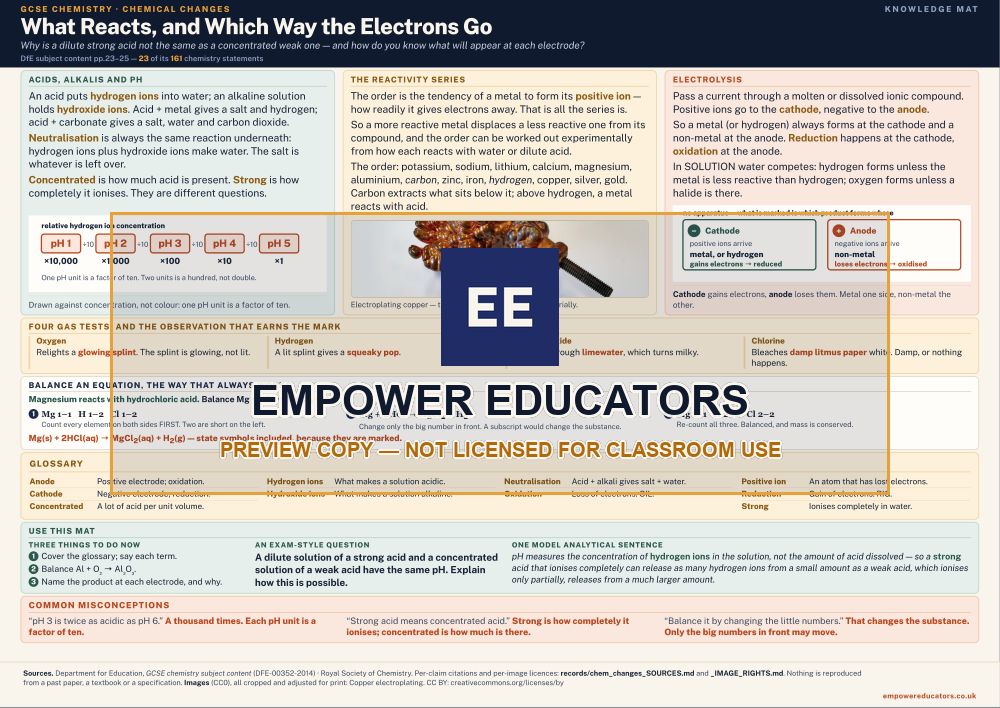
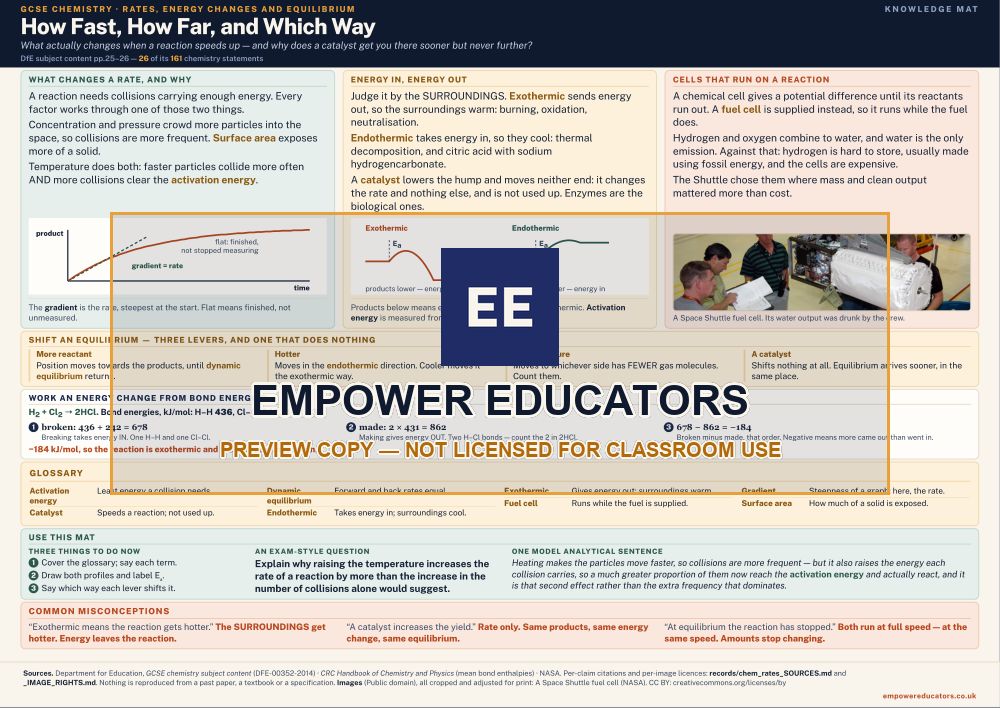
All 4 sheets — Atomic structure and the periodic table, Structure, bonding and the properties of matter, Chemical changes and Rates, energy changes and equilibrium — for £3.99. One landscape page per topic,
every claim sourced and every image licensed.
4 sheets · one A4 landscape PDF each · instant download
Bought once for the set, not per sheet. Photocopy them for your classes freely — keep
the running foot on the page, which carries the image credits the licences require.
Why an element's place in the table tells you how it will react — and why Mendeleev's gaps turned out to be right. Six dates on how the model of the atom changed, from Dalton to Chadwick; the particles and the scale of the atom; Mendeleev's own first table; Groups 1, 7 and 0 with 2,8,1 shell notation; the four scientists a GCSE answer needs; four things the table lets you predict. Eight terms to define, a model answer on why the group trends run opposite ways, and the misconceptions that cost marks.
Why something held together by strong covalent bonds melts in your hand while a salt needs 800 °C. Ionic, covalent and metallic bonding; carbon three ways — diamond, graphite and graphene — with the bond count that decides everything; the three states and the particle model's own limitations; diamond, buckminsterfullerene and gold nanoparticles compared; a worked surface-area-to-volume ratio. Ten terms to define, a model answer contrasting chlorine and sodium chloride, and the misconceptions that cost marks.
Why a dilute strong acid is not the same as a concentrated weak one — and how you know what appears at each electrode. Acids, alkalis and pH drawn against hydrogen-ion concentration; the reactivity series in full, with carbon and hydrogen placed in it; electrolysis of melts and solutions; four gas tests and the observation that earns the mark; balancing an equation the way that always works, state symbols included. Ten terms to define, a model answer on strong versus concentrated, and the misconceptions that cost marks.
What actually changes when a reaction speeds up — and why a catalyst gets you there sooner but never further. Collision theory and a rate graph read by its gradient; exothermic and endothermic profiles side by side with activation energy marked; chemical and fuel cells, with the Space Shuttle's fuel cell photographed; the three levers that shift an equilibrium and the one that does nothing; a worked bond-energy calculation. Eight terms to define, a model answer on temperature and rate, and the misconceptions that cost marks.
The previews above are the full sheets, watermarked. Where a sheet carries photographs,
every one is public domain worldwide or licensed CC BY, verified per image against the
licence itself rather than a label, and the running foot names every creator, records that
the images have been cropped and adjusted for print, and links the licence; figures are
drawn in code for the sheet, and extracts are written for it or verified against a
public-domain text. Nothing on any sheet is reproduced
from a past paper, a mark scheme, an examiner report or a specification, and Empower
Educators is not affiliated with any awarding body.
Cookies
This site works the same either way. Measurement — Google Analytics and Microsoft
Clarity — only runs if you say yes, and it is used to see which resources people
actually reach. What is collected.