503·Physical Education · GCSE
If You Can't Measure It,
You Can't Train It
GCSE PE Knowledge Mat — Training & Data (PDF)
Two athletes train the same hours a week — why does only one improve? The two families of fitness with all eleven components named; the principles of training, with what a warm up and a cool down each do and why the DfE names both; and measurement done properly, because a fitness test is only worth running if it is valid, reliable and specific to the sport. A table gives a standard test for each component — Cooper run, sit-and-reach, Illinois agility, vertical jump, 30-metre sprint, ruler drop — and a drawn figure sets the training zones as percentages of a stated maximum heart rate, so changing the maximum moves every boundary with it. Eleven terms to define, a worked heart-rate calculation, and the misconceptions that cost marks.
Everything else this site has for Physical Education: Physical Education teaching resources
One purchase covers the school that buys it. Print it, copy it, hand it round your department. Not for passing to other schools or uploading anywhere.
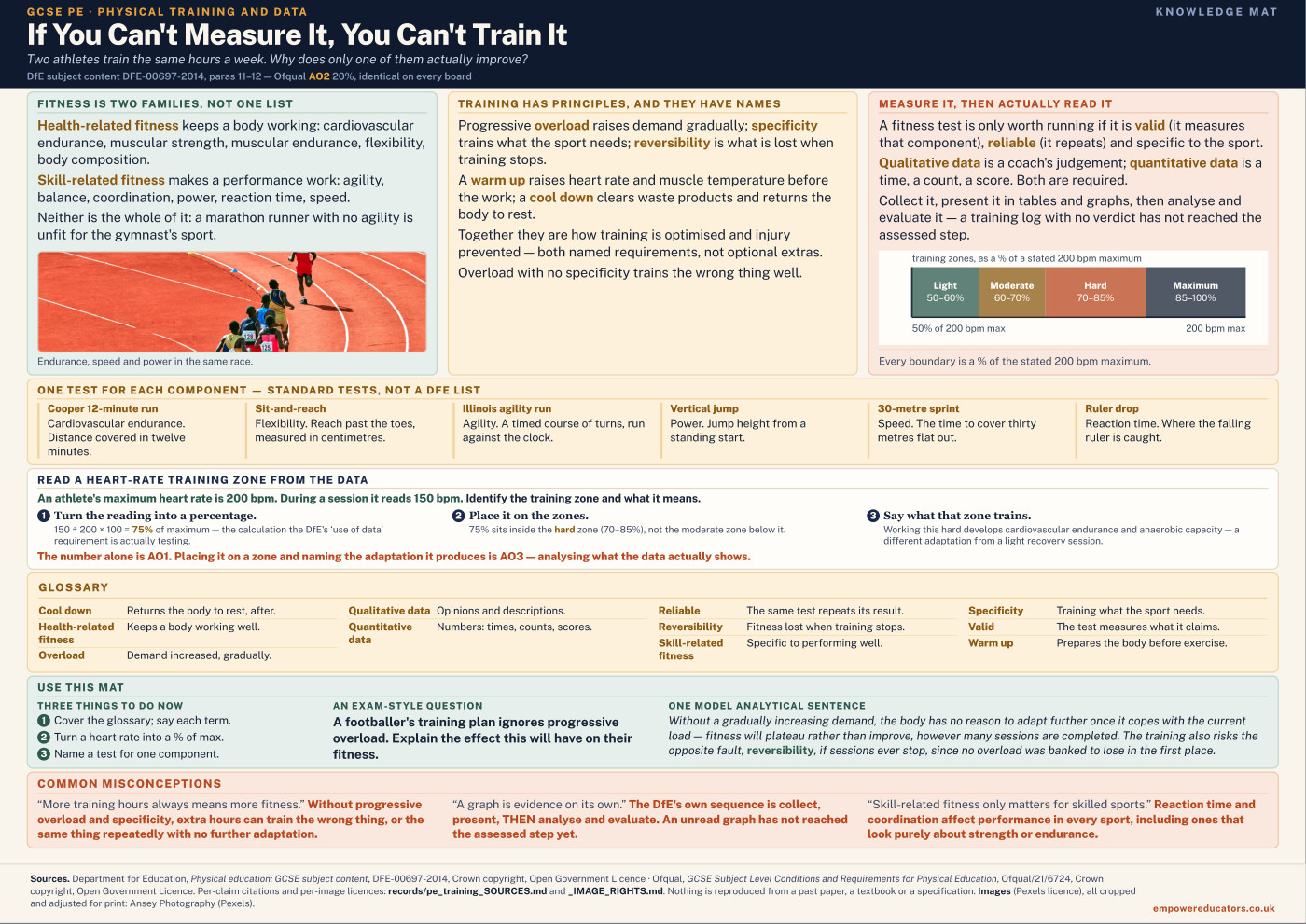
One landscape A4 page on one part of the GCSE Physical Education course, anchored to the DfE's own subject content (DFE-00697-2014) and Ofqual's subject level conditions (Ofqual/21/6724) rather than a board's paraphrase — so it holds whichever specification a department follows. It carries the two families of fitness, the principles of training, warm up and cool down, how fitness is measured and what makes a test worth running, and the DfE's own data sequence — then the vocabulary, a worked heart-rate calculation, and the misconceptions that cost marks.
The components of fitness and the principles of training are standard sport-science vocabulary, not a DfE list, and the sheet states that outright rather than presenting one board's set as the only correct one. Nothing is reproduced from a past paper, a textbook or a specification.
Sold by subject: all four Physical Education sheets for one price. A knowledge organiser stores a unit and is revised from afterwards; this is meant to be on the table while the lesson is happening.
- Written to The DfE GCSE physical education subject content (DFE-00697-2014) and Ofqual's subject level conditions (Ofqual/21/6724), quoted; no board's specification, mark scheme or past paper. Every quotation on the sheet is checked word for word against the document it cites
- Intended for PE teachers — on the desk during the lesson, not a student revision guide
- Extent 1 page · 8 sections
—·Look inside
Real pages, straight from the PDF
Click any page to see it full size.
—·Contents
All 8 sections
Taken from the booklet’s own contents page, so the page numbers are the real ones.