502·Physical Education · GCSE
The Engine
and the Levers
GCSE PE Knowledge Mat — Anatomy & Movement (PDF)
Two sprinters have the same muscles, so why does one run faster? What the two body systems actually do — bones as levers, antagonistic pairs, gas exchange, and cardiac output as heart rate times stroke volume — then aerobic against anaerobic as a supply problem. Levers are treated as a decision rather than a bone: the class is fixed by the order of fulcrum, load and effort, and a drawn figure sets the three classes side by side in their own panels. A second figure draws the same body three times so the sagittal, frontal and transverse planes, and the axes at right angles to them, can be seen rather than listed. A table of what exercise changes during it and over weeks of it, thirteen terms to define, a worked classification, and the misconceptions that cost marks.
Everything else this site has for Physical Education: Physical Education teaching resources
One purchase covers the school that buys it. Print it, copy it, hand it round your department. Not for passing to other schools or uploading anywhere.
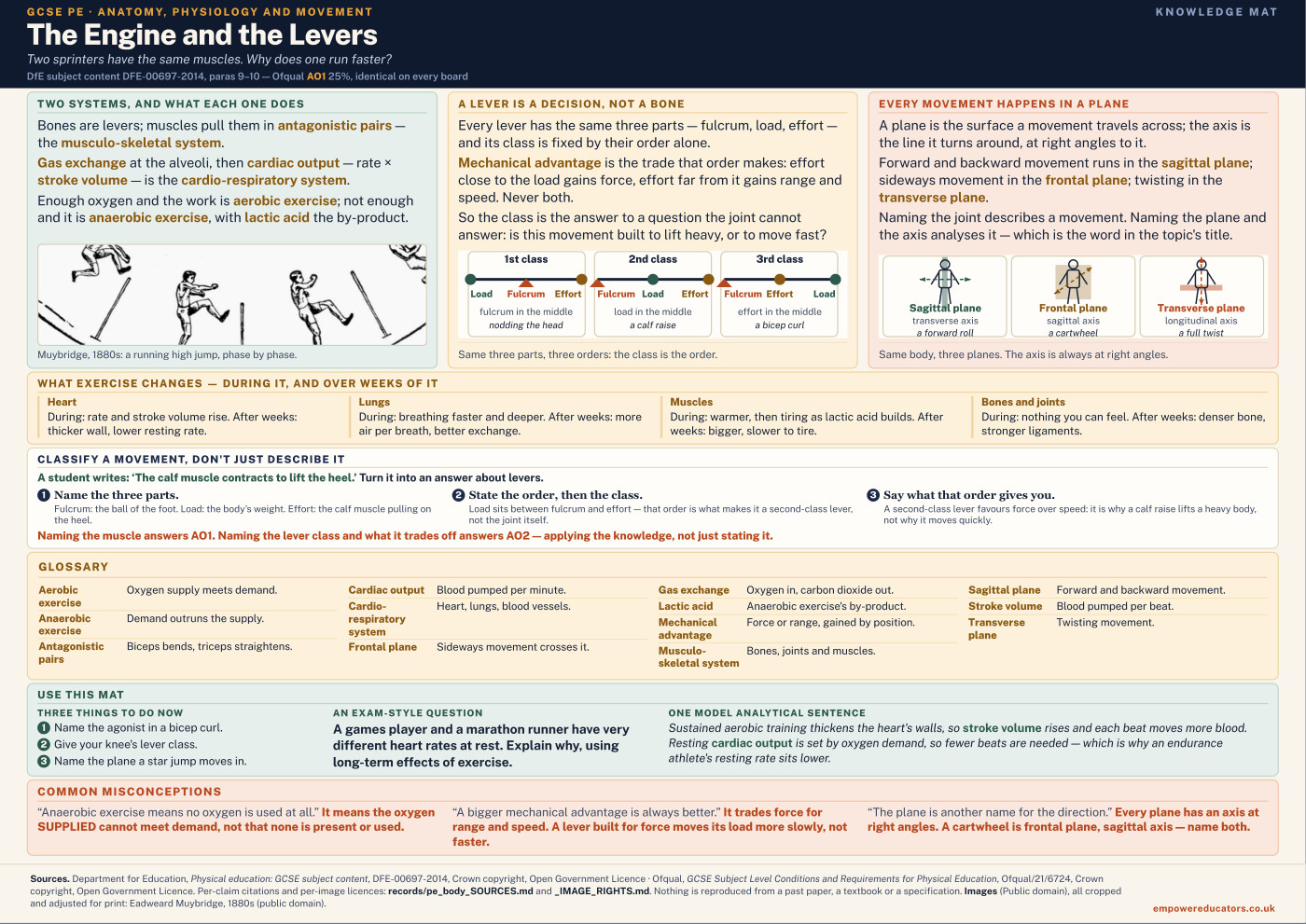
One landscape A4 page on one part of the GCSE Physical Education course, anchored to the DfE's own subject content (DFE-00697-2014) and Ofqual's subject level conditions (Ofqual/21/6724) rather than a board's paraphrase — so it holds whichever specification a department follows. It carries the musculo-skeletal and cardio-respiratory systems and what each one does, aerobic against anaerobic exercise, the short- and long-term effects of training, lever classes with mechanical advantage, and the planes and axes of movement — then the vocabulary, a worked classification, and the misconceptions that cost marks.
PE is the one GCSE where nearly half the grade is earned away from a desk, so the written content on these sheets is written to connect to what happens in the gym and on the field, not to sit beside it. Nothing is reproduced from a past paper, a textbook or a specification, and where a term is standard sport-science vocabulary rather than the DfE's own wording, the sheet says so rather than presenting one board's list as the only correct one.
Sold by subject: all four Physical Education sheets for one price. A knowledge organiser stores a unit and is revised from afterwards; this is meant to be on the table while the lesson is happening.
- Written to The DfE GCSE physical education subject content (DFE-00697-2014) and Ofqual's subject level conditions (Ofqual/21/6724), quoted; no board's specification, mark scheme or past paper. Every quotation on the sheet is checked word for word against the document it cites
- Intended for PE teachers — on the desk during the lesson, not a student revision guide
- Extent 1 page · 8 sections
—·Look inside
Real pages, straight from the PDF
Click any page to see it full size.
—·Contents
All 8 sections
Taken from the booklet’s own contents page, so the page numbers are the real ones.