—·Physical Education · GCSE
If You Can't Measure It, You Can't Train It
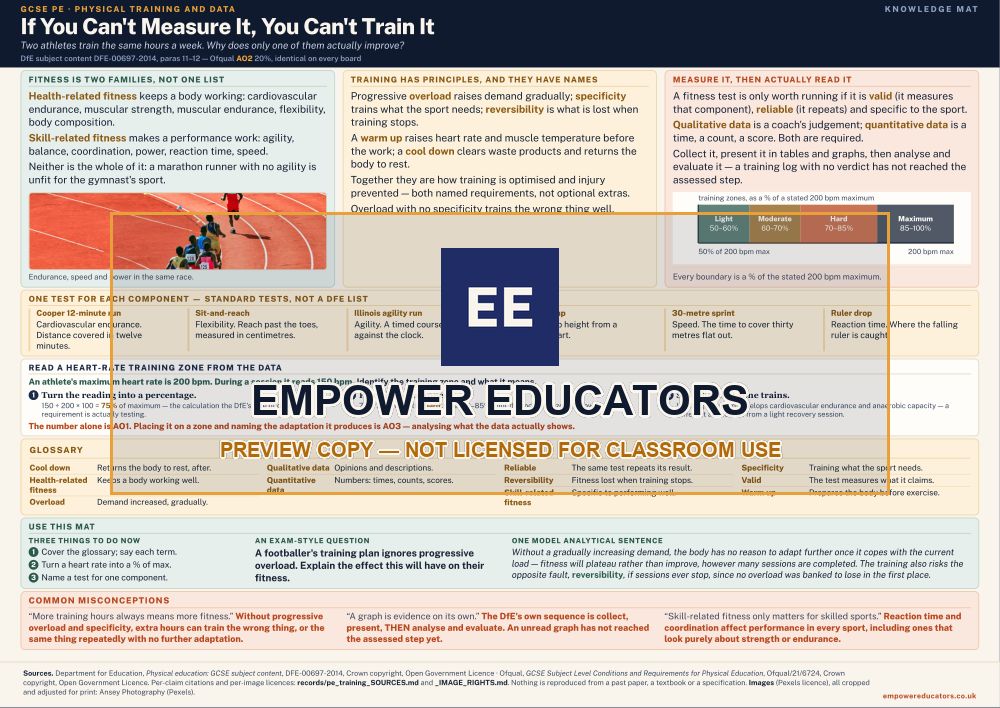
Two athletes train the same hours a week — why does only one improve? The two families of fitness with all eleven components named; the principles of training, with what a warm up and a cool down each do and why the DfE names both; and measurement done properly, because a fitness test is only worth running if it is valid, reliable and specific to the sport. A table gives a standard test for each component — Cooper run, sit-and-reach, Illinois agility, vertical jump, 30-metre sprint, ruler drop — and a drawn figure sets the training zones as percentages of a stated maximum heart rate, so changing the maximum moves every boundary with it. Eleven terms to define, a worked heart-rate calculation, and the misconceptions that cost marks.
Ready for the classroom
Get the clean copy
You have seen all 1 sheets — nothing is held back. What you buy is the same set without the watermark, at full print resolution, ready to run off for every class in the department.
- Every sheet with no watermark, at print resolution
- 1 print-and-use template
- Referenced to the DfE GCSE physical education subject content (DFE-00697-2014) and Ofqual's subject level conditions (Ofqual/21/6724), quoted; no board's specification, mark scheme or past paper. Every quotation on the sheet is checked word for word against the document it cites
- Instant PDF download, yours to keep and reproduce across the school that buys it — not for other schools