—·Physical Education · GCSE
The Engine and the Levers
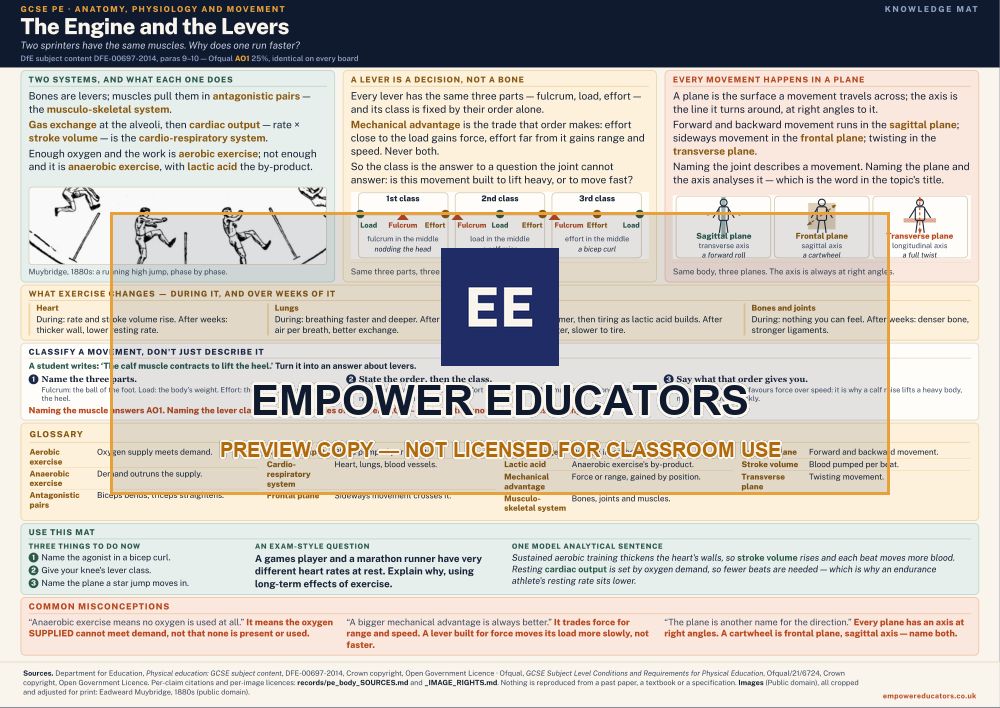
Two sprinters have the same muscles, so why does one run faster? What the two body systems actually do — bones as levers, antagonistic pairs, gas exchange, and cardiac output as heart rate times stroke volume — then aerobic against anaerobic as a supply problem. Levers are treated as a decision rather than a bone: the class is fixed by the order of fulcrum, load and effort, and a drawn figure sets the three classes side by side in their own panels. A second figure draws the same body three times so the sagittal, frontal and transverse planes, and the axes at right angles to them, can be seen rather than listed. A table of what exercise changes during it and over weeks of it, thirteen terms to define, a worked classification, and the misconceptions that cost marks.
Ready for the classroom
Get the clean copy
You have seen all 1 sheets — nothing is held back. What you buy is the same set without the watermark, at full print resolution, ready to run off for every class in the department.
- Every sheet with no watermark, at print resolution
- 1 print-and-use template
- Referenced to the DfE GCSE physical education subject content (DFE-00697-2014) and Ofqual's subject level conditions (Ofqual/21/6724), quoted; no board's specification, mark scheme or past paper. Every quotation on the sheet is checked word for word against the document it cites
- Instant PDF download, yours to keep and reproduce across the school that buys it — not for other schools