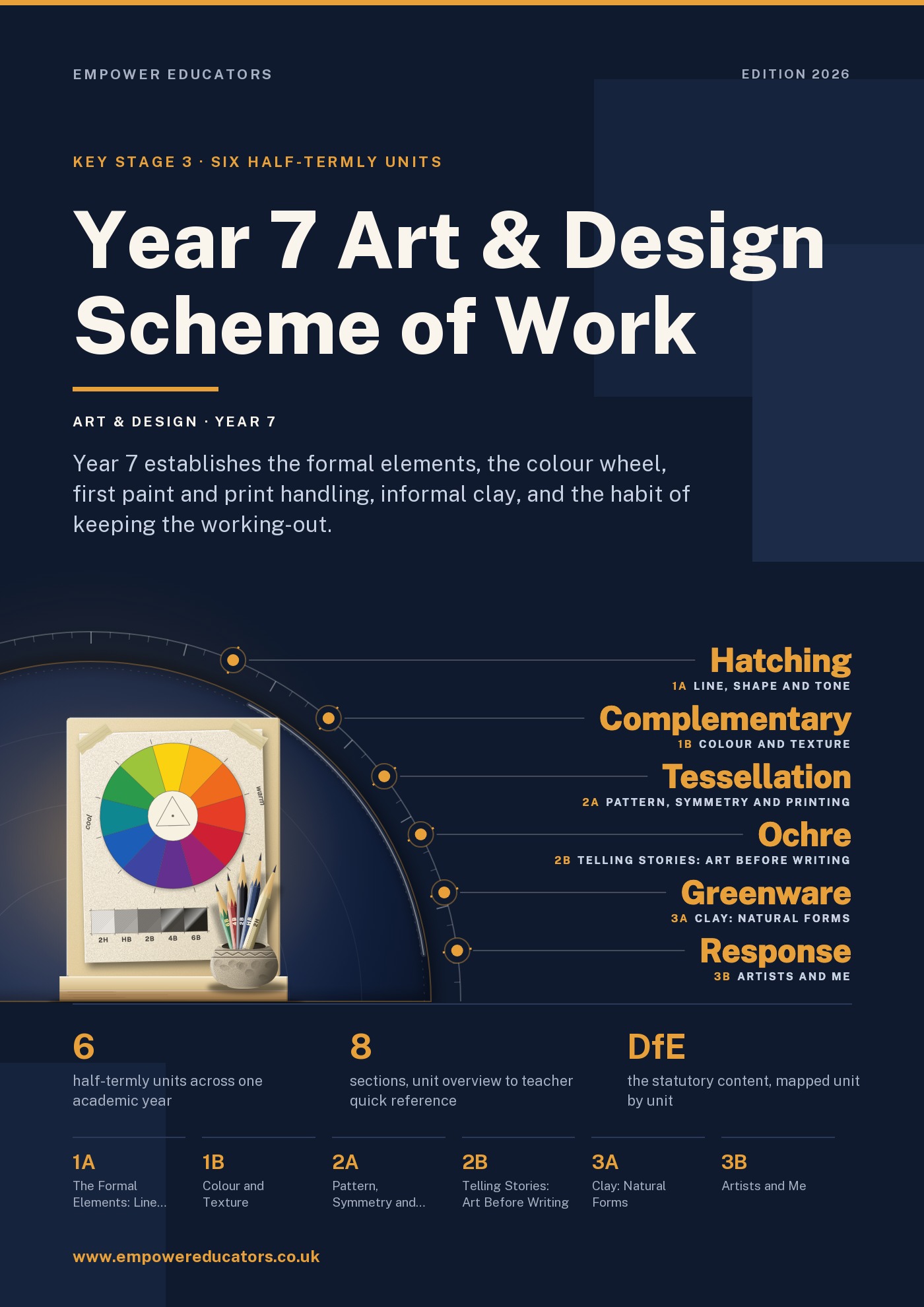
Six half-term units, in the order we teach them: the formal elements of line, shape and tone; colour and texture; pattern, symmetry and printing; art before writing, from Lascaux to the Bayeux Tapestry; clay and natural forms; and a personal response to an artist. Below is what each unit asks pupils to produce, the artists it studies and the skills it teaches, taken from our Year 7 Art & Design scheme of work.
Six half-termly units, written backwards from what Year 8 states it assumes on entry. Year 7 establishes the formal elements, the colour wheel, first paint and print handling, informal clay, and the habit of keeping the working-out.
Year 7 means ages 11–12, or P7–S1 in Scotland.
The year, unit by unit
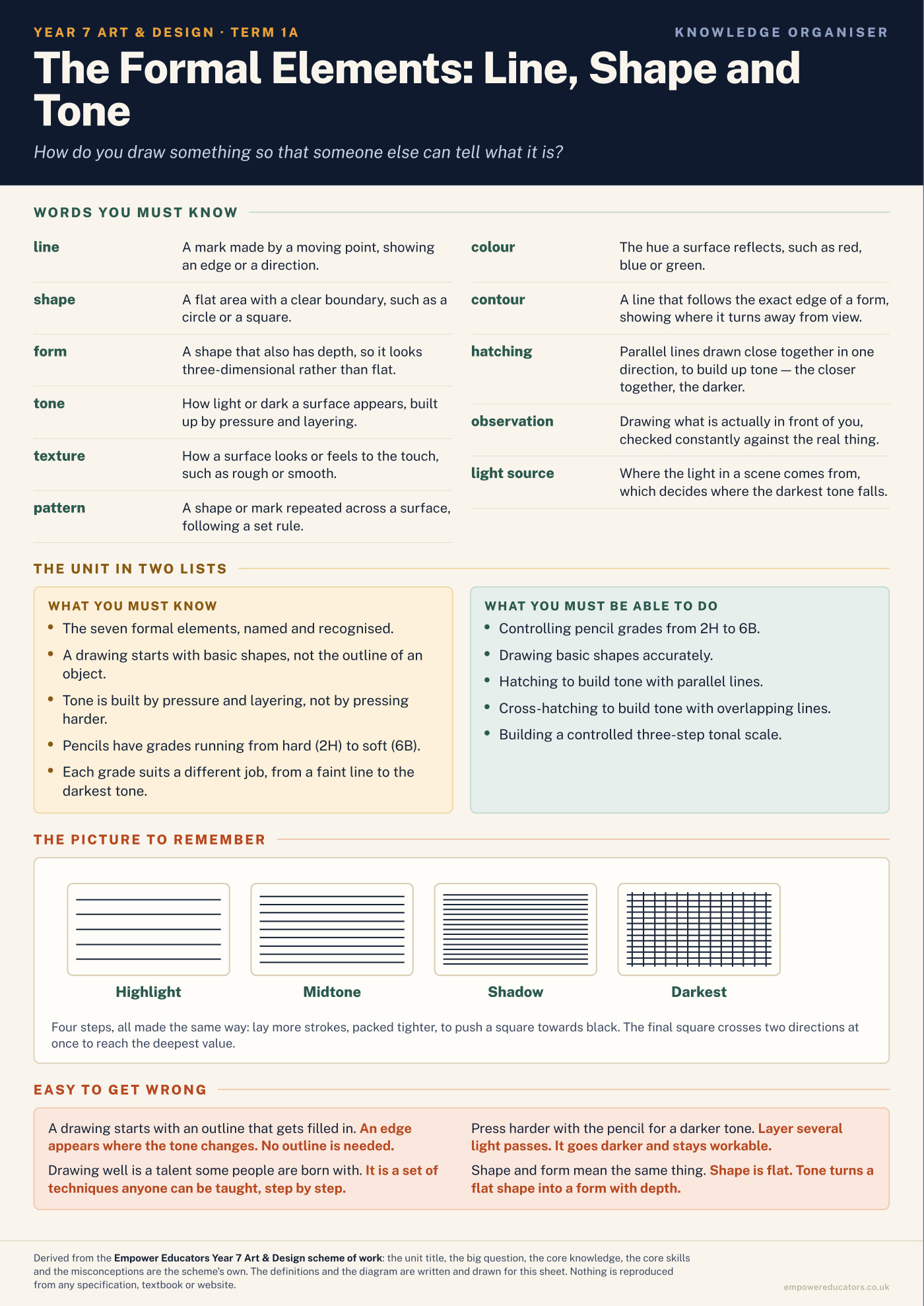
The Formal Elements: Line, Shape and Tone
Unit 1a · Autumn 1 · approx. 7 weeks · September – October
How do you draw something so that someone else can tell what it is?
Pupils produce
An A3 observational drawing of a still life group, using line, shape and a three-step tonal range.
Artists
Vincent van Gogh, Georges Seurat, Bridget Riley
Core skills
Controlling 2H to 6B · Drawing basic shapes accurately · Hatching and cross-hatching · A three-step tonal scale
Colour and Texture
Unit 1b · Autumn 2 · approx. 7 weeks · November – December
Can you make a picture that someone can almost feel?
Pupils produce
An A3 mixed-media study of a textured natural object, using a colour scheme chosen for a reason.
Artists
Henri Matisse, Yayoi Kusama, Anni Albers
Core skills
Mixing secondaries and tertiaries from three primaries · Handling ready-mix paint and brushes · Creating implied texture through mark-making · Rubbing, printing and collage for real texture
Pattern, Symmetry and Printing
Unit 2a · Spring 1 · approx. 6 weeks · January – February
Why does a repeated shape stop looking like a shape and start looking like a pattern?
Pupils produce
A printed repeat pattern made with found objects and hand-cut stamps, from a designed motif.
Artists
Adinkra cloth tradition (Ghana), Japanese katagami stencils, M.C. Escher
Core skills
Designing a simple motif · Reflective and rotational repeats · Inking and printing with found objects and stamps · Even pressure and coverage
Telling Stories: Art Before Writing
Unit 2b · Spring 2 · approx. 6 weeks · February – April
How did people tell stories before anyone could write them down?
Pupils produce
A narrative sequence of three images telling one story, using an earth-pigment palette.
Artists
Lascaux cave paintings, Ancient Egyptian tomb painting, the Bayeux Tapestry
Core skills
Simplifying a figure to essential action · Working with a restricted earth palette · Composing a sequence · Mark-making on a textured ground
Clay: Natural Forms
Unit 3a · Summer 1 · approx. 6 weeks · April – May
What can you make with your hands that you could never draw?
Pupils produce
A modelled clay natural form with a worked surface, made by pinching and modelling from one piece.
Artists
Barbara Hepworth, Andy Goldsworthy, Kate Malone
Core skills
Pinching from one piece · Modelling to a natural form · Impressing and incising surface · Keeping walls even
Artists and Me
Unit 3b · Summer 2 · approx. 6 weeks · June – July
What can I take from an artist and make my own?
Pupils produce
A personal response to one artist chosen from a departmental shortlist, with the research and experiments kept.
Artists
Student-selected from a departmental shortlist of six
Core skills
Researching an artist for a technique · Testing that technique on your own subject · Choosing between options · Annotating what you did and why
How it meets the key stage 3 programme of study
The scheme maps each requirement of the statutory programme of study for key stage 3 art and design (Department for Education, 2013) to the unit that teaches it. Pupils should be taught to…
use a range of techniques to record their observations in sketchbooks, journals and other media as a basis for exploring their ideas
Every unit. Sketchbook recording is the spine of 1a and assessed in 3b.
use a range of techniques and media, including painting
1b is the first paint unit — mixing a colour wheel from three primaries. Paint returns in 2b and as an option in 3b.
increase their proficiency in the handling of different materials
analyse and evaluate their own work, and that of others, in order to strengthen the visual impact or applications of their work
Section 7 of every unit; peer testing in 2a and 2b; annotation in every unit.
about the history of art, craft, design and architecture, including periods, styles and major movements from ancient times up to the present day
2b Lascaux c. 17,000 BCE, Egyptian tomb painting and the Bayeux Tapestry · 2a Adinkra and katagami traditions · 1a and 1b run 19th to 20th century.
Unit 2b takes the key stage's historical range back to approximately 17,000 BCE. With Year 8's Egyptian, Islamic, Greek and Nok sources and Year 9's 19th and 20th century artists, “from ancient times up to the present day” is met across the three years with real breadth rather than by assertion. If 2b is dropped or replaced, that claim no longer holds for the key stage.
The Year 7 Art resources
Two PDFs sit behind this page, and they are meant to be used together: the scheme of work to plan the year, the knowledge organisers to put in front of pupils.
The statutory programme of study for key stage 3 art and design (DfE, 2013)·33 pages, 8 sections·For heads of art, subject leaders and every teacher who has to deliver it
Six half-term units, in the order they are taught: The Formal Elements: Line, Shape and Tone, Colour and Texture, Pattern, Symmetry and Printing, Telling Stories: Art Before Writing, Clay: Natural Forms and Artists and Me.
What do pupils produce in Year 7 Art?
An A3 observational drawing of a still life group, using line, shape and a three-step tonal range; An A3 mixed-media study of a textured natural object, using a colour scheme chosen for a reason; A printed repeat pattern made with found objects and hand-cut stamps, from a designed motif; A narrative sequence of three images telling one story, using an earth-pigment palette; A modelled clay natural form with a worked surface, made by pinching and modelling from one piece; A personal response to one artist chosen from a departmental shortlist, with the research and experiments kept.
Does Year 7 Art meet the National Curriculum?
It maps each requirement of the statutory programme of study for key stage 3 art and design (Department for Education, 2013) to the unit that teaches it, and on this year the scheme is plain: “Unit 2b takes the key stage's historical range back to approximately 17,000 BCE.”
Cookies
This site works the same either way. Measurement — Google Analytics and Microsoft Clarity — only runs if you say yes, and it is used to see which resources people actually reach.Measurement only runs if you say yes.What is collected.