Art & Design · Key Stage 3 · £4.99
Year 7
Art & Design
Scheme of Work
Six half-termly units across one academic year, written backwards from what Year 8 states it assumes on entry. Year 7 establishes the formal elements, the colour wheel, first paint and print handling, informal clay, and the habit of keeping the working-out.
£4.99The Year 7 scheme: 6 half-termly units, 33 pages
- A4 PDF
- first 8 pages free to read
- instant download
Teaching all of Key Stage 3? Year 7, Year 8 and Year 9 as one set: £11.99, saving £2.98.
One purchase covers the school that buys it. Print it, copy it, hand it round your department. Not for passing to other schools or uploading anywhere.
PDF download, ready straight after payment. Downloading it ends the 14-day right to cancel; a file that is faulty or not as described is always refunded. Refunds
Read before publication by serving senior leaders, in school.
5.0 from 24+ reviews on Google
Schools that have bought from Empower Educators include Nottingham High School, Northampton High School GDST and Sutton Valence School.
Complete your Art & Design
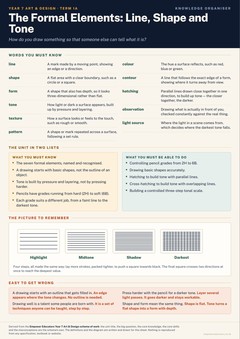
The whole key stage: KS3 Art & Design scheme of work
Everything else this site has for Art & Design: Art & Design teaching resources
- 1aThe Formal Elements: Line, Shape and Tone
- 1bColour and Texture
- 2aPattern, Symmetry and Printing
- 2bTelling Stories: Art Before Writing
- 3aClay: Natural Forms
- 3bArtists and Me
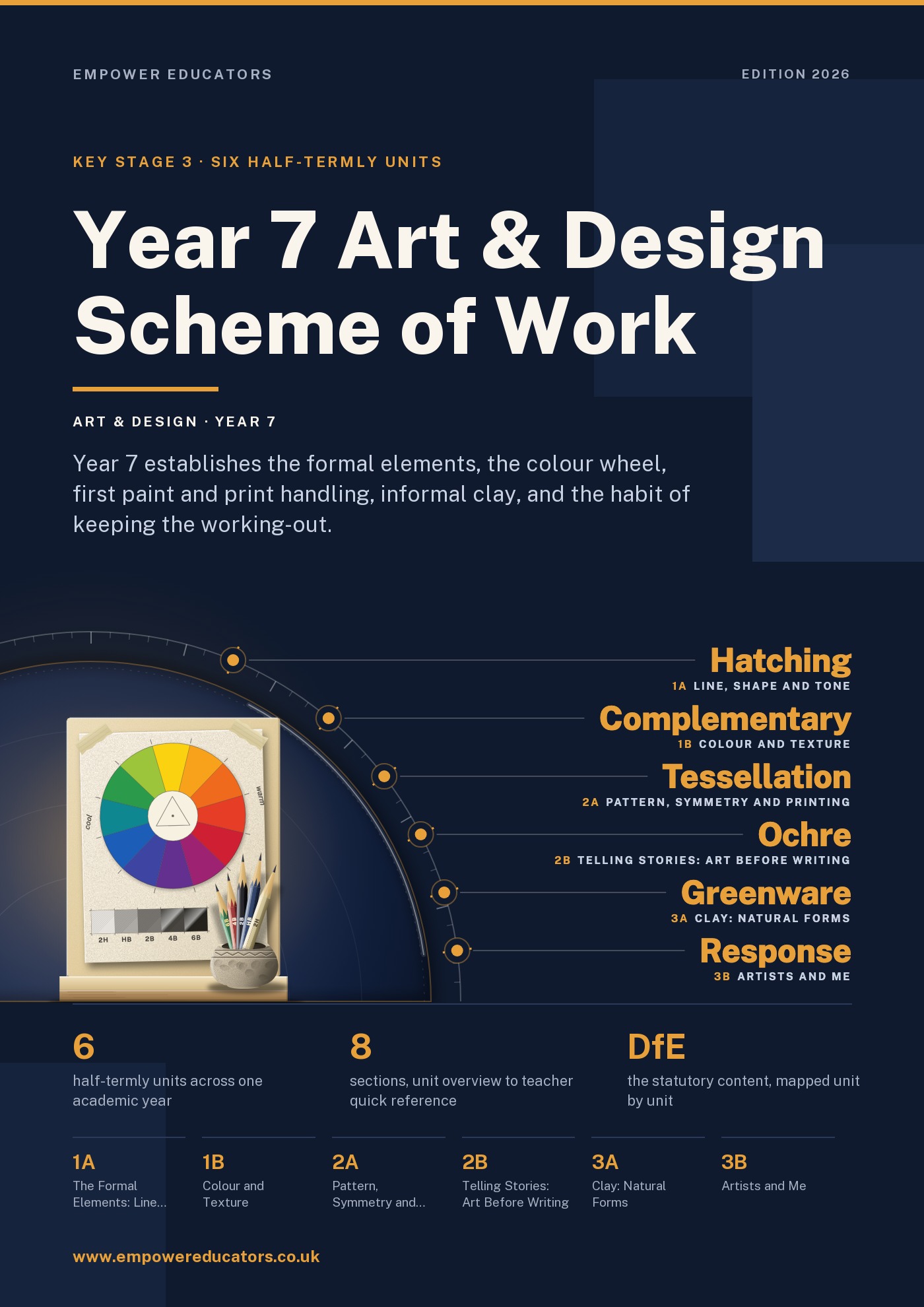
Ten sections per unit, in the same order every time. Lessons are one row each rather than a page each — enough to teach from, not so much that it cannot be maintained across a whole department.
One principle applies to every unit and is stated once at the front: the working-out is kept. Experiments, tests and rejected attempts are evidence, not scrap, and they are assessed.
Every duration, material, artist and assessment word is a strong default rather than a fixed rule. Year 7 means ages 11–12, or P7–S1 in Scotland. The document assumes nothing about primary experience, because it varies more at the start of Year 7 than at any other point in the key stage.
- Written to
- The statutory programme of study for key stage 3 art and design (DfE, 2013)
- Intended for
- heads of art, subject leaders and every teacher who has to deliver it
- Extent
- 33 pages · 8 sections
The sequence
What this scheme of work covers, unit by unit
The 6 units of the Year 7 Art & Design Scheme of Work, in teaching order, with the term each one runs in and the question it is built to answer, what students make, the artists they meet and the vocabulary they learn.
1a
The Formal Elements: Line, Shape and Tone
Autumn 1 · approx. 7 weeks · September – October
How do you draw something so that someone else can tell what it is?
- End outcome
- An A3 observational drawing of a still life group, using line, shape and a three-step tonal range.
- Core skills
- Controlling 2H to 6B · Drawing basic shapes accurately · Hatching and cross-hatching · A three-step tonal scale
- Key artists
- Vincent van Gogh, Georges Seurat, Bridget Riley
- Key vocabulary
- line, shape, form, tone, texture, pattern, colour, contour, hatching, observation, light source
1b
Colour and Texture
Autumn 2 · approx. 7 weeks · November – December
Can you make a picture that someone can almost feel?
- End outcome
- An A3 mixed-media study of a textured natural object, using a colour scheme chosen for a reason.
- Core skills
- Mixing secondaries and tertiaries from three primaries · Handling ready-mix paint and brushes · Creating implied texture through mark-making · Rubbing, printing and collage for real texture
- Key artists
- Henri Matisse, Yayoi Kusama, Anni Albers
- Key vocabulary
- primary, secondary, tertiary, warm, cool, complementary, harmonious, texture, implied, frottage, collage
2a
Pattern, Symmetry and Printing
Spring 1 · approx. 6 weeks · January – February
Why does a repeated shape stop looking like a shape and start looking like a pattern?
- End outcome
- A printed repeat pattern made with found objects and hand-cut stamps, from a designed motif.
- Core skills
- Designing a simple motif · Reflective and rotational repeats · Inking and printing with found objects and stamps · Even pressure and coverage
- Key artists
- Adinkra cloth tradition (Ghana), Japanese katagami stencils, M.C. Escher
- Key vocabulary
- motif, repeat, symmetry, reflection, rotation, tessellation, stamp, impression, coverage
2b
Telling Stories: Art Before Writing
Spring 2 · approx. 6 weeks · February – April
How did people tell stories before anyone could write them down?
- End outcome
- A narrative sequence of three images telling one story, using an earth-pigment palette.
- Core skills
- Simplifying a figure to essential action · Working with a restricted earth palette · Composing a sequence · Mark-making on a textured ground
- Key artists
- Lascaux cave paintings, Ancient Egyptian tomb painting, the Bayeux Tapestry
- Key vocabulary
- narrative, sequence, convention, pigment, ochre, silhouette, register, composition
3a
Clay: Natural Forms
Summer 1 · approx. 6 weeks · April – May
What can you make with your hands that you could never draw?
- End outcome
- A modelled clay natural form with a worked surface, made by pinching and modelling from one piece.
- Core skills
- Pinching from one piece · Modelling to a natural form · Impressing and incising surface · Keeping walls even
- Key artists
- Barbara Hepworth, Andy Goldsworthy, Kate Malone
- Key vocabulary
- form, in the round, pinch, model, impress, incise, leather-hard, greenware, texture
3b
Artists and Me
Summer 2 · approx. 6 weeks · June – July
What can I take from an artist and make my own?
- End outcome
- A personal response to one artist chosen from a departmental shortlist, with the research and experiments kept.
- Core skills
- Researching an artist for a technique · Testing that technique on your own subject · Choosing between options · Annotating what you did and why
- Key artists
- Student-selected from a departmental shortlist of six
- Key vocabulary
- response, research, technique, experiment, develop, annotate, evidence
Look inside
Real pages, straight from the PDF
Click any page to see it full size.
Contents
All 8 sections
Taken from the book’s own contents page, so the page numbers are the real ones.